

Key takeaways
- Five vacuum gauges for engine diagnosis and carburettor tuning, compared by dial size, vacuum range, hose length, adapters and case, with a needle guide.
As an Amazon Associate we earn from qualifying purchases.
A vacuum gauge is one of the oldest engine diagnostic tools still worth owning. Teed into intake manifold vacuum on a warm, idling engine, its needle reports how the engine breathes: steady and high on a healthy motor, low, flickering or drifting when something is wrong. No scan tool reads piston rings, valve sealing or exhaust restriction the way a bouncing needle can hint at them, which is why the gauge remains a first check on carburetted engines, older trucks, small blocks in project cars and the tow vehicles and motorhomes that camping trips depend on.
The honest caveat comes first. A vacuum gauge does not name a failed part. The diagnosis lives in the needle’s behaviour — steady, flickering, drifting or low — and the classic reading charts are interpretation guidance, not certainty. A pattern suggests a direction; a compression test, leak-down test or smoke test confirms it. Altitude also moves the baseline: a healthy engine shows roughly 17 to 21 inHg at idle at sea level, and the reading falls by about 1 inHg for every 1,000 feet of elevation. Judge any gauge against your engine’s specification and your altitude, not against a single universal number.
Affiliate Disclosure: This article contains affiliate links. If you buy through them, the site may earn a commission at no extra cost to you.
How to Read the Needle
Connect the gauge to a direct manifold vacuum source — a spare manifold fitting or a tee in the brake booster hose — never to a ported source above the throttle plate, which reads near zero at idle. Warm the engine fully, then watch the needle at idle and again holding about 2,500 rpm.
- Steady 17–21 inHg at sea level: a mechanically sound engine in good tune.
- Steady but low: a vacuum leak, late ignition timing or a retarded cam are the usual suspects.
- Regular, rhythmic drop of a few inches: one cylinder is not sealing — a burnt or sticking valve, or a head gasket leaking into a cylinder.
- Rapid flicker or vibration at idle that steadies as rpm rises: worn valve guides are the classic cause; an ignition misfire can look similar.
- Normal at idle, then slowly falling at a held 2,500 rpm: the exhaust is restricted, commonly a clogged catalytic converter or muffler.
- Needle swings wide when the throttle is snapped open and shut: healthy rings and breathing give a deep drop toward zero followed by an overshoot above the idle reading; a lazy swing points to wear.
Treat each pattern as a hypothesis. The gauge narrows the search cheaply; it does not finish it. It also cannot find where a vacuum leak is — it only reports that manifold vacuum is low. Locating a leak takes a smoke machine, careful hose inspection or controlled propane enrichment, all separate methods.
What to Look For
Dial size and damping. Needle behaviour is the whole point, so the dial has to be readable from the driver’s seat or across the engine bay. Dials of 3-1/2 to 4 inches are the useful range. Damping matters just as much: a gauge with an impulse damper or a steady Bourdon movement smooths normal pulsing (four and six cylinder engines pulse more) without hiding the regular drop that signals a valve problem.
Vacuum and pressure scales. Most of these tools are dual-purpose: vacuum to 25–30 inHg on one side, low pressure on the other. Label that honestly — the pressure side, typically 10 to 15 psi, suits mechanical fuel pumps on carburetted engines only. It is far below fuel-injection pressures and must never be connected to an injection system; injected engines need a dedicated high-pressure fuel tester.
Hose and adapters. A hose of about 2 feet reaches from a manifold fitting to a fender or the driver’s seat. Tee fittings, tapered adapters and a universal fuel line adapter decide how many vehicles the kit fits without extra parts.
Case. A Bourdon tube gauge is a delicate instrument. A blow-molded case keeps it from being knocked out of calibration in a toolbox drawer.
A note on a sibling class: hand vacuum pumps such as brake bleeder kits create vacuum to test isolated components and bleed brakes. They complement a passive gauge but do a different job, so they are not picks here.
The Five Gauges
1. OTC 5613 Vacuum/Pressure Gauge Kit
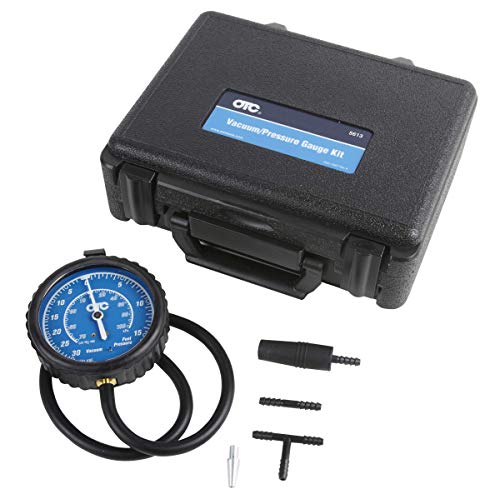
OTC’s 5613 is the professional-pattern kit in this group: a 3-1/2 inch gauge with a chrome bezel and rubber boot, dual scales for vacuum and low pressure, and a blow-molded case that carries a vacuum-reading chart printed under the lid — the interpretation guide travels with the tool. The adapter set covers the common connections: an in-line barbed connector, a tee fitting, a conical nozzle adapter and a universal fuel line adapter, on a 24 inch hose. It is the pick for regular diagnostic work on carburetted engines, where the pressure side checks mechanical fuel pump output and the vacuum side handles manifold diagnosis and carburettor tuning.
Specs
- Gauge: 3-1/2 in dial, chrome bezel, rubber protective boot
- Vacuum range: 0–30 inHg (0–70 cmHg)
- Pressure range: 0–15 psi (0–100 kPa)
- Hose: 24 in
- Adapters: in-line barbed connector, tee fitting, conical nozzle adapter, universal fuel line adapter
- Case: blow-molded hard case with vacuum-reading chart under the lid
2. Innova 3620 Vacuum and Carburetor Fuel Pressure Tester

Innova builds the 3620 specifically around carburettor work. The 3-1/2 inch dial is dual-calibrated and colour-coded, so the normal-running band is visible at a glance, and the movement is a heavy-duty Bourdon tube type. The 24 inch hose is oil-resistant rubber, and the kit includes a universal fitting adaptor, a tapered adaptor and a tee connector for manifold hookups. Innova is explicit about the boundary: the tester is for vehicles equipped with carburetors, and its pressure side is for carburetted fuel systems — not diesel and not fuel-injection pressure testing. For a classic car, truck or small engine tuned by ear and needle, that focus is the point.
Specs
- Gauge: 3-1/2 in dial, dual-calibrated, colour-coded scales
- Movement: heavy-duty Bourdon tube
- Hose: 24 in oil-resistant rubber
- Adapters: universal fitting adaptor, tapered adaptor, tee connector
- Application: carburetor-equipped vehicles; vacuum checks and carburetted fuel pump pressure
3. Lisle 20300 Vacuum Gauge and Fuel Pump Tester
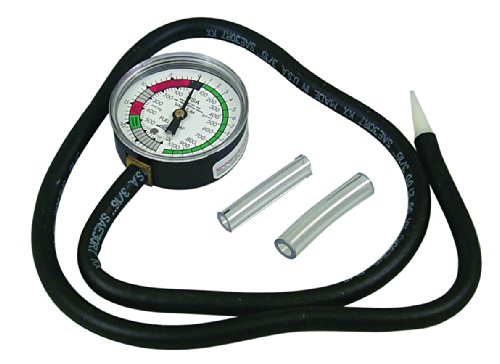
Lisle’s 20300 is the stripped-back option: a gauge, its hose and basic fittings, sold skin-packed with no case. Its scales run a little narrower than most — vacuum to 25 inHg with an 800 mmHg metric scale, pressure to 14 psi — which still covers the full working range of manifold diagnosis and mechanical fuel pump testing, since a healthy engine lives between 15 and 22 inHg. At a shipping weight of 9 ounces it is the lightest tool here and the easiest to keep in a glovebox or a roadside kit. Buyers who want a case should look at the OTC, ABN or HFS kits instead; buyers who want a known US specialty-tool brand in the simplest form get exactly that.
Specs
- Vacuum range: 0–25 inHg (0–800 mmHg)
- Pressure range: 0–14 psi
- Format: gauge with hose and fittings, skin-packed, no case
- Shipping weight: 9 oz
- Maker: Lisle Corporation, specialty automotive tools
4. ABN Car Vacuum and Fuel Pump Tester Gauge Kit (ABN-2190)

The ABN kit leads on dial size: a full 4 inch, colour-coded gauge with rubber side notches for grip, the easiest face here to read for needle flicker while watching from the driver’s seat. Scales run to 28 inHg of vacuum and 10 psi of pressure, and the hose is rated to a 40 psi maximum working pressure. The blow-molded case holds the gauge, a 2 foot rubber hose, a brass cone adapter, a plastic connector and 14 mm and 18 mm manifold adapters. ABN frames it, correctly, for carburetor engines with fuel pump pressures under 10 psi: fuel delivery pressure, fuel pump vacuum, intake manifold and vacuum circuit tests.
Specs
- Gauge: 4 in diameter, colour-coded scales, rubber grip notches
- Vacuum range: 0–28 inHg (0–70 cmHg)
- Pressure range: 0–10 psi (0–0.7 kg/cm²)
- Hose: 2 ft rubber (13/64 in ID), rated to 40 psi maximum working pressure
- Adapters: brass cone adapter, plastic connector, 14 mm and 18 mm manifold adapters
- Case: blow-molded carrying case; kit weight 1.65 lb
5. HFS(R) Fuel Pump Tester Gauge Kit

The HFS kit is the budget pattern of the same tool: a 3-1/2 inch gauge reading engine vacuum to 28 inHg and fuel pump pressure to 10 psi, a 24 inch hose, adapters to fit most vehicles and a storage box. The maker, Hardware Factory Store, frames it for carbureted engines running mechanical fuel pump pressures under 10 psi — checking carburetor settings and valve adjustments is the stated job. It lacks the OTC’s printed chart case and the ABN’s larger dial, but the working ranges match the class, and for occasional use on a project car or an older tow vehicle it covers the same tests.
Specs
- Gauge: 3-1/2 in diameter
- Vacuum range: to 28 inHg
- Pressure range: to 10 psi
- Hose: 24 in
- Adapters: adapter set for most vehicles
- Storage: storage box included
- Maker: Hardware Factory Store; model 8542039686
Which One Fits
For regular shop or serious hobby use, the OTC 5613’s case, adapter set and under-lid reading chart make it the most complete diagnostic package. The ABN kit suits anyone who values the largest, easiest-to-read dial. The Innova 3620 is the carburettor specialist’s choice, with the clearest statement of what its pressure side should and should not touch. The Lisle 20300 is the minimalist, brand-name gauge for a roadside kit, and the HFS kit covers the same tests at the budget end.
Whichever gauge ends up in the toolbox, the working method matters more than the brand: warm engine, direct manifold source, altitude allowed for, and every needle pattern treated as a lead to confirm — not a verdict. Used that way, a simple vacuum gauge still earns its place next to the scan tool.
Frequently Asked Questions
Where should a vacuum gauge be connected?
To a direct intake manifold vacuum source below the throttle plate — a spare manifold fitting or a tee in a manifold hose such as the brake booster line. Ported vacuum ports above the throttle plate read near zero at idle and will mislead the test.
What is a normal vacuum reading?
On a healthy engine at sea level, a steady 17 to 21 inHg at idle is typical. Subtract roughly 1 inHg for every 1,000 feet of altitude, and expect lower, less steady readings from engines with long-duration performance camshafts. Always compare against the vehicle maker’s specification.
Can these gauges test a fuel-injected engine’s fuel pump?
No. The pressure scales here top out between 10 and 15 psi, which suits mechanical pumps on carburetted engines only. Fuel-injected systems run far higher pressures and require a dedicated fuel injection pressure tester. The vacuum side still works for manifold diagnosis on any gasoline engine with a suitable vacuum port.
Can a vacuum gauge find a vacuum leak?
It can show that manifold vacuum is low, which suggests a leak among other causes, but it cannot show where the leak is. Pinpointing a leak takes a smoke test, hose-by-hose inspection or another dedicated method.
More from Amazon
Programs that pair well with the guide above. Offers and eligibility are set by Amazon and may change.
Free shipping on eligible items, Prime Video and more. Eligible new members can start with a free trial.
Start a Prime free trialA Prime membership for ages 18-24 with a trial period. Eligibility is set by Amazon.
See Prime for Young AdultsAudiobooks and podcasts to listen to on the go. Eligible new members can start with a free trial.
Try Audible freeAd-free music streaming. Eligible new subscribers can start with a free trial.
Try Music Unlimited freeAs an Amazon Associate we earn from qualifying purchases.









Write Your Review
No reviews yet. Be the first to share your experience!