

Key takeaways
- Compare the best spark testers for cars and small engines, from simple inline testers to adjustable gap and coil-on-plug tools that judge spark strength.
As an Amazon Associate we earn from qualifying purchases.
When an engine cranks but will not start, the fault is almost always one of three things: no fuel, no compression, or no spark. A spark tester settles the third question in under a minute. Connect it between the ignition system and a ground or a spark plug, crank the engine, and watch. Either spark is reaching the plug or it is not, and that single answer decides whether you spend the afternoon on coils and leads or move on to the fuel system.
The five testers below fall into three families. Inline testers sit between the plug and its wire and flash a bulb with each spark, which is the fastest way to find a dead cylinder on a plug-wire engine. Gap testers make the spark jump an open-air gap to ground: a fixed gap is a pass-or-fail load test, and an adjustable gap lets you widen the jump until a weak coil gives up, which is the closest thing to a strength measurement this class of tool offers. Coil-on-plug testers solve the access problem on modern engines where each plug has its own coil and there is no plug wire to tap into.
Safety comes before technique here. Ignition systems deliver tens of thousands of volts. That output is brief, but it can give a serious shock, and anyone with a pacemaker or implanted defibrillator should not use these tools or hold ignition leads while an engine cranks. Never hold a tester or a plug lead in your hand while cranking, keep hands on insulated parts only, and keep every open spark away from fuel vapour: a plug lead pulled off a running or cranking engine sits near a fuel system, and an exposed spark plus vapour is a fire risk. Ventilate the area and disable the fuel pump or injectors on fuel-injected engines during extended cranking tests where the service information calls for it.
One limit applies to every tool in this article. A spark tester works at cranking speed, in open air, at atmospheric pressure. A visible spark proves the ignition can fire under those gentle conditions. It does not prove the plug will fire inside a cylinder under compression, where the voltage needed to jump the gap rises sharply. That is exactly why gap testers matter: widening the air gap loads the coil harder and imitates some of that in-cylinder demand. A coil that lights a bulb happily may fail a wide gap, and that failure is real diagnostic information.
Affiliate Disclosure: This article contains affiliate links. If you buy through them, we may earn a commission at no extra cost to you.
1. Lisle 20610 Inline Spark Tester

The Lisle 20610 is the tester most mechanics picture when someone says “spark tester.” It connects inline between the spark plug and the plug wire, and a bulb inside its clear housing flashes a mirror image of the ignition spark while the engine runs or cranks. A steady flash on every cylinder but one points straight at that cylinder’s lead, coil or plug; no flash anywhere sends you back toward the coil and ignition supply.
Its practical advantage is the double-ended lead: one end carries a straight boot and the other a 90-degree boot, so the same tool fits engines whose plug wires approach from either direction without forcing the lead into an awkward bend. Because the bulb does the indicating, your hands stay on the insulated body rather than near a live lead, and the flash is easier to see in daylight than a bare spark. Lisle sells the bulb as a spare part (part 20680), so a blown bulb does not end the tool’s life, and the maker covers it with a lifetime warranty against defects in material and workmanship.
Be clear about what it cannot do. The 20610 shows that spark is present; it says nothing about how strong that spark is. A heavily fouled plug can fail to fire in the cylinder while this bulb still lights. It also needs a plug wire to sit in, so on coil-on-plug engines it has nothing to connect to unless the coil comes off and the setup allows it; the kit in the next entry exists for exactly that case.
Specs
- Type: inline bulb spark tester
- Connection: between spark plug and plug wire
- Boots: double-ended lead, straight boot and 90-degree boot
- Indication: bulb flashes a mirror image of the ignition spark
- Replacement bulb: Lisle 20680
- Weight: 4 ounces
- UPC: 083045206101
- Warranty: lifetime, against defects in material and workmanship
2. Lisle 20580 Inline Spark Tester with Coil-On-Plug Wire

The Lisle 20580 takes the same flashing-bulb tester and adds the piece modern engines need: an additional extension plug wire, about 7 inches long, made for coil-on-plug setups where the coil sits down in a recess in the head and there is no conventional plug wire to tap. The short wire in the kit is double ended, with a straight boot on one side and a 90-degree boot on the other, so between the two leads the kit covers ordinary plug-wire engines and recessed coil-on-plug engines with one tool.
The test itself is the same honest yes-or-no as the 20610. With the engine running, the tool flashes a mirror image of the ignition spark, cylinder by cylinder, which makes it a quick way to walk a misfire down to a single coil or lead before swapping parts. Lisle backs this kit with a limited lifetime warranty.
The limits are the same as any bulb tester, and they are worth repeating: the flash proves spark is present at cranking and idle conditions, not that it is strong enough to fire under compression and load. If every cylinder flashes and the engine still misfires under load, the next step is a gap tester from further down this list, not more bulb tests.
Specs
- Type: inline bulb spark tester kit with coil-on-plug extension wire
- Connection: between spark plug and plug wire or coil
- Boots: double-ended short wire, straight boot and 90-degree boot
- Extension: additional plug wire, about 7 inches, for recessed coil-on-plug coils
- Indication: bulb flashes a mirror image of the ignition spark
- UPC: 083045205807
- Warranty: limited lifetime
3. Lisle 20700 Coil-on Plug Spark Tester
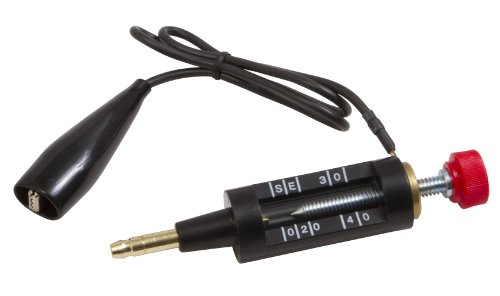
The Lisle 20700 answers the question a bulb cannot: how much spark is there? It is an adjustable gap tester built for coil-on-plug ignitions. The tip connects to the coil or plug wire, a ground lead clips to clean engine metal, and a knob widens or narrows the air gap the spark must jump while the engine cranks. The barrel is marked with a voltage scale, so instead of a flicker you get a working estimate of coil output: a healthy electronic ignition jumps a wide gap with a strong blue-white spark, while a coil that only manages a narrow, orange spark is on its way out.
That adjustability is the whole point. Start narrow and every coil looks fine; widen the gap and the load on the coil climbs, which separates a genuinely strong coil from one that fires in open air but will misfire under compression. The threaded tip unscrews, which adapts the tester to some small engines and motorcycles as well as cars.
Open-gap testing carries the sharpest warnings in this article. The spark is exposed, so keep it well away from fuel vapour, never touch the tip or ground lead while cranking, and do not open the gap wider than the job needs: forcing a coil to hunt for a path across an excessive gap can strain the coil and module. The threaded tip should be checked for tightness before use, as a loose tip changes the gap you think you set.
Specs
- Type: adjustable gap spark tester for coil-on-plug and conventional ignitions
- Readout: graduated voltage scale on the barrel
- Ground: lead with alligator clip to engine ground
- Tip: threaded, removable, adapts to some small engines and motorcycles
- Test method: widen the gap while cranking to load the coil and judge output
- Indication: visible spark jumping the set air gap
4. OTC 6589 Electronic Ignition Spark Tester

The OTC 6589 is a fixed-gap tester built specifically for high-energy electronic ignition (HEI) systems, the class of ignition fitted to most modern petrol cars and trucks and plenty of small engines. There is nothing to adjust: the gap inside is preset at 0.250 inch, several times wider than a spark plug gap. Clip the tester to a good engine ground, connect the plug wire or coil boot, crank, and watch. A system in proper health jumps that gap cleanly; a weak coil, failing module or tired lead that would still light a bulb tester can fail here.
That fixed, demanding gap is the tester’s argument. It forces the ignition to produce close to its maximum output, so the result is a genuine pass-or-fail verdict on the system’s reserve strength rather than a bare indication that something fired. The hookup is two steps, and the tool is listed in professional service information as an essential spark-troubleshooting tool for production engines, which tells you the design brief was workshop use rather than glovebox novelty.
The trade-offs follow from the design. Because the gap is fixed, it gives a verdict, not a measurement; for a graduated sense of how far a coil can go, the adjustable testers above and below are the tools. And because it is calibrated for high-energy electronic ignitions, it is not the right check for older low-output points systems, which may fail its gap despite being healthy for their design.
Specs
- Type: fixed-gap spark tester for electronic ignition
- Gap: preset at 0.250 inch
- Application: gasoline engines in domestic and import cars, trucks and small engines
- Ignition systems: high-energy electronic ignition (HEI)
- Connection: plug wire or coil boot to tester, clamp to engine ground
- Construction: plastic and metal
- Weight: about 0.22 pounds
5. Thexton THE404 Adjustable Ignition Spark Tester

The Thexton THE404 is a compact adjustable gap tester with a gauge background behind the gap, so the distance the spark jumps can be read against a scale instead of guessed. An alligator clip holds the ground lead to the engine, and a safety shield stands between the open gap and the user. Widening or narrowing the gap while cranking gives the same rough strength check as the Lisle 20700: strong systems keep firing as the gap grows, weak ones fade early.
Thexton sells the 404 for high-energy electronic ignitions and for small engines alike, which makes it a reasonable single tool for a household that maintains a car and a mower with the same toolbox. It is small, light and simple, with no bulb to burn out and no battery to go flat in a drawer.
Two honest cautions. First, an open spark in bright sunlight can be genuinely hard to see, so shade the gap or work in the garage before concluding there is no spark. Second, supply of this tester has been uneven; at least one distributor lists it as discontinued with no direct replacement, so treat the listing as the deciding word on availability. As with every open-gap tester, the shock and fuel-vapour warnings in the introduction apply in full.
Specs
- Type: adjustable gap spark tester
- Readout: gap viewed against a gauge background scale
- Ground: alligator clip lead
- Shield: safety shield between gap and user
- Ignition systems: high-energy electronic ignitions and small engines
- Indication: visible spark jumping the set air gap
How to Choose a Spark Tester
Start with the ignition layout, not the tool shelf. If the engine has ordinary plug wires, an inline bulb tester is the fastest first check and the Lisle 20610’s two boot styles cover most wire angles. If the engine is coil-on-plug, a plain inline tester has nothing to grab; choose a kit with a coil-on-plug extension wire, like the Lisle 20580, or an adjustable tester designed to connect at the coil, like the Lisle 20700.
Next, decide what question you are asking. “Is there spark?” is a bulb test. “Is there enough spark?” is a gap test. A fixed-gap tester such as the OTC 6589 gives a strict pass-or-fail at a demanding preset gap, which suits a quick verdict on a high-energy system. An adjustable tester gives a graduated answer and lets you compare cylinders against each other at the same setting, which is more informative when one cylinder is suspect.
Match the tester to the ignition’s energy. High-energy electronic systems need testers rated for them; a bargain tester built for small engines can be damaged by a car HEI system or, worse, pass it falsely. Conversely, a demanding HEI gap tester is a poor judge of an old points ignition. Small engines sit at the other end of the scale: most testers here cover them, and the removable-tip designs adapt best.
Finally, work safely and in order. Disable fuel delivery where service information directs it, keep open sparks away from vapour, keep hands off live parts while cranking, and remember what a pass means: spark in open air, at cranking speed. If the tester passes and the engine still will not run, the fault is compression, fuel, or a plug that fails under pressure — and a gap test at a wider setting is the honest next step before replacing parts.
FAQ
Can a spark tester damage an ignition system?
Used as directed, no. The risks come from misuse: opening an adjustable gap far beyond what the check needs forces the coil to hunt for a path and can strain the coil or module, and holding leads or touching the gap while cranking exposes the user, not the car, to a shock.
Why does the bulb flash but the engine still misfire?
Because presence is not strength. A bulb lights at voltages far below what a plug needs under compression. Move to a gap tester, widen the setting, and compare the suspect cylinder against a healthy one.
Do these testers work on diesel engines?
No. Diesel engines have no spark plugs or ignition system; they ignite fuel by compression. None of the tools in this article applies to them.
Can I use a spark tester on a chainsaw or mower?
Yes, that is one of their oldest jobs. Small engines use simple magneto ignitions, and most testers here cover them; adjustable models with removable tips adapt most easily. Keep the same fuel-vapour discipline, since small fuel tanks vent close to the plug.
More from Amazon
Programs that pair well with the guide above. Offers and eligibility are set by Amazon and may change.
Free shipping on eligible items, Prime Video and more. Eligible new members can start with a free trial.
Start a Prime free trialA Prime membership for ages 18-24 with a trial period. Eligibility is set by Amazon.
See Prime for Young AdultsAudiobooks and podcasts to listen to on the go. Eligible new members can start with a free trial.
Try Audible freeAd-free music streaming. Eligible new subscribers can start with a free trial.
Try Music Unlimited freeAs an Amazon Associate we earn from qualifying purchases.









Write Your Review
No reviews yet. Be the first to share your experience!