

Key takeaways
- Compare the best refractometers for coolant and battery testing, with separate glycol scales, ATC ranges and battery acid scales explained clearly.
As an Amazon Associate we earn from qualifying purchases.
A refractometer answers two routine questions with two or three drops of fluid. Put coolant on the prism and it shows the freeze point of the mix, so you know whether the system is protected for winter. Put battery electrolyte on the same prism and it shows the specific gravity of the acid, the standard way to judge the state of charge of a flooded lead-acid battery cell by cell. It does both jobs more precisely than the older float hydrometer, needs a far smaller sample, and works on propylene glycol coolant, which float testers calibrated for ethylene glycol cannot read reliably.
The five instruments below are all handheld optical refractometers built for automotive fluids. They differ in the scales they carry, whether the scale reads in Fahrenheit or Celsius, how wide the automatic temperature compensation (ATC) range runs, and small but real details such as whether a vial of distilled water for calibration is in the case. One carries a fourth scale for diesel exhaust fluid (DEF), which matters if a diesel truck shares your driveway.
Two cautions apply to the whole category. First, ethylene glycol and propylene glycol bend light differently, so each has its own scale: read a propylene glycol coolant on the ethylene scale and the freeze point you write down will be wrong. Second, a refractometer measures freeze protection and acid density, not coolant health. Corrosion inhibitors deplete with age and mileage without changing the freeze point at all, so a passing reading never cancels the coolant change interval in the owner’s manual.
Affiliate Disclosure: This article contains affiliate links. If you buy through them, we may earn a commission at no extra cost to you.
1. Robinair 75240 Coolant and Battery Refractometer

The Robinair 75240 is the long-standing shop standard in this category, from a maker known for air conditioning and cooling system service equipment. It carries scales for the freeze point of both ethylene glycol and propylene glycol coolant, running from −60°F up to 32°F, plus a battery acid scale from 1.15 to 1.30 specific gravity. The coolant scale resolves in 10°F steps and the battery scale in 0.01 specific gravity steps, which matches the precision the jobs actually need: you are confirming a protection level and spotting a weak cell, not doing laboratory work.
Robinair builds the 75240 around high-quality optics with a smooth focusing eyepiece, and the kit reflects shop practice. Alongside the instrument you get an eyeshade, a screwdriver for the correction screw, a glass rod and soft cloth, a leather cover, and a vial of distilled water so the zero point can be checked and set before a session. At 176 g and 160 mm long it lives happily in a toolbox drawer. Temperature compensation is built in, so readings hold steady across normal workshop temperatures.
The limits are the category limits. The battery scale only works on batteries you can open: sealed and AGM batteries give you no way to draw an electrolyte sample, so no refractometer can test them this way. And like every pick here, it reports freeze point only, not the condition of the additive package.
Specs
- Type: handheld optical refractometer with ATC
- Coolant scales: ethylene glycol and propylene glycol freeze point, −60°F to 32°F
- Battery scale: 1.15 to 1.30 specific gravity
- Resolution: 10°F coolant, 0.01 specific gravity
- Sample size: a few drops on the prism
- Dimensions: 27 x 40 x 160 mm
- Weight: 176 g
- Kit contents: refractometer, eyeshade, screwdriver, glass rod, soft cloth, leather cover, vial of distilled water
2. Triplett RFT55 Glycol and Battery Refractometer

The Triplett RFT55 covers the same two jobs as the Robinair but splits its coolant scales at slightly different endpoints, which is worth knowing if you work in deep cold. Its propylene glycol scale runs from −60°F to 32°F, while the ethylene glycol scale runs from −60°F to 25°F. Resolution is 2°F, finer than the Robinair’s 10°F steps, and Triplett states accuracy at ±2% across the ranges. The battery acid scale covers 1.15 to 1.30 specific gravity, the span that separates a discharged cell from a fully charged one.
ATC compensates for ambient temperature between 50°F and 86°F (10°C to 30°C), the band that covers most garages in most seasons; outside it, let the instrument and the sample settle to room temperature before trusting a reading. Calibration is the standard routine for this class: a drop of distilled water, the included screwdriver, and the correction screw. The kit adds a pipette, a cleaning cloth and a carry case, and the instrument itself is 170 mm long and weighs 6 oz.
Triplett also sells a Celsius twin, the RFT50, so confirm which unit of measure a listing describes before ordering — the RFT55 covered here is the Fahrenheit model. As with the Robinair, the battery function is for serviceable flooded batteries with removable caps; there is no way to sample a sealed battery.
Specs
- Type: handheld optical refractometer with ATC
- Propylene glycol scale: −60°F to 32°F freeze point
- Ethylene glycol scale: −60°F to 25°F freeze point
- Battery scale: 1.15 to 1.30 specific gravity
- Resolution: 2°F
- Accuracy: ±2%
- ATC range: 50°F to 86°F (10°C to 30°C)
- Dimensions: 6.7 x 1.6 x 1.6 in (170 x 40 x 40 mm)
- Weight: 6 oz (170 g)
- Kit contents: refractometer, screwdriver, cleaning cloth, pipette, case
3. Extech RF41 Portable Battery Coolant/Glycol Refractometer

The Extech RF41 is the Celsius member of this group, from a maker of test and measurement instruments. Both glycol scales — propylene and ethylene — run from −50°C to 0°C with 1°C resolution and stated accuracy of ±2%, and the battery acid scale covers 1.15 to 1.30 specific gravity with 0.01 resolution. Extech builds the RF41 with non-corrosive optics and a simple focus adjustment on the prism and lens, and the automatic temperature compensation works across 10°C to 30°C.
A Celsius scale is a genuine deciding factor rather than a footnote. Workshop manuals for many European and Japanese vehicles quote freeze protection in Celsius, and converting every reading invites exactly the kind of error a tester is meant to eliminate. If your manuals and coolant jugs speak Celsius, this is the natural pick; if they speak Fahrenheit, the Robinair or Triplett above will read more directly.
The kit is the expected set: the instrument in a case, a calibration screwdriver and a plastic pipette. Two to three drops are all a reading takes. The same category limits apply — flooded batteries only for the acid scale, and freeze point says nothing about inhibitor condition — and Extech’s Fahrenheit twin is a different model number, so check the listing carefully if you order across the range.
Specs
- Type: handheld optical refractometer with ATC
- Coolant scales: propylene and ethylene glycol freeze point, −50°C to 0°C
- Battery scale: 1.15 to 1.30 specific gravity
- Resolution: 1°C coolant, 0.01 specific gravity
- Accuracy: ±2%
- ATC range: 10°C to 30°C
- Sample size: 2 to 3 drops
- Kit contents: refractometer, case, calibration screwdriver, plastic pipette, user manual
4. ATD Tools 3705 Coolant Refractometer

The ATD Tools 3705 takes a different trade. Its steel body is built for a busy shop drawer, and its battery acid scale is the widest here, running from 1.100 to 1.400 specific gravity, so it reads deeply discharged and overcharged electrolyte that narrower scales clip. The ethylene glycol freeze point scale runs from −84°F to 32°F and the propylene glycol scale from −60°F to 32°F, both in 5°F divisions, with stated accuracy of ±5°F — coarser than the Triplett, and worth knowing if you split hairs over a few degrees of protection.
ATD fits automatic temperature compensation across 50°F to 86°F, an adjustable-focus viewfinder, and large, high-contrast scale graphics that are easy to read under shop lighting. The box holds a storage case, a fluid dropper and a calibration screwdriver.
One limitation is stated by the maker and matters more every model year: the 3705 is not for use with OAT (organic acid technology) coolants, and not for DEF. Many newer vehicles leave the factory filled with OAT coolant. If that is what your system runs, choose one of the other instruments here and confirm its coolant notes, or fall back on test strips for condition and a different method for freeze point. Read the jug before you trust any reading.
Specs
- Type: handheld optical refractometer with ATC, steel body
- Ethylene glycol scale: −84°F to 32°F freeze point
- Propylene glycol scale: −60°F to 32°F freeze point
- Battery scale: 1.100 to 1.400 specific gravity
- Minimum division: 5°F coolant, 0.01 specific gravity
- Accuracy: ±5°F coolant, ±0.01 specific gravity
- ATC range: 50°F to 86°F (10°C to 30°C)
- Coolant limits: not for OAT coolants or DEF, per the maker
- Kit contents: refractometer, storage case, fluid dropper, calibration screwdriver
5. Aichose 4-in-1 Antifreeze, DEF and Battery Refractometer
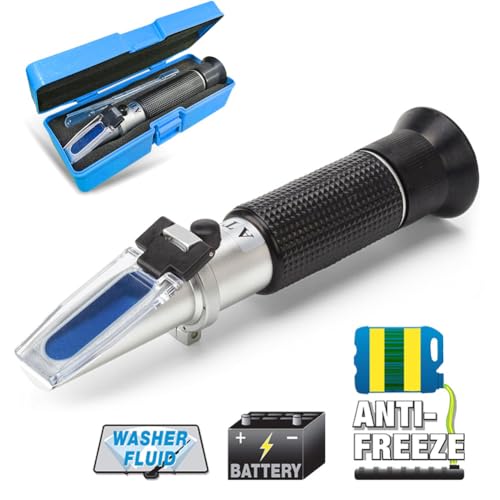
The Aichose 4-in-1 is the pick for a mixed driveway. Alongside the two glycol freeze point scales and a battery acid scale, it adds a windshield washer fluid freeze point scale and a diesel exhaust fluid scale that reads urea concentration from 30% to 35% — the narrow band where DEF is in specification. Weak or diluted DEF is a real cause of derate warnings on modern diesels, and this is the only instrument in the group that can check it. The coolant scales run from −50°C to 0°C for both ethylene and propylene glycol, the washer fluid scale from −40°C to 0°C, and the battery scale from 1.10 to 1.40 specific gravity.
Automatic temperature compensation is built in, the body is aluminium alloy, and the prism materials resist the acidic and alkaline fluids the tool samples. The kit follows the usual pattern: the instrument in a hard case with a cleaning cloth, a screwdriver for calibration, pipettes and instructions. Calibrate with distilled water before a session, as with every optical refractometer here.
The honest trade-offs: the scales are in Celsius, which suits some owners and not others, and four scales in one eyepiece view are busier to read than the two-scale instruments above. If you only ever check coolant and a flooded battery in a gasoline car, the simpler tools are easier on the eyes. If a diesel with a DEF tank sits next to it, this one tool covers the whole fleet.
Specs
- Type: handheld optical refractometer with ATC, aluminium alloy body
- Coolant scales: ethylene and propylene glycol freeze point, −50°C to 0°C
- Battery scale: 1.10 to 1.40 specific gravity
- Washer fluid scale: −40°C to 0°C freeze point
- DEF scale: urea concentration 30% to 35%
- Sample size: 2 to 3 drops
- Kit contents: refractometer, hard case, cleaning cloth, screwdriver, pipettes, instructions
How to Choose the Right Refractometer
Match the scale to your coolant. Ethylene glycol and propylene glycol each need their own scale, and every instrument here carries both — but you have to read the right one. Check the coolant jug or the owner’s manual first. If the vehicle runs an OAT extended-life coolant, read the maker’s notes for the specific instrument, as the ATD 3705 above shows: not every refractometer is cleared for every coolant chemistry.
Pick your unit of measure once. Fahrenheit and Celsius versions of the same tool often sit side by side in listings. Choose the one your manuals use, and confirm the model number in the listing matches it, because a converted reading is an error waiting to happen.
ATC and calibration decide real-world accuracy. Automatic temperature compensation corrects for the air around the prism, but only inside its stated range — typically 50°F to 86°F (10°C to 30°C) on the tools here. In a freezing barn or a hot engine bay, let the tool and sample come to room temperature. Then zero the instrument with distilled water before the session; it takes seconds and is the difference between a measurement and a guess.
The battery scale has a hard boundary. Specific gravity testing needs a sample of electrolyte, which means a flooded battery with removable caps. Sealed, AGM and gel batteries cannot be sampled at all. On a flooded battery, compare cells against each other: one cell reading far below its neighbours points at that cell, whatever the average says.
Keep the sample clean and the engine cold. A refractometer needs only drops, but dirt, oil film or old residue on the prism bends light too, and the reading follows the contamination. Wipe the prism, take the sample from the radiator or reservoir of a cold engine — never open a hot, pressurised system — and rinse and dry the prism afterwards, especially after battery acid.
Freeze point is not coolant condition. A refractometer will happily report strong freeze protection on coolant whose corrosion inhibitors are exhausted. Pair it with the change interval in the owner’s manual, and with test strips if you want a read on additive condition and pH.
Against the float hydrometer. The older hydrometer is the budget alternative and fine for a rough ethylene glycol check, but it needs a larger sample, its reading shifts with sample temperature, and it cannot handle propylene glycol reliably. The refractometer’s small sample, temperature compensation and dual glycol scales are why it has taken over the job.
Conclusion
For most owners, the Robinair 75240 or the Triplett RFT55 covers coolant and battery duty in Fahrenheit with no fuss; the Extech RF41 is the same idea in Celsius from an instrument maker. The ATD Tools 3705 suits a working shop that values a steel body and a wide battery scale, provided OAT coolant is not on the menu. The Aichose 4-in-1 earns its place wherever a diesel’s DEF tank joins the fleet. Whichever you choose, calibrate it with distilled water, read the scale that matches your coolant, and remember that freeze protection is only half of coolant health.
More from Amazon
Programs that pair well with the guide above. Offers and eligibility are set by Amazon and may change.
Free shipping on eligible items, Prime Video and more. Eligible new members can start with a free trial.
Start a Prime free trialA Prime membership for ages 18-24 with a trial period. Eligibility is set by Amazon.
See Prime for Young AdultsAudiobooks and podcasts to listen to on the go. Eligible new members can start with a free trial.
Try Audible freeAd-free music streaming. Eligible new subscribers can start with a free trial.
Try Music Unlimited freeAs an Amazon Associate we earn from qualifying purchases.









Write Your Review
No reviews yet. Be the first to share your experience!