

Key takeaways
- Compare indoor bike storage racks, stands and wall mounts by capacity per bike, tire width, e-bike fit and install type before you buy or drill.
As an Amazon Associate we earn from qualifying purchases.
Affiliate Disclosure: This article contains affiliate links. If you buy through a link on this page, we may earn a commission at no extra cost to you.
A bike stored indoors lasts longer than one left in the rain, but the wrong rack creates its own problems: a hook that cannot carry the bike, a slot too narrow for the tire, or a mount that pulls out of drywall the first time it is loaded. The five systems below cover the main indoor formats — a no-drill gravity stand, a pivoting wall mount, a simple vertical hook, a ceiling hoist and a freestanding floor parking rack — and each Specs block pins the four numbers that decide whether a rack fits your bike: bikes held, maker weight capacity per bike, tire width accepted, and installation needed.
Two measurements matter first. Weigh your bike or check its maker specification: a road bike may be under 20 pounds, a trail mountain bike around 30, and most e-bikes land between 50 and 70 pounds — heavy enough to rule out several racks outright. Then measure your tire width: road and hybrid tires run roughly 1 to 2 inches, mountain bike tires 2.1 to 2.8 inches, and fat bike tires 4 to 5 inches, needing wide hooks or slots many racks do not offer.
One honest warning applies to every wall and ceiling system here: a rack is only as strong as its anchoring. Screws must land in wall studs or ceiling joists, not drywall alone. Where a pick cannot take an e-bike or a fat tire, the Specs say so plainly.
1. Delta Cycle Michelangelo Two-Bike Gravity Stand — No-Drill Pick for Renters
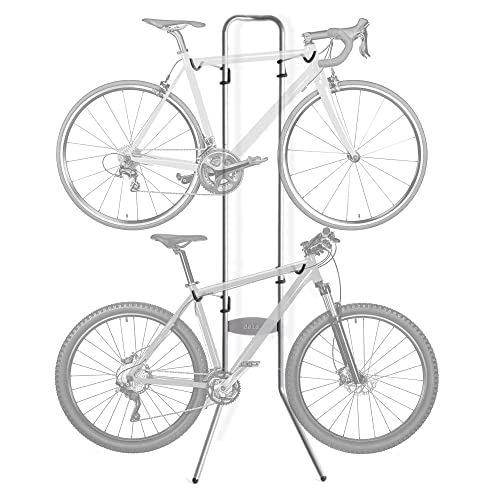
The Michelangelo is the answer for anyone who cannot or will not drill: a steel frame that leans against the wall and holds two bikes horizontally, one above the other, purely by gravity. Nothing is screwed into the wall in normal use, so it suits renters and finished rooms. The support arms adjust independently for different frame shapes, making it forgiving for mixed pairs of road, mountain and hybrid bikes.
Capacity is the trade-off. Delta Cycle rates the stand at 80 pounds in total — 40 pounds per bike. That suits road bikes, hybrids and most hardtails, but rules out e-bikes entirely: at 50 to 70 pounds each, even one exceeds the per-bike limit. The upper bike must be lifted to roughly shoulder height, so the heavier bike belongs on the lower arms. Because bikes hang by their frames, tire width is not the limiting factor here — frame shape and weight are.
Specs
- Format: freestanding gravity lean-to stand
- Bikes held: 2
- Maker weight capacity: 80 lb total, 40 lb per bike
- Tire width limit: none published — bikes hang by the frame, so tire width is not the constraint
- E-bike fit: no — the 40 lb per-bike limit excludes typical 50–70 lb e-bikes
- Install type: freestanding, no drilling; leans against a wall, optional safety strap included
- Frame: powder-coated steel, rubber-coated arms; needs about 84 in of wall height
2. Steadyrack Classic Rack — Pivoting Wall Mount That Needs No Lifting

The Steadyrack takes a different approach: instead of lifting the bike onto a hook, you roll the front wheel in at ground level and tip the bike up into its vertical position, using the wheel as a lever. That roll-in loading is the main reason to choose it — a vertical hook demands you dead-lift the bike’s full weight, while the Steadyrack asks for balance rather than strength. Once stored, the bike pivots up to 160 degrees side to side, so several racks can line one wall with bikes angled flat against it; the rack folds flat when empty.
This Classic model is sized for road and gravel bikes with tires up to 2.1 inches wide and wheels from 20 to 29 inches. Steadyrack rates it at 77 pounds (35 kg) per rack — the strongest per-bike figure among the wall-mounted picks here — covering most e-bikes in the 50 to 70 pound range provided the tire fits the 2.1 inch limit; wide-tire e-MTBs need the wider MTB or Fat versions, which are separate models. Installation is not cosmetic: the rack must be screwed into a wall stud (or masonry fixings), and that anchoring is what the rating depends on.
Specs
- Format: pivoting vertical wall mount with roll-in loading
- Bikes held: 1 per rack
- Maker weight capacity: 77 lb (35 kg) per rack
- Tire width limit: up to 2.1 in; wheel diameter 20–29 in
- E-bike fit: yes for most e-bikes up to 77 lb with tires up to 2.1 in; wider tires need the MTB or Fat models
- Install type: wall mount — screws into a wall stud or masonry; drilling required
- Pivot: up to 160 degrees side to side; folds flat when empty; steel and UV-treated polymer
3. Delta Cycle Leonardo Single-Bike Wall Hook — The Simple Budget Hook

The Leonardo is the simplest format here: a single rubberized steel hook that holds one bike vertically by its front wheel, paired with a tray that catches the rear tire and keeps it off the wall. There is nothing to adjust and almost nothing to assemble, and it mounts with included hardware into a single wall stud. For one light bike in a garage corner or hallway, it is a tidy solution.
Its limits are equally simple. The hook is rated at 40 pounds maximum, covering road bikes, hybrids and lighter hardtails but excluding e-bikes and heavier full-suspension rigs. It is documented for tires up to 2.5 inches wide, so most mountain bike tires fit, but 4 to 5 inch fat tires do not — Delta sells a separate fat-tire version. Hanging a bike vertically also means lifting it onto the hook, and the rating assumes a stud fixing, not drywall.
Specs
- Format: vertical wall hook with rear tire tray
- Bikes held: 1
- Maker weight capacity: 40 lb maximum
- Tire width limit: up to 2.5 in per maker documentation; fat tires need the separate fat-tire version
- E-bike fit: no — 40 lb limit, and the bike must be lifted onto the hook
- Install type: wall mount — single stud fixing, hardware included; drilling required
- Hook: rubberized steel; tire tray protects the wall from scuffs
4. RAD Sportz Bicycle Hoist — Ceiling Storage for High Garages
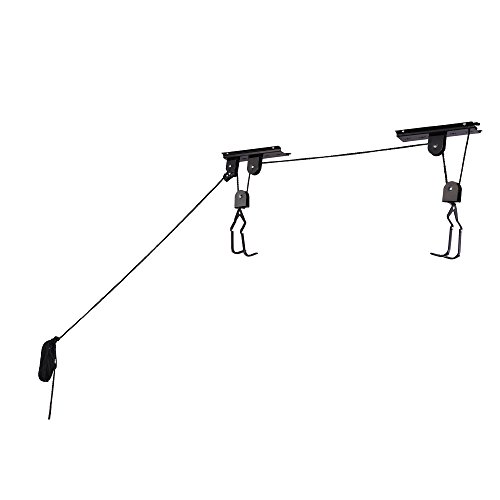
When wall and floor space are both spoken for, the remaining surface is the ceiling. The RAD Sportz hoist uses a rope-and-pulley system with hooks that grip the bike at the handlebar and saddle, raising it overhead and out of the way. RAD Sportz rates it at 100 pounds — the highest capacity in this guide — for ceilings up to 12 feet high. Because the hooks attach at the bars and saddle rather than gripping a tire, tire width is no constraint at all, making this one of the few formats that can store a fat bike.
The honesty points matter more here than with any other pick. First, the 100 pound rating is only real if the mounting plates are screwed into ceiling joists; into drywall or plaster alone, the system will fail under far less. Second, capacity is not the same as ease: raising a 60 pound e-bike means steadying a heavy, swinging load while you pull the rope, and the hooks must be seated securely before you start. In practice the hoist suits light and mid-weight bikes stored long-term — a winter road bike over the car — rather than a heavy bike ridden daily.
Specs
- Format: ceiling pulley hoist
- Bikes held: 1 per hoist
- Maker weight capacity: 100 lb
- Tire width limit: none — hooks attach at handlebar and saddle, so fat tires fit
- E-bike fit: within the 100 lb rating, but raising a 50–70 lb bike overhead is awkward; best for lighter bikes
- Install type: ceiling mount — must be screwed into ceiling joists; drilling required
- Ceiling height: up to 12 ft; rope and pulley with locking mechanism and tie-off
5. CyclingDeal Bicycle Floor Parking Rack — Freestanding Slots for a Full Household

The CyclingDeal floor rack is the parking-lot format scaled for a garage: a steel frame with wheel slots that up to six bikes roll into and out of, with no lifting, no hooks and no installation beyond assembling the frame. Bikes should be parked in alternating directions — front wheel in, then rear wheel in — so handlebars clear each other, and in real use five bikes sit more comfortably than six. It is the natural pick for a household fleet of mixed bikes, including kids’ bikes.
Because bikes rest on their own wheels, CyclingDeal publishes no per-bike weight rating, and none should be assumed; the practical limits are set by the slots. The rack accepts wheels from 12 to 29 inches including 700C, and tires up to about 2.4 inches wide — covering road, hybrid and most mountain bike tires, but not 4 to 5 inch fat tires. Wide e-bike tires should be measured first. E-bikes otherwise work well here since their weight sits on the floor; just set the rack on a level surface, against a wall for stability.
Specs
- Format: freestanding floor parking rack with wheel slots
- Bikes held: up to 6 (5 sit comfortably, parked in alternating directions)
- Maker weight capacity: no per-bike rating published — bikes rest on their own wheels
- Tire width limit: up to about 2.4 in; wheel sizes 12–29 in and 700C; fat tires do not fit
- E-bike fit: yes for models with tires under the slot width, since weight rests on the floor
- Install type: freestanding — frame assembly only, no drilling or anchoring
- Construction: steel frame, model CB-618-6AN
How to Choose the Right Indoor Bike Storage
Start with the bike, not the rack. Weigh it, measure the tire, and be honest about how often you ride it: a daily rider belongs somewhere reachable without lifting, while a bike stored for the season can go on the ceiling.
Match the format to your walls and your tenancy. If you cannot drill, the choice narrows to the gravity stand and the floor parking rack. If you can drill, studs decide everything: hooks and mounts must be fixed into studs, hoists into joists. A maker capacity figure only holds when the anchoring is structural.
Then check the two fit numbers per bike. Weight first: the 40 pound limits exclude e-bikes and some full-suspension mountain bikes, while the Steadyrack’s 77 pound rating and the hoist’s 100 pound rating cover heavier machines. Tire width second: 2.1 inches caps the Classic Steadyrack, about 2.4 to 2.5 inches caps the floor rack slots and the Leonardo hook, and only the gravity stand and the hoist ignore tire width. Fat bikes need one of those two formats, or a dedicated fat-tire wall rack.
Finally, count your bikes and your space. Vertical wall storage frees the most floor; the floor rack is easiest to use and hungriest for floor area; the gravity stand splits the difference for two bikes.
FAQ
Can any of these racks store an e-bike?
Yes, with conditions. The Steadyrack Classic is rated at 77 pounds per rack, covering most e-bikes if the tire is 2.1 inches or narrower. The ceiling hoist is rated at 100 pounds but is awkward to load with a heavy bike. The floor rack carries e-bike weight on the floor, subject to its roughly 2.4 inch slot width. The gravity stand and Leonardo hook, both limited to 40 pounds per bike, cannot take typical 50 to 70 pound e-bikes.
What should I do if my bike has fat tires?
Fat tires of 4 to 5 inches will not fit the Steadyrack Classic, the Leonardo hook or the floor rack slots. Use a format that does not grip the tire: the gravity stand hangs bikes by the frame, and the ceiling hoist hooks the handlebar and saddle.
Do wall mounts really need to go into a stud?
Yes. Every wall and ceiling capacity here assumes fixing into a stud or joist. Drywall anchors are not a substitute, and a mount that pulls out can damage both wall and bike.
Which format suits a rental apartment best?
The two freestanding formats: the gravity stand for one or two bikes in a corner, or the floor parking rack where there is floor space. Neither needs drilling, and both leave with you when you move out.
Bottom Line
For most households, the pivoting Steadyrack is the strongest all-round wall solution, the Michelangelo gravity stand is the best no-drill option for two lighter bikes, and the CyclingDeal floor rack is the easiest answer for a whole fleet. The Leonardo covers the single light bike, and the RAD Sportz hoist reclaims the ceiling for seasonal storage. Whichever format you choose, let the per-bike weight limit and tire width — not the headline bike count — decide.
More from Amazon
Programs that pair well with the guide above. Offers and eligibility are set by Amazon and may change.
Free shipping on eligible items, Prime Video and more. Eligible new members can start with a free trial.
Start a Prime free trialA Prime membership for ages 18-24 with a trial period. Eligibility is set by Amazon.
See Prime for Young AdultsAudiobooks and podcasts to listen to on the go. Eligible new members can start with a free trial.
Try Audible freeAd-free music streaming. Eligible new subscribers can start with a free trial.
Try Music Unlimited freeAs an Amazon Associate we earn from qualifying purchases.










Write Your Review
No reviews yet. Be the first to share your experience!