

Key takeaways
- Compare the best pitchforks for compost, hay, mulch and manure: forged manure forks, a basket bedding fork and a 10-tine mulch fork, with tine counts.
As an Amazon Associate we earn from qualifying purchases.
A pitchfork is a carrying tool, not a digging tool. That distinction matters, because the two fork families look similar on a store wall and do opposite jobs. A digging or spading fork has four short, flat, heavy tines built to be levered against soil. The forks in this article — pitchforks, manure forks and bedding forks — have longer, slimmer tines made to slide into a pile of loose material, lift it, carry it and toss it. Use one of these to pry a root ball out of the ground and you will bend it; use a digging fork to move a compost pile and you will move a third as much per trip and feel it in your back by the tenth load.
Tine count and spacing decide what a fork can actually carry, and this is where buyers most often get it wrong. A wide-spaced fork with three to five tines spears hay, straw and loose compost beautifully, because the strands bridge the gaps — but shovel the same fork into finished compost or wood shavings and half the load falls straight through before you reach the wheelbarrow. At the other end, a bedding fork with ten or more close-set tines sifts shavings and lifts fine material cleanly, yet it cannot spear a section of a hay bale or bite into a matted straw pack at all; it skates across the surface. There is no universal fork. There is the fork that matches your material.
Tine shape matters second. Round and oval tines slide into fibrous piles with the least resistance and are the classic manure fork profile. Flat tines are stiffer in the bending direction and shed sticky material a little less willingly. Finally, the joint where head meets handle — socket, ferrule and rivets — is the failure point on every fork here. These tools are built to lift loose loads, not to pry. The moment you use one as a lever against something fixed, the load concentrates at that joint, and either the tines bend, the socket splits or the handle snaps. The five forks below span the real range: two classic forged manure forks, a fiberglass-handled variant, a polycarbonate basket fork for bedding, and a wide 10-tine steel fork for mulch volume.
Affiliate Disclosure: This article contains affiliate links. If you buy through a link on this page, we may earn a commission at no extra cost to you. We only list products we can verify, and every specification below comes from the maker or the retailer listing for that exact model.
1. Truper 30314 Tru Pro 5-Tine Manure Fork — the classic forged all-rounder

Truper’s Tru Pro line is the traditional end of the catalog, and the 30314 is the pattern most people picture when they hear “manure fork”: a one-piece forged steel head with five oval tines on a 54-inch North American ash handle. Forging matters here. A head hammered from a single piece of steel has no welds to crack, and oval tines are the right profile for this job — they part straw and hay strands instead of cutting through them, so a forkful stays together on the way to the barrow.
The ash handle is the other half of the design. Ash flexes slightly under load and absorbs the shock when the tines hit something solid in the pile, which a rigid handle passes straight into your wrists. The trade-off is maintenance: ash needs to stay dry and benefits from an occasional rub of linseed oil, and a handle left leaning against a damp barn wall for years will eventually check or rot at the socket. The head is riveted into its ferrule, and at 3.75 lb the whole tool is light enough for a full morning of turning compost without becoming the workout itself. For a mixed workload of compost turning, mulch spreading and straw handling, this is the balanced default.
Specs
- Tines: 5, oval, forged alloy steel, one-piece head
- Head width: about 9 inches
- Handle: North American ash, 54 inches, straight shaft (no end grip)
- Joint: riveted ferrule
- Weight: 3.75 lb
- Model: Truper 30314 (Tru Pro)
- Best for: compost turning, hay, straw and general mulch work
- Source: https://www.amazon.com/dp/B000LF91AE
2. Truper 30323 Pro Manure Fork — fiberglass handle for wet work

The 30323 keeps the same five-tine forged head pattern as its ash-handled sibling but mounts it on a 50-inch fiberglass handle with a 9-inch non-slip cushion grip. That swap changes where the fork belongs. Fiberglass does not rot, does not check in the sun, and does not care about being left in a wet wheelbarrow overnight — the exact conditions that slowly kill a wooden handle around compost bins and manure piles, where everything is damp most of the year.
The head is forged and riveted, with the tines formed as one piece with the head across a 9-inch width, and Truper rates the handle assembly for serious leverage loads. What fiberglass gives up is feel: it transmits more vibration than ash and fails by splintering rather than cracking gradually, so it gives less warning before it goes. The cushion grip is a genuine improvement for tossing work, where the top hand slides and twists on every throw. Gardeners whose fork lives outdoors near the bins, or who work mostly in wet material — soaked bedding, fresh manure, saturated mulch — get the better tool here; traditionalists who store tools indoors and like wood in the hand should look at the 30314 instead.
Specs
- Tines: 5, forged steel, one-piece with head
- Head width: about 9 inches
- Handle: fiberglass, 50 inches, 9-inch non-slip cushion grip
- Joint: forged head, riveted
- Weight: not published by the maker
- Model: Truper 30323 (Pro)
- Best for: wet compost, manure and mulch in damp conditions
- Source: https://www.amazon.com/dp/B005Q7CRNU
3. Truper 30317 Tru Pro 6-Tine Manure Fork — one more tine, finer work

The 30317 is the 30314’s close relative with a sixth tine added to the forged head. One extra tine sounds like a small change, but it closes the spacing across the head noticeably, and spacing is what decides how much fine material rides the fork instead of sifting through it. Half-finished compost, chopped straw, leaf mold and coarse shavings all stay on a six-tine fork better than on a five, while the head is still open enough to spear into a hay or straw pile without fighting you.
Everything else follows the Tru Pro pattern: one-piece forged alloy steel head, a 54-inch North American ash handle with the same shock-absorbing flex, and a riveted joint. At 4.2 lb it carries a little more weight than the five-tine version, which you notice less in the lifting than in the balance — the head end feels a touch more planted. This is the fork for a gardener whose pile work is mostly finer material but who still handles straw often enough that a true bedding fork would frustrate them. It is a compromise, and like most compromises it is the right answer for the mixed middle of the workload and the wrong one at either extreme.
Specs
- Tines: 6, oval, forged alloy steel, one-piece head
- Handle: North American ash, 54 inches, straight shaft (no end grip)
- Joint: riveted ferrule
- Weight: 4.2 lb
- Model: Truper 30317 (Tru Pro)
- Best for: finer compost, chopped straw, leaf mold and coarse shavings
- Source: https://www.amazon.com/dp/B002Q7L0V8
4. Little Giant DuraPitch II — the polycarbonate basket fork for bedding
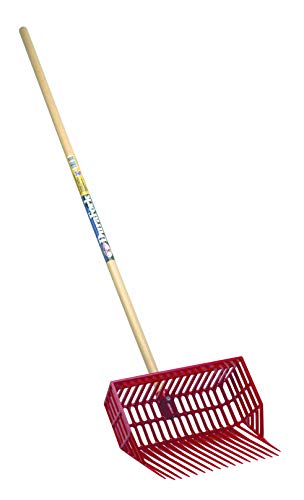
The DuraPitch II, made by Miller Manufacturing in the USA, abandons steel entirely: the head is molded polycarbonate, formed into a basket profile with closely spaced, angled tines about 13 inches long. That shape exists for one job — picking stalls and beds. The basket curve holds a load of shavings while you shake the fork so clean bedding falls back through the tines and only the soiled clumps stay on board. No flat steel fork can do that trick, and doing it by hand a stall at a time is why bedding forks exist.
Polycarbonate flexes instead of bending permanently, shrugs off the ammonia and moisture of a stable, and keeps the whole tool light — the listing gives a 61-inch overall length and a package weight of about 3.2 lb. The head mounts to a 52-inch hardwood handle secured with a nylon locknut, and replacement heads are a normal part of this fork’s life: a tine snapped on a frozen pile is a head swap, not a new tool. The limits are just as clear. Polycarbonate cannot pry, cannot spear compacted or matted material, and goes brittle in deep cold. For garden compost it is the wrong tool; for shavings, pellets and loose bedding it is the specialist the steel forks cannot match.
Specs
- Tines: closely spaced polycarbonate, angled, about 13 inches, basket profile
- Head width: about 16 inches (listing dimensions)
- Handle: hardwood, 52 inches, nylon locknut fitting
- Overall length: 61 inches
- Weight: about 3.2 lb (package weight)
- Model: Little Giant DuraPitch II DP2RED, made in the USA
- Best for: sifting shavings and bedding, stall and coop cleaning
- Source: https://www.amazon.com/dp/B000HHM5MW
5. Nohovu 10-Tine Pitch Fork — wide steel head for mulch volume

The Nohovu fork takes the ensilage pattern — ten steel tines across a wide head — and packages it at a handier length. The head is cast high carbon steel, about 14.7 inches wide, with a coated finish against rust, and the ten tines are spaced to carry loose, bulky material: bark mulch, wood chips, leaf piles and finished compost. Ten tines across that width means each forkful is a genuinely large scoop, and for the classic spring job of moving a mulch pile into beds, volume per trip is the whole game.
At 45 inches overall with a D-shaped grip, this is a shorter tool than the Truper manure forks, and the shape tells you how it is meant to be used: close work, loading and spreading, with the D-grip giving the top hand a positive hold for the tossing motion. The head-to-handle joint is reinforced with two rivets, a direct answer to the usual failure point, and at 6.1 lb it is the heaviest fork here — the weight of a cast steel head that wide. That heft is fine for an hour of mulching and tiring for a day of it. It also cannot do the bedding fork’s sifting work or the five-tine’s hay spearing; it is a bulk mover, and a good one.
Specs
- Tines: 10, high carbon steel, coated finish
- Head width: about 14.7 inches
- Handle: 45 inches overall, D-shaped non-slip grip
- Joint: double-rivet reinforcement
- Weight: 6.1 lb
- Model: Nohovu NH_07
- Best for: bark mulch, wood chips, leaves and finished compost in bulk
- Source: https://www.amazon.com/dp/B0D14FMYPB
How to choose: match the fork to the material
Start with what you move most, not what you move occasionally. Long-strand material — hay, straw, loose stalks — wants few, widely spaced tines that spear and hold: five tines is the sweet spot, six if the strands are chopped short. Fine, loose material — shavings, pellets, sawdust bedding — wants the opposite: many close tines or a basket head that lets you sift as you lift. Bulk garden material — mulch, chips, finished compost — sits in between and rewards width: a 10-tine head moves it fastest, at the cost of weight.
Handle material is the second decision. Ash and hardwood flex, absorb shock and feel alive in the hands, but they are organic: store them dry, oil them occasionally, and expect a finite life in wet conditions. Fiberglass ignores weather and rot entirely, at the cost of vibration and a more sudden failure mode. Grip style follows the work: a straight shaft suits two-handed lifting and turning, while a D-grip gives the top hand leverage for tossing and spreading.
Whatever you choose, respect the joint. Every fork in this article will fail at the head-to-handle connection if it is used as a pry bar against roots, frozen ground or compacted soil — that work belongs to a digging fork or a bar. Keep steel heads rinsed and dry, straighten a bent tine early before it fatigues, and a material-moving fork will last for years of piles.
FAQ
Can I turn compost with a bedding fork?
You can move loose, finished compost with one, but a polycarbonate bedding fork will flex and skate on a dense, half-finished pile. A forged five- or six-tine manure fork is the better compost tool; the bedding fork is for sifting fine material.
Why does my compost fall through the fork?
Because the tine spacing is wider than the material. Finished compost and shavings need close-set tines or a basket head. Wide-spaced forks are built for hay and straw, whose strands bridge the gaps.
Is a fiberglass handle stronger than ash?
It is more weatherproof, not simply stronger. Fiberglass resists rot and moisture completely but transmits more shock and tends to splinter when it fails. Ash flexes, absorbs shock and usually cracks gradually, giving warning first.
What breaks a pitchfork fastest?
Prying. Using the fork as a lever against anything fixed concentrates the whole load at the head-to-handle joint and at the tine roots. Lift loose loads, and use a digging fork or bar for anything that fights back.
More from Amazon
Programs that pair well with the guide above. Offers and eligibility are set by Amazon and may change.
Free shipping on eligible items, Prime Video and more. Eligible new members can start with a free trial.
Start a Prime free trialA Prime membership for ages 18-24 with a trial period. Eligibility is set by Amazon.
See Prime for Young AdultsAudiobooks and podcasts to listen to on the go. Eligible new members can start with a free trial.
Try Audible freeAd-free music streaming. Eligible new subscribers can start with a free trial.
Try Music Unlimited freeAs an Amazon Associate we earn from qualifying purchases.

Write Your Review
No reviews yet. Be the first to share your experience!