

Key takeaways
- Wind-up, digital and visual kitchen timers compared for cooking, baking and brewing, with timing ranges, channels, alarms, mounts and battery details.
As an Amazon Associate we earn from qualifying purchases.
Affiliate Disclosure: This article contains affiliate links. If you buy through a link on this page, the site may earn a commission at no additional cost to you. Product details below come from the makers’ published specifications.
A phone is a poor kitchen timer. It locks itself mid-countdown, gets buried under a flour-dusted hand, and its alarm competes with every other notification on the device. A dedicated kitchen timer does one job, stays where you put it, and can be set with wet hands in two seconds. The five timers below cover the four formats that earn counter space: a mechanical wind-up dial, a compact digital single timer, a digital dual timer, a three-channel digital timer for full meals, and a visual disk timer that shows time passing instead of counting digits. These are kitchen timers only — hose and irrigation timers are plumbing valves on a clock, a different tool entirely, and nothing here is a smart speaker, an oven control or a gym interval clock.
How to Choose a Kitchen Timer
Format decides the range. A mechanical wind-up timer is a spring and a bell. It needs no battery and can be set with one twist, but the format caps out at 60 minutes and the spring drive drifts a little over a long count — a minute or two across an hour is normal for the class. That is fine for pasta, eggs and a tray of cookies. It is the wrong tool for a three-hour braise, a slow ferment or an overnight cold brew, where a digital timer’s hours-long range and exact count earn their place.
Channels only help if they are labelled. A multi-channel timer earns its keep when each channel is identified — numbered on the display, and ideally given a different beep pattern — so that when an alarm sounds you know whether it is the rice or the roast without walking over to read the screen. If you rarely run more than two things at once, a dual timer is the honest ceiling; three channels pay off on holiday meals and canning days, not Tuesday dinners.
Treat loudness figures as maker claims. There is no shared standard for how timer volume is measured, so one maker’s decibel figure cannot be compared directly with another’s. What can be compared is the feature set: adjustable volume levels, a silent mode with a flashing display for quiet houses, and how long the alarm sounds before it gives up — a full minute of beeping is far harder to miss than a few chirps.
Mounting is a real-world test, not a listing photo. A magnetic back is convenient until the fridge door is curved, the magnet is weak, or pressing a button pushes the timer slowly down the door — magnetic timers sliding on curved or textured doors is the most common complaint in this class. A fold-out stand works anywhere flat, and a pocket clip suits cooks who move between stove and counter. The Taylor below skips the magnet entirely and relies on a slip-proof base, the right trade for a tool you wind by twisting its whole body.
Check the battery before it checks you. Timers that run on AAA cells are easy to feed and easy to make safe. Timers that run on a button cell — the CDN below uses one LR44 — carry a specific household hazard: a swallowed button cell can cause severe internal burns in a small child. If a button-cell timer lives in your kitchen, it should have a screw-secured battery door, and spare cells should be stored out of children’s reach like medicine.
1. Taylor 5830 Mechanical Kitchen Timer — the wind-up classic

The Taylor 5830 is the timer format your grandparents used, built properly: a brushed stainless steel housing, a rubberised twist knob and a slip-proof base, with bold black markings on a large dial face. Setting it is one motion — turn the dial all the way to 60 to wind the spring fully, then turn back to the minutes you want. That full wind matters: a partially wound spring is why cheap mechanical timers sometimes stop early or ring weakly.
The honesty points for the format apply in full. The range stops at 60 minutes, so long braises, slow roasts and cold-brew steeps are simply outside its job description. It reads in one-minute marks, not seconds, so it is a baking and boiling timer, not a tool for a 90-second sear or a precise pour-over bloom. And like every spring timer it can drift slightly across a long count. In exchange you get a timer with no battery to die, no screen to fog with steam, and a mechanical bell the maker rates as a loud nine-second ring — a fixed duration, stated plainly, with no volume setting to adjust.
Specs
- Format: Mechanical wind-up dial timer
- Timing range: 0 to 60 minutes, set in 1-minute increments on the dial
- Channels: 1
- Display: Analogue dial with bold black graphics; no digital display
- Alarm: Mechanical bell; the maker states a 9-second ring; no volume adjustment
- Mounting: Countertop only, slip-proof rubber base; no magnet
- Battery: None — spring powered
- Model: 5830
2. CDN TM8 Multi-Task Timer & Clock — the compact digital single

The CDN TM8 is a small, single-channel digital timer that has been a fixture in coffee bars for years, and its spec sheet explains why: it counts up or down over a full 24 hours in hours, minutes and seconds, doubles as a clock and stopwatch, has a memory for the time you set most often, and counts up after zero so you can see how far past the deadline a bake has run. It is the natural pick for brewing, where the same unit times a pour-over in the morning and a long cold-brew steep overnight.
Two limitations should be stated plainly. The display is small — the maker lists it at 1.375 by 0.5 inches — so this is a timer you read at arm’s length, not across the room. And it runs on a single LR44 button cell. CDN’s current manual carries the full ingestion-hazard warning for that cell and secures the battery cover with a small screw; keep that screw snug, and store spare cells away from children. The alarm is one of the better-documented in this class: the maker specifies at least 70 dB sounding for one minute before the unit switches to counting up.
Specs
- Format: Digital single-channel timer, clock and stopwatch
- Timing range: 24 hours by hours, minutes and seconds; counts up and down; 1-second resolution
- Channels: 1, with a memory function for a stored time
- Display: LCD, 1.375 x 0.5 inches per the maker’s spec sheet
- Alarm: Maker specifies an alarm of at least 70 dB for 1 minute, then counts up past zero
- Mounting: Pocket clip, magnet, stand and hanging loop
- Battery: 1 LR44 button cell, included — button-cell ingestion hazard; battery cover is screw-secured per the maker’s manual, keep spare cells out of children’s reach
- Model: TM8
3. TempPro TM02 Digital Dual Kitchen Timer — two channels, big screen

The TM02 — sold under the TempPro name on the current listing, and under ThermoPro in older references; the model number is the part to match — runs two independent countdowns at once, each up to 23 hours 59 minutes, on a 2.6-inch backlit LCD that takes up most of its stainless-faced front. Two channels is the sweet spot for most real cooking: the main dish on one, the side or the bake on the other, both readable at a glance without cycling through menus.
The alert system is the other half of the design. The maker states an adjustable alarm spanning 70 to 105 dB across its volume settings, plus a silent mode in which the display flashes instead — the right setting for timing a proofing loaf late at night. Treat the decibel span as a maker claim rather than a lab comparison; what the manual verifies is the behaviour: at zero the alarm beeps for one minute and the timer then counts up. Mounting covers both common cases, a magnetic back for flat steel surfaces and a fold-out stand, and it runs on two AAA batteries, included in the listing.
Specs
- Format: Digital dual-channel timer
- Timing range: Up to 23 hours 59 minutes per channel; counts up and down
- Channels: 2, independently set and displayed together
- Display: 2.6-inch backlit LCD with large digits
- Alarm: Maker states adjustable volume from 70 to 105 dB plus a silent flashing mode; alarm beeps for 1 minute per the manual
- Mounting: Magnetic back and fold-out stand
- Battery: 2 AAA batteries, included
- Model: TM02
4. OXO Good Grips Triple Timer — three labelled channels for full meals
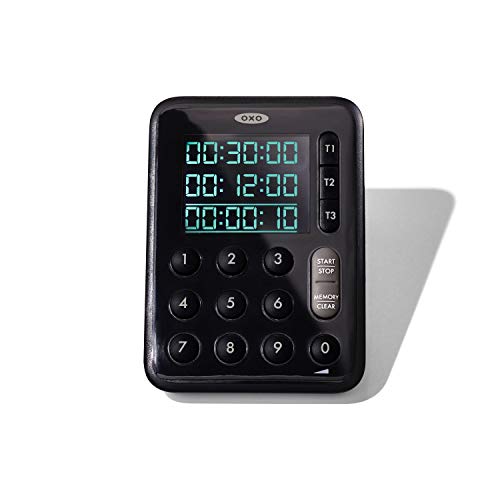
OXO’s Triple Timer is built for the meals where two channels run out: a roast, a side and a bake finishing together, or a canning day with a venting timer, a processing timer and a cooling timer stacked up. Its three independent channels each count up to 100 hours, entered on a full numeric keypad rather than by holding a scroll button, and shown together on a large inverse backlit display — white digits on black — angled upward on its stand for reading from a standing position.
The channel labelling is done the way the buying guide asks for: the channels are marked T1, T2 and T3, and OXO gives each channel its own beep pattern, so the alarm itself tells you which job is done. Volume is adjustable across three settings. One figure OXO does not publish is how long the alarm sounds before stopping, and the Specs below say so rather than guessing. The honest costs are size and simplicity: this is a countertop unit with a non-slip base and no magnet, and a cook who only ever times one thing will find it more machine than the job needs.
Specs
- Format: Digital multi-channel timer with keypad entry
- Timing range: Up to 100 hours per channel; counts down, with a stopwatch function
- Channels: 3, labelled T1, T2 and T3, each with a distinct beep pattern per the maker
- Display: Large inverse backlit LCD, angled face for countertop reading
- Alarm: Adjustable volume with three settings per the maker; alarm duration is not published by the maker
- Mounting: Countertop stand with non-slip base; no magnet
- Battery: 3 AAA batteries, included per the listing
- Model: 11303700
5. Time Timer PLUS 60 Minute — the visual disk timer

The Time Timer PLUS replaces digits with a disappearing red disk. Turn the centre knob and a red wedge appears covering the fraction of the hour you have set; as time passes the wedge shrinks clockwise, so the time left is visible as a shape, from across the room, without reading a number. In a kitchen that means a glance tells you the bread has about a quarter of its proof left while your hands stay in the dough. It is also the format that works for cooks who find beeping alarms stressful, because the alert is optional.
That optionality cuts both ways. The PLUS runs silently by default; a volume-control dial on the back turns on an audible alert at the end of the count, but the maker publishes no decibel figure for it, and it is a single end-of-count alert rather than a minute-long alarm — if hearing the timer from another room is the whole point, pick a digital timer above instead. The range is 60 minutes like the wind-up Taylor, with the same exclusion of long braises and brews. The unit is freestanding with a carry handle and a protective lens over the disk, sized at 5.5 by 7 inches, and one AA battery — not included — powers the mechanism.
Specs
- Format: Visual countdown timer with disappearing disk
- Timing range: 0 to 60 minutes, set by turning the centre knob
- Channels: 1
- Display: Coloured disk that shrinks as time elapses; no digits
- Alarm: Optional audible alert with a volume control dial; silent operation otherwise; the maker publishes no decibel figure
- Mounting: Freestanding with carry handle; no magnet on this model
- Battery: 1 AA battery, not included
- Model: TTP7-WHT-W
Safety and Recall Check
The CPSC recall database at SaferProducts.gov was checked for this product class on 2026-11-21. Searches for kitchen timers, countdown timers and visual timers returned no recall records, and none of the five models above appears in any recall. The nearest timer recall in the database covers a gym interval timer with an overheating battery — a different product class, and one more reason the kitchen and gym categories should not be blurred. The live safety issue in this class is not recalls but the button cell in the CDN TM8: follow the maker’s screw-secured battery door, keep the timer itself where a toddler cannot pry at it, and store spare LR44 cells out of reach.
Quick Answers
What timer suits long braises and cold brew? A digital one. Mechanical and visual-disk timers stop at 60 minutes; the CDN TM8 counts to 24 hours and the TempPro TM02 to just under 24 hours per channel, which covers overnight steeps and slow ferments.
How many channels do most cooks need? Two covers the great majority of meals. Three channels, like the OXO, pay off when a main, a side and a bake run together, or during canning — provided the channels are labelled, as they are on that unit.
Is a louder timer always better? Not necessarily. Volume figures are maker claims with no shared measuring standard. A minute-long alarm and a flashing silent mode are more useful, and more verifiable, features than a headline decibel number.
Can a magnetic timer be trusted on any fridge? No. Curved doors, textured finishes and button presses all make magnetic timers creep downward. If your fridge door is curved, choose a stand or clip model, or a heavy countertop timer like the Taylor.
More from Amazon
Programs that pair well with the guide above. Offers and eligibility are set by Amazon and may change.
Free shipping on eligible items, Prime Video and more. Eligible new members can start with a free trial.
Start a Prime free trialA Prime membership for ages 18-24 with a trial period. Eligibility is set by Amazon.
See Prime for Young AdultsAudiobooks and podcasts to listen to on the go. Eligible new members can start with a free trial.
Try Audible freeAd-free music streaming. Eligible new subscribers can start with a free trial.
Try Music Unlimited freeAs an Amazon Associate we earn from qualifying purchases.










Write Your Review
No reviews yet. Be the first to share your experience!