

Key takeaways
- Compare five refillable soap dispensers on capacity, pump build and refill design: stainless and glass pumps, two touchless models, one foaming pick.
As an Amazon Associate we earn from qualifying purchases.
A refillable soap dispenser is a simple object with one moving part that matters: the pump. Bottles rarely fail. Pumps clog, dribble, lose their prime and die, and when they do, the whole dispenser is landfill unless the pump can be replaced. So this guide judges the five picks below the way they will actually be used at a kitchen or bathroom sink: how the pump is built, how much the reservoir holds, how awkward the refill is, and what the maker honestly states about batteries, soap thickness and care. Three are manual pumps — a stainless countertop model, a glass bottle with a stainless pump, and one foaming dispenser, labelled as such because foaming is a different mechanism with different rules. Two are automatic sensor models, one compact and rechargeable, one with a much larger tank that runs on replaceable batteries. Built-in dispensers that mount through a drilled sink hole are excluded on purpose: they are a plumbing decision, not a countertop purchase.
How to Choose a Soap Dispenser
Start with the pump, because the pump is the product. A manual dispenser lives or dies on its pump mechanism: the spring, the seal and the nozzle. Makers who publish pump materials — stainless steel rather than plated plastic — are telling you something about expected lifespan. Whatever the bottle is made of, budget for the reality that a cheap pump on a beautiful bottle still clogs on thick soap and starts dribbling down the neck within months. If a dispenser you love has a standard screw-on pump, a generic replacement can save it; several picks below use proprietary pump heads, and their Specs say so plainly.
Manual or automatic is a lifestyle choice, not an upgrade. A manual pump works with wet or soapy hands, never needs power, and has exactly one failure mode. An automatic sensor model keeps greasy fingers off the bottle and doses consistently, but it adds a motor, a sensor and a battery to a wet environment. Sensors can also fire when something passes under the spout, and steam or bright light can confuse cheaper ones — makers of the better models say as much in their own manuals. If the dispenser will sit where nobody wants to think about it for months, manual wins. If raw-chicken hands are the problem, automatic earns its place.
Capacity and the refill opening decide how often you curse it. Nine ounces at a family bathroom sink means refilling every few weeks; 17 ounces stretches that considerably. Just as important is how the refill happens. A wide mouth with a visible fill line can be topped up straight from a bulk bottle without a funnel. A narrow bottle neck cannot, whatever the marketing says, and the difference shows up as soap running down the outside of the bottle.
Foaming is a different mechanism — treat it separately. A foaming pump mixes a diluted soap solution with air as it dispenses. It will not foam with ordinary undiluted liquid soap, and forcing thick soap through one is the fastest way to clog it. The trade is real economy: a foaming dispenser stretches a small amount of soap across many washes. One pick below is a foaming model, clearly labelled, with the maker’s own dilution ratio in its Specs.
1. OXO Good Grips Stainless Steel Soap Dispenser (13273700)

The OXO is the straightforward manual pick for a kitchen sink: a brushed stainless steel body with a fingerprint-resistant finish, a large soft pump head that can be pressed with a palm or the back of a wrist, and an angled spout that puts soap on a sponge rather than down the bottle. Two details separate it from generic steel dispensers. A clear window low on the body shows the soap level, so refills are planned rather than discovered mid-wash, and the top opening is wide with a printed MAX fill line, which makes topping up from a bulk refill bottle a one-step job. The non-slip base matters more than it sounds: a dispenser that stays put can be pumped one-handed, and one that skates across a wet counter cannot. OXO states a 12-ounce capacity, which is mid-sized — fine for a kitchen, a little small for a high-traffic family bathroom. The pump head is a proprietary part and OXO does not list a replacement pump for this model, so the honest expectation is that when the pump eventually wears out, the dispenser is done.
Specs
- Type: manual pump dispenser for liquid soap (not foaming)
- Capacity: 12 oz / 355 ml, per the maker
- Body material: brushed stainless steel with fingerprint-resistant finish; plastic and silicone internal parts per the maker’s listing data
- Pump: large soft-touch pump head, one-handed operation; angled spout
- Refill opening: wide top opening with MAX fill line; clear window at the base shows soap level
- Pump replaceable: no — maker does not list a separate replacement pump for this model
- Base: non-slip
- Dimensions: about 3.5 x 3 x 7.5 in, per the maker’s listing data
2. Now Designs Bees & Blooms Glass Soap Dispenser (NBA1775D)

This is the glass option, from Danica’s Now Designs line: a 16-ounce bottle in borosilicate glass with a printed bees-and-blooms design, topped with a pump the maker specifies as 100 percent stainless steel. Borosilicate is the glass used in laboratory ware and better bakeware; it shrugs off the temperature swings of a steamy bathroom better than ordinary soda-lime glass, though it is still glass, and the honesty point belongs up front — a glass dispenser that slides off a wet stone or tile counter edge will break, so this pick suits a bathroom vanity with a tray or a back corner of the sink, not a crowded stainless kitchen sink where pans get swung around. In its favour, glass is completely indifferent to the soap itself: no staining, no absorbed odours, and the level is visible through the bottle. At 16 ounces it is the largest manual reservoir in this guide, and the stainless pump is the right pairing for it — the weak point of most glass dispensers is a plated plastic pump pretending to be metal, and this one is specified as steel throughout.
Specs
- Type: manual pump dispenser for liquid soap (not foaming)
- Capacity: 16 oz / 473 ml
- Body material: 100 percent borosilicate glass, per the maker; printed Bees & Blooms design
- Pump: 100 percent stainless steel, per the maker
- Refill opening: pump unscrews from the bottle neck; a small funnel makes refills cleaner
- Pump replaceable: sold as a complete unit; maker does not list a separate replacement pump
- Item weight: 8.8 oz, per the maker’s listing data
- Placement note: glass — keep it off exposed sink edges where a knock can drop it onto stone or tile
3. simplehuman 9 oz. Sensor Pump, Brushed Stainless Steel

The simplehuman is the compact automatic: a 9-ounce stainless reservoir with a sensor under the spout and no button to touch. Its dosing idea is the clever part. Instead of fixed output levels, the dose is variable — hold your hand close under the sensor for a small amount, farther away for more — which in practice means one gesture for a hand wash and a different one for a sponge. Inside, a clog-proof tubing pump feeds a flexible silicone valve that snaps shut after each dose, and that valve is why the counter under the spout stays clean: no slow drip of soap between uses. The funnel-shaped refill opening is wide enough to top up without spills. Power is a built-in rechargeable battery with no replaceable cells; simplehuman states one charge lasts up to three months, and the unit carries an IP67 waterproof rating, so it can be rinsed under the tap — genuinely useful at a kitchen sink. The trade-offs are the format’s own: 9 ounces is the smallest tank here, the battery cannot be swapped when it eventually ages, and the sensor will dispense if something passes beneath the spout, so switch it off before moving or cleaning around it.
Specs
- Type: automatic sensor dispenser for liquid soap (not foaming)
- Capacity: 9 oz / 266 ml
- Body material: brushed stainless steel
- Pump: clog-proof tubing pump with flexible silicone no-drip valve
- Dispense volume: variable — hand closer to the sensor dispenses less, farther away dispenses more; no fixed dose steps
- Sensor behaviour: touch-free sensor beneath the spout; dispenses when a hand or sponge passes under it
- Battery: built-in rechargeable, no replaceable cells; maker states up to 3 months per charge
- Refill opening: wide funnel refill opening
- Water resistance: IP67, per the maker — can be rinsed in the sink
- Dimensions: about 2.8 x 4.4 x 6.8 in, per the maker’s specification sheet
4. Secura 17 oz Automatic Liquid Soap Dispenser (ASD-500)

The Secura answers the two complaints about compact automatics: the tank is too small and the dose is never right. The reservoir holds 17 ounces — close to double the simplehuman — and a dial on the unit adjusts each dose from 0.03 to 0.19 fluid ounces, so it can be set once for hand soap and left alone. An infrared sensor detects a hand up to about 2.75 inches below the spout, an LED shows the unit is on, and it can sit on the counter or mount on a wall with the included bracket, which gets it off a small vanity entirely. Power comes from four AA alkaline batteries you replace yourself — no proprietary pack, no charging cable — and Secura is unusually direct in its manual: do not use rechargeable batteries, because their lower voltage will cause the dispenser to fail, and do not use thick or lotion-based soaps, which can clog the mechanism. That candour is worth more than a feature list. The maker does not publish a months-per-set battery figure, so expect to swap AAs periodically rather than on a stated schedule. The body is plastic with a metallic finish — this listing is the Dark Gunmetal version — and the maker lists a two-year warranty. This is the pick for a busy family bathroom or a utility sink where refills and recharging are chores nobody wants.
Specs
- Type: automatic sensor dispenser for liquid soap (cannot dispense foaming soap)
- Capacity: 17 oz / 500 ml
- Body material: plastic with metallic finish (Dark Gunmetal on this listing)
- Pump: motorised pump with adjustable volume control dial
- Dispense volume: 0.03–0.19 fl oz per activation, set by dial
- Sensor behaviour: infrared sensor, detects a hand up to about 2.75 in below the spout; ON/OFF switch and LED indicator
- Battery: 4 AA alkaline (not included); maker warns against rechargeable batteries — lower voltage causes failure; no maker-stated battery-life figure
- Refill opening: reservoir lid lifts off for filling
- Mounting: countertop or wall-mounted with included bracket
- Soap limits: maker warns thick or lotion-based soaps may clog the mechanism
- Warranty: two-year, per the maker
5. OXO Good Grips Foaming Soap Dispenser (13331100) — Foaming Model
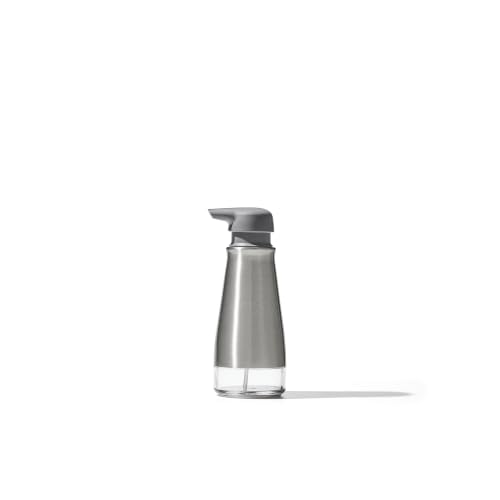
This is the one foaming dispenser in the guide, labelled plainly because it plays by different rules. A foaming pump does not dispense liquid soap; it dispenses a mixture of diluted soap and air, and it only works if the soap is diluted. OXO builds that fact into the hardware: the clear base section is the soap measure and the stainless body above it is the water section, and the maker’s own instructions are one part liquid soap to five parts water, filled to the MAX line in the clear window, then shaken to mix. Follow that ratio and each 500 ml fill contains only a small amount of actual soap, which is the entire economic point of the format — a bulk bottle of hand soap lasts far longer through a foaming pump. Ignore the ratio and the failures are predictable: undiluted soap will not foam and can clog the pump, and an over-soapy mix comes out as wet bubbles that collapse on contact. The dispenser itself shares the good bones of the liquid OXO above — large soft one-handed pump head, angled spout, non-slip base, fingerprint-resistant brushed steel — and the clear window doubles as the mixing gauge. Care is hand wash only, per the maker.
Specs
- Type: manual FOAMING pump dispenser — requires diluted soap or pre-made foaming soap; will not foam undiluted liquid soap
- Capacity: 500 ml total fill (about 16.9 fl oz), most of it water at the maker’s ratio
- Body material: brushed stainless steel with clear plastic base and fill window; PVC-free plastic, per the maker
- Pump: foaming pump mechanism with large soft pump head; angled spout; one-handed operation
- Mix ratio: 1 part liquid soap to 5 parts water, per the maker’s instructions; fill lines marked on the clear window
- Refill opening: pump head lifts off; MAX fill line in the clear window
- Pump replaceable: no — maker does not list a separate replacement pump for this model
- Base: non-slip
- Care: hand wash only; not dishwasher safe, per the maker
- Dimensions: 3.3 x 3.3 x 7.8 in, per the maker’s manual data
Notes That Apply to Every Pick
Recall check. Before finalising this list, the product class was checked against the CPSC SaferProducts.gov recall database. There are no recalls for soap dispensers in the database; the dispenser recalls on record concern water coolers and beverage dispensers, a different product entirely, and none of the five models or makers here appear in any recall record. The check is still worth doing for this category, because automatic dispensers put batteries and motors next to water — if a listing ever feels anonymous and specification-free, that is the one to skip.
Living with an automatic. Every sensor dispenser can fire when something other than a hand passes under the spout, and steam from a hot shower or a running dishwasher can trigger occasional unintended doses on sensitive models. Place automatics where the sensor’s view is clear of moving towels and passing traffic, and use the off switch — both automatic picks here have one — when cleaning around the sink.
Soap thickness is the hidden specification. Thick, lotion-heavy and exfoliating soaps clog pumps, manual and automatic alike; two makers above say so in their own documentation. If a pump slows down, the first fix is not a new dispenser — it is pumping warm water through the mechanism to clear it, which the OXO manuals describe and which works on most manual pumps in this guide.
Affiliate Disclosure
This article contains affiliate links. If you buy through a link on this page, we may earn a commission at no additional cost to you. This does not influence which products are included or how they are described; every dispenser above was selected on its capacity, pump construction and suitability for the sinks named in the title.
More from Amazon
Programs that pair well with the guide above. Offers and eligibility are set by Amazon and may change.
Free shipping on eligible items, Prime Video and more. Eligible new members can start with a free trial.
Start a Prime free trialA Prime membership for ages 18-24 with a trial period. Eligibility is set by Amazon.
See Prime for Young AdultsAudiobooks and podcasts to listen to on the go. Eligible new members can start with a free trial.
Try Audible freeAd-free music streaming. Eligible new subscribers can start with a free trial.
Try Music Unlimited freeAs an Amazon Associate we earn from qualifying purchases.










Write Your Review
No reviews yet. Be the first to share your experience!