

Key takeaways
- Five heeled weightlifting shoes compared on heel height, heel material, straps and sizing: Reebok, two adidas Powerlift models, Nordic Lifting and Inov-8.
As an Amazon Associate we earn from qualifying purchases.
Affiliate Disclosure: This article contains affiliate links. If you buy through a link on this page, we may earn a commission at no extra cost to you.
A weightlifting shoe is built around one idea: a rigid, raised heel on a flat, incompressible sole, so the foot sits on a stable wedge instead of a cushioned trainer. That wedge lets the knees travel further forward, which helps a lifter with limited ankle mobility reach squat depth with a more upright torso, and it gives the snatch and clean a planted base to pull from. The five shoes in this guide span the useful range of the class, from 15 mm heels aimed at general strength training to a 22 mm TPU heel built for the platform. Every shoe is pinned to one exact size and colour variant, because in this category each size and colourway is sold under its own listing code — the size stated in each Specs block is the size that code belongs to, and other sizes sit under their own separate codes.
How to Choose a Weightlifting Shoe
Heel height is the first decision. Most dedicated lifters sit between 15 mm and 22 mm of effective heel height (heel stack minus forefoot stack). A taller heel, around 20 to 22 mm, does the most for squat depth and for an upright torso in the bottom of a snatch or clean, and it is the standard shape for Olympic lifting. A lower heel, around 15 to 16 mm, feels less extreme, transfers more easily from ordinary gym shoes, and suits lifters who mostly squat and press. Neither is better in the abstract: the taller heel helps most when ankle mobility is the thing limiting your squat, and helps least when it is not.
The trade-off is the deadlift. A raised heel pitches the body slightly forward and lengthens the pull, which is exactly what a deadlift does not need. Heeled lifters are a poor deadlift shoe, and that applies to every model in this guide: pull in flat shoes, deadlift slippers or socks, and keep the lifters for squats and the Olympic lifts. A shoe that claims to do both jobs well is compromising on one of them.
Heel material decides how the shoe ages. TPU heels are rigid and stay rigid; they are the standard on competition-style shoes. High-density EVA wedges are lighter and cheaper to make, and a good one feels firm on day one, but EVA can compress gradually over years of heavy use in a way TPU does not. Wood heels, the classic construction, are rare in current listings. Whichever material you choose, the sole itself should be flat and effectively incompressible — if you can twist or squash the midsole in your hands, it is a trainer, not a lifter.
Straps lock the midfoot. Almost every lifter pairs laces with at least one hook-and-loop metatarsal strap, and the strap is not decoration: under a heavy clean the foot wants to slide forward inside the shoe, and the strap is what stops it. Two straps hold harder than one, and one wide strap holds better than a narrow one. A few models add their own twist, such as the inflatable tongue on the Reebok below.
Sizing runs differently across brands. Adidas lifters are known for a narrow, snug last; Reebok’s lifting line runs wider; Nordic Lifting and Inov-8 sit between. There is no honest conversion rule beyond checking the maker’s own size chart for the exact model, and ordering with a return route if you are between sizes. A lifting shoe should fit close — heel locked, toes able to spread but not slide — because internal movement is lost stability.
Be clear about what the shoe does. A lifter stabilises the platform you lift from: it removes the wobble of a cushioned sole and changes the geometry of the squat. It does not add strength, it does not fix technique by itself, and no shoe in this guide is claimed to prevent injury. It is a tool with a specific mechanical effect, and it earns its place in a gym bag on that basis alone.
The 5 Best Weightlifting Shoes
1. Reebok Legacy Lifter III (Women’s)

The full-height Olympic pick. The Legacy Lifter III carries a 22 mm (0.87 in) TPU heel clip, the joint-tallest effective heel in this guide, in the rigid material that does not soften with use. The upper is a woven textile with an inflatable Pump tongue that fills the midfoot space, and the closure combines laces with one wide midfoot strap, so the foot is held from three directions at once. The rubber outsole is flat and textured for platform grip. This is the shoe here aimed squarely at snatch and clean work and deep squats, and the one whose heel height a deadlift wants least. The variant pinned below is the White/Pure Grey/Reebok Lee colourway in a US women’s 9; other sizes and colourways are listed under their own codes.
Specs
- Effective heel height: 22 mm (0.87 in)
- Heel material: TPU heel clip
- Upper material: Woven textile with Pump inflatable tongue
- Strap configuration: Laces plus one wide midfoot hook-and-loop strap
- Sole type: Flat rubber outsole
- Pinned variant: US women’s 9, White/Pure Grey/Reebok Lee (other sizes sit under their own ASINs)
2. adidas Powerlift 5
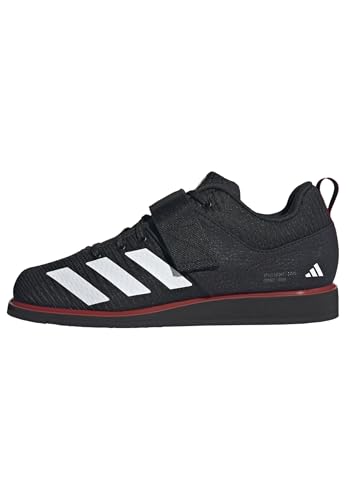
The current-generation entry point to the class. Adidas lists the Powerlift 5 with a 16 mm effective heel height (a 34 mm heel stack over an 18 mm forefoot), built as a high-density EVA midsole wedge rather than a TPU heel. The upper is canvas with open-mesh inserts, which makes it the most breathable shoe here and also the least armoured; the closure is laces plus a single wide hook-and-loop strap, and the outsole is flat rubber. At 16 mm the heel sits at the gentle end of the class: enough to change squat geometry for a lifter coming from flat trainers, not so much that it feels like a specialist tool. The variant pinned below is the Black/White/Pure Ruby colourway in the listing’s US size 5; other sizes sit under their own codes.
Specs
- Effective heel height: 16 mm (34 mm heel stack, 18 mm forefoot, as listed by adidas)
- Heel material: High-density EVA midsole wedge
- Upper material: Canvas with open-mesh inserts
- Strap configuration: Laces plus one wide hook-and-loop midfoot strap
- Sole type: Flat rubber outsole
- Pinned variant: US size 5 (unisex listing), Black/White/Pure Ruby (other sizes sit under their own ASINs)
3. Nordic Lifting MEGIN

The tallest stance in this guide. The MEGIN’s listing data states a platform height of 1.4 inches, built on a hard EVA heel wedge, which puts it above even the 22 mm competition shoes in raw elevation — a shape aimed at lifters who want maximum help reaching depth. The upper combines mesh with polyurethane overlays, the closure is lace-up with a hook-and-loop strap over the midfoot, and the sole is EVA with a flat profile. Two honest qualifications: an EVA wedge at this height is doing more work than the lower EVA heels here, so long-term compression is a fair thing to watch for, and a heel this tall is the furthest of the five from anything you would deadlift in. The variant pinned below is Black in a US men’s 7 (listed as a women’s 8.5 equivalent); other sizes sit under their own codes.
Specs
- Heel height: 1.4 in platform height, as stated in the listing data
- Heel material: Hard EVA wedge
- Upper material: Mesh with polyurethane overlays
- Strap configuration: Lace-up plus hook-and-loop midfoot strap
- Sole type: Flat EVA sole
- Pinned variant: US men’s 7 / women’s 8.5, Black (other sizes sit under their own ASINs)
4. Inov-8 Fastlift 335 (Women’s)

The light, flexible-forefoot option. The Fastlift 335 has a 16.5 mm heel drop built on Inov-8’s Power-Truss heel system, a TPU structure that keeps the heel rigid while the forefoot stays flexible enough to move between lifts and conditioning work without changing shoes. At about 335 g per shoe it is the lightest model here by a clear margin. The upper is synthetic with mesh, the closure is laces plus a single metatarsal strap, and the outsole is rubber. One sourcing note: this is an older model that has been out of the current range for some years, so remaining stock is scattered across sizes — the variant pinned below is the Pink/Purple/Blue colourway in a US women’s 9.5, and if your size is not among the remaining listings, the Powerlift 5 above is the closest current alternative in shape.
Specs
- Effective heel height: 16.5 mm drop
- Heel material: TPU (Power-Truss heel system)
- Upper material: Synthetic with mesh
- Strap configuration: Laces plus one metatarsal hook-and-loop strap
- Sole type: Rubber outsole, flexible forefoot
- Pinned variant: US women’s 9.5, Pink/Purple/Blue (other sizes sit under their own ASINs)
5. adidas Powerlift 3.1 (Men’s)

The earlier-generation value pick, still widely listed. The Powerlift 3.1 uses a 15 mm (0.6 in) effective heel in high-density EVA, the lowest heel in this guide, on a completely flat rubber outsole. The upper mixes lightweight leather with breathable mesh — a more substantial build than the canvas of the Powerlift 5 — and the closure is laces plus a single wide strap across the top of the tongue. As with the newer model, the honest limits are the EVA heel’s long-term compression compared with TPU and a heel height that general strength training will appreciate more than a competitive weightlifter will. The variant pinned below is the Utility Black/Black/White colourway in a US men’s 12; other sizes and colourways sit under their own codes.
Specs
- Effective heel height: 15 mm (0.6 in)
- Heel material: High-density EVA wedge
- Upper material: Lightweight leather and mesh
- Strap configuration: Laces plus one wide hook-and-loop strap
- Sole type: Flat rubber outsole
- Pinned variant: US men’s 12, Utility Black/Black/White (other sizes sit under their own ASINs)
Safety and Recall Check
Before publishing this guide, the US CPSC recall database at SaferProducts.gov was searched for this product class under “weightlifting shoe” and “lifting shoe”. No recalls were returned for weightlifting shoes or for any of the five models listed here; a broader search under “weightlifting” returned only unrelated barbell equipment from 2006, not footwear. That is a check of the recall database at the time of writing, not a guarantee. Whatever lifter you buy: inspect straps and stitching before heavy sessions, break in a new heel height with lighter squats before loading it fully, and retire a shoe whose wedge has visibly compressed unevenly or whose outsole has started to peel.
Which One Should You Buy?
Choose by heel height and heel material, not by brand. For Olympic lifting and the deepest squat assistance, the Reebok Legacy Lifter III pairs the joint-tallest heel here with a TPU build that will not soften, and the Nordic Lifting MEGIN stands taller still if maximum elevation is the whole point. For a first lifter or a general strength program, the two adidas Powerlift models are the measured choice — the Powerlift 5 if you want the current model and a breathable canvas upper, the Powerlift 3.1 if you prefer the leather-and-mesh build and the lowest heel. The Inov-8 Fastlift 335 is the pick for mixed sessions where the shoe stays on between lifts, in the sizes that remain. And whichever pair you buy, leave them in the bag for deadlifts: every heel in this guide works against that lift, and flat feet on the floor remain the right tool for it.
More from Amazon
Programs that pair well with the guide above. Offers and eligibility are set by Amazon and may change.
Free shipping on eligible items, Prime Video and more. Eligible new members can start with a free trial.
Start a Prime free trialA Prime membership for ages 18-24 with a trial period. Eligibility is set by Amazon.
See Prime for Young AdultsAudiobooks and podcasts to listen to on the go. Eligible new members can start with a free trial.
Try Audible freeAd-free music streaming. Eligible new subscribers can start with a free trial.
Try Music Unlimited freeAs an Amazon Associate we earn from qualifying purchases.







Write Your Review
No reviews yet. Be the first to share your experience!