

Key takeaways
- Five Pilates rings compared on diameter, core material and handle pads: studio plastic, fiberglass and steel magic circles for home mat workouts.
As an Amazon Associate we earn from qualifying purchases.
A Pilates ring — also sold as a magic circle or fitness circle — is a flexible band formed into a hoop, with padded grips on opposite sides. You squeeze it between your hands, between your ankles or knees, or between a limb and the floor, and the band’s spring tension pushes back. Joseph Pilates built the original from the steel hoop of a beer keg, and the modern versions keep the same simple job: they add resistance and feedback to mat exercises that would otherwise rely on body weight alone, and they give the inner thighs, arms, chest and pelvic floor something definite to work against.
What actually differs between rings is a short list: the diameter, what the core band is made of, how the handles are padded, and what else comes in the box. The five picks below cover the main builds on the market — a studio plastic ring, a fiberglass home ring, two steel rings at opposite ends of the resistance range, and a lightweight 15-inch option — and every Specs block pins the diameter, core material where the maker publishes it, pad design and contents, because those are the details listings most often blur.
Affiliate Disclosure
This article contains affiliate links. If you buy a product through one of these links, we may earn a commission at no additional cost to you. Product selections are based on published specifications and manufacturer information.
How to Choose a Pilates Ring
Diameter is a fit decision. Most rings are 14 or 15 inches across. The 14-inch size is the traditional studio standard and suits most adults for inner-thigh, arm and chest work. A 15-inch ring gives taller users and wider stances a little more room, and it changes the geometry of leg work slightly because the knees sit further apart. Smaller 12-inch rings exist for smaller frames and for arm and pelvic-floor work close to the body. None of these sizes is stronger than another by itself — diameter sets the fit, while the core sets the resistance.
Core material shapes how the squeeze feels. Fiberglass bands flex with a progressive curve: the further you compress them, the more they push back, which many instructors prefer for controlled work. Plastic cores with a rubberised shell, the Balanced Body pattern, feel smooth and forgiving and are built to survive studio handling. Steel cores span the widest range of all — a heavy-gauge steel ring is the firmest option here, while a light steel cord ring can be the gentlest — so the material name alone does not tell you the resistance. Construction quality matters more than the label: a well-made ring returns to round after every squeeze, and one that stays slightly oval has reached the end of its life.
Handles decide comfort and exercise range. Look for pads on both the inside and the outside of the ring. Inside pads are what your palms or inner knees press; outside pads matter just as much, because outer-thigh and arm exercises press the ring against the outside of the leg or the back of the arm. Rings with padding on only one face limit half of that repertoire or make it uncomfortable. Foam pads are the soft option; molded, nonporous grips wipe clean and suit shared or studio use.
Resistance is spring tension, not a calibrated weight. There is no industry standard for measuring a ring’s resistance, and most makers publish no force figure at all — they describe the feel as light, medium or firm. One pick below, the ProBody, is a partial exception: its listing states a figure of roughly 30 pounds of resistance, and that is the maker’s own number, quoted as such. Treat every such figure as a rough guide within one brand, never as a scale you can compare across brands. A ring adds resistance and feedback to an exercise; it does not tone a muscle group by itself, and results come from the programme you use it in. Nothing in this guide is a therapy or rehabilitation claim — rings are exercise equipment, whatever setting they are used in.
Check the contents line. Some rings ship alone. Others add a carry pouch or a printed exercise guide, which is genuinely useful if the ring is your first piece of Pilates equipment and you have no routine to follow. Every Specs block below states the contents exactly as the maker lists them.
The Five Picks
1. Balanced Body Ultra-Fit Circle — the Studio Standard

Balanced Body supplies Pilates studios worldwide, and the Ultra-Fit Circle is its flagship ring: a 15-inch flexible plastic band in a rubberised shell, with padded handles on both the inside and the outside of the ring. The dual padding is the point of the design — it keeps the full exercise repertoire open, from inner-thigh squeezes to outer-leg presses, without a hard edge against the limb. Balanced Body positions the resistance in the middle of the range, and the 15-inch diameter gives the ring a roomy feel that taller users and reformer users tend to prefer. There are no extras in the box; this is a ring-only purchase aimed at people who already have a routine, and the build reflects studio expectations rather than home-bundle thinking.
Specs
- Diameter: 15 in (38 cm)
- Core material: Flexible plastic with rubberised shell
- Handles: Padded handles on inside and outside
- Weight: Approx. 1.5 lb
- Maker part number: 14607
- Contents: Ring only
2. ProBody Pilates Circle — the Fiberglass All-Rounder
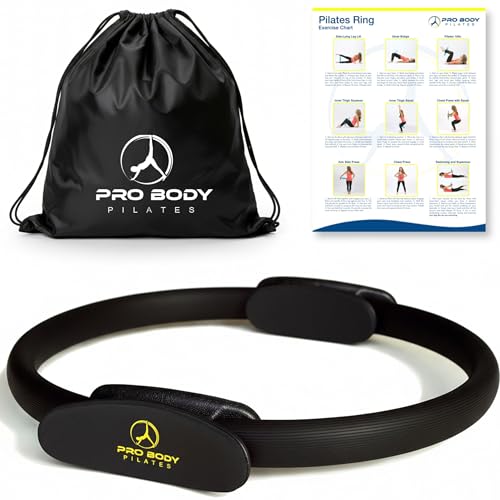
ProBody’s ring is the home-market favourite in this category: a 14-inch band with a genuine fiberglass core under a protective laminate and foam cover, and foam grips on both faces of the ring. The fiberglass build gives it the progressive flex described above — a squeeze that builds smoothly instead of snapping back — and ProBody’s listing rates the resistance at roughly 30 pounds, the only published force figure among these five picks; treat it as the maker’s own guide to a medium-firm feel, not a measurement you can hold other brands to. Unusually for the category, the box contents go beyond the ring: a carry pouch and a workout guide are included, which makes this the easiest pick to start with if you are building a home routine from nothing.
Specs
- Diameter: 14 in
- Core material: Fiberglass with plastic laminate and foam cover
- Handles: Dual foam grips, pads on both faces
- Resistance: Maker-stated approx. 30 lb
- Weight: Under 1 lb
- Contents: Ring, carry pouch, workout guide
3. AeroPilates Magic Circle — the Heavy Steel Option

Stamina’s AeroPilates ring is the substantial one here: a steel core ring under a rubber cover, measuring 14.75 inches across and weighing about 2 pounds — noticeably heavier in the hand than the fiberglass and plastic rings. The grips are form-molded foam with a nonporous molded padding that resists moisture, so the contact surfaces wipe clean rather than absorbing sweat, a design carried over from its intended double life on the mat and alongside AeroPilates reformers. The steel build and the weight give the squeeze a firm, deliberate feel, and this is the pick for users who found lighter rings too easy to overpower. It ships as a ring only, with a 90-day parts warranty from Stamina.
Specs
- Diameter: 14.75 in
- Core material: Steel with rubber cover
- Handles: Form-molded foam grips, nonporous molded padding
- Weight: Approx. 2 lb
- Maker model: 05-0020B (Stamina)
- Contents: Ring only; 90-day parts warranty
4. ProsourceFit Pilates Resistance Ring — the Gentle Steel Option
ProsourceFit’s ring shows why core material is not a resistance rating: it is also steel — a steel band in a durable rubber cover — but the maker describes its resistance as gentle, and at about 12 ounces it is one of the lightest rings here. The 14-inch diameter is the standard size, and the foam handles are padded on both sides, so the ring works for outer-leg and arm positions as well as the usual inner-thigh squeezes. That combination — standard size, dual pads, light tension — makes it the natural starting ring for beginners, for older users, and for anyone returning to exercise who wants feedback from the ring without fighting it. It is sold as a single ring with no bag or guide.
Specs
- Diameter: 14 in
- Core material: Steel with durable rubber cover
- Handles: Foam handles padded on both sides
- Resistance: Gentle (maker description)
- Weight: Approx. 12 oz (340 g)
- Maker model: ps-2303-pr-black
- Contents: 1 ring
5. Gaiam Pilates Ring — the Lightweight 15-Inch Option

Gaiam’s ring takes the 15-inch diameter of the Balanced Body and pairs it with a much lighter build: the ring weighs about 15 ounces, with foam padded handles that have a non-slip texture. For home users who want the roomier diameter — for wider leg work and for pressing the ring between the hands at full arm extension — without the studio ring’s heft or the steel rings’ firmness, this is the straightforward option. Gaiam does not publish a core material or a force figure for this model in its listing data, so the Specs block says exactly that rather than filling the gap; the resistance sits in the light-to-medium band typical of the brand’s home range. The listing’s included components are the ring alone, and Gaiam supports the line with exercise material through its own channels.
Specs
- Diameter: 15 in
- Core material: Not published by the maker
- Handles: Foam padded, non-slip
- Weight: Approx. 15 oz (431 g)
- Maker model: 05-63872
- Contents: Ring only
Safety and Recall Check
Before publication, this product class was checked against the U.S. Consumer Product Safety Commission recall database (SaferProducts.gov). Searches for Pilates rings, magic circles and fitness circles returned no recalls, and none of the five products above is subject to a CPSC recall. The only Pilates-related record the search surfaces is a 2006 recall of inflatable Pilates exercise balls from a different maker — a different product entirely, included here only so the check is reported in full.
Two habits keep a ring in service. Inspect the band before sessions: cracks in the cover, a ring that no longer returns to round, or pads splitting away from the band are all retire-it signals, because a band that fails mid-squeeze fails suddenly. And keep the ring on the floor or against the body as designed — it is a squeeze tool, not a support: never stand on it or put body weight through it.
Which Ring Fits Your Practice
Match the ring to the work. If you train in a studio style and want the reference build, the Balanced Body’s dual-padded 15-inch ring is the safe default. If you are starting at home and want a guide in the box, the ProBody pairs its fiberglass flex with the pouch and workout sheet. Strong users who overpower light rings should look at the AeroPilates and its steel build, while beginners and gentler programmes are better served by the ProsourceFit’s light tension. The Gaiam splits the difference for anyone who wants the larger diameter in the lightest package. Whichever you choose, start with the diameter that fits your frame, squeeze with control rather than force, and let the programme — not the ring — do the progressing.
More from Amazon
Programs that pair well with the guide above. Offers and eligibility are set by Amazon and may change.
Free shipping on eligible items, Prime Video and more. Eligible new members can start with a free trial.
Start a Prime free trialA Prime membership for ages 18-24 with a trial period. Eligibility is set by Amazon.
See Prime for Young AdultsAudiobooks and podcasts to listen to on the go. Eligible new members can start with a free trial.
Try Audible freeAd-free music streaming. Eligible new subscribers can start with a free trial.
Try Music Unlimited freeAs an Amazon Associate we earn from qualifying purchases.










Write Your Review
No reviews yet. Be the first to share your experience!