

Key takeaways
- Five neck harnesses for plate-loaded neck training compared: chain and strap designs, padding, fit systems and maker load figures, with safe-start tips.
As an Amazon Associate we earn from qualifying purchases.
A neck harness is the simplest tool for loading the neck directly: a padded strap assembly that sits on your head, with a chain or tether hanging from the sides so a weight plate can pull against your neck muscles as you nod, tilt or turn against it. Wrestlers, fighters, racing drivers and lifters use them to train neck flexion (nodding forward), extension (looking up against load) and, on multi-clip designs, lateral flexion and rotation. The five harnesses below cover the main ways the tool is built: classic plate-and-chain straps, a long-chain multi-ring design, a strap-and-tether harness with no chain at all, and a full kit that adds bands and a loading pin.
Affiliate Disclosure: This article contains affiliate links. If you buy through a link on this page, we may earn a commission at no extra cost to you.
Read This Before You Load Any Harness
Start far lighter than you think. The neck is not a limb. Its muscles are small, its joints and discs are not built like a knee or a shoulder, and its soft tissues adapt to load slowly. Begin with the empty harness to learn the fit, then the smallest plate you own, and add load in the smallest steps your plates allow over weeks, not days. Every harness below can physically hang far more weight than a beginner’s neck should ever be asked to move.
Smooth, controlled reps only. Flexion and extension work should be slow nods through a comfortable range, with the plate hanging still. Never jerk, bounce or swing a load from your head, and never let a hanging plate twist the harness mid-rep. If the load makes you brace, grimace or hold your breath to get through a rep, it is too heavy for this training.
Know the stop signals. Stop the set — and the session — on any sharp pain, dizziness, numbness or tingling in the arms or hands, or a headache that builds under load. Anyone with an existing neck condition, a history of disc problems, or recent neck injury should talk to a clinician before training with a harness at all.
Ignore the injury-prevention marketing. Sellers of neck gear routinely claim their products prevent concussions and injuries. No harness in this guide is credited with any such claim here, because a strap and a chain cannot be shown to do that. What a harness can do is let you strengthen neck muscles progressively and measurably. Buy it for that, train it conservatively, and treat any stronger promise as advertising.
Maker load figures are hardware figures. Where a maker publishes a capacity, it describes what the strap, chain and stitching are claimed to hold — not a recommended working load for a human neck. Working loads in sane neck training are a small fraction of these numbers.
How the Designs Differ
Chain vs strap. Most harnesses hang plates from a steel chain: simple, durable, and easy to thread through a plate’s centre hole, though a plate can settle unevenly across a chain link. Strap designs replace the chain with a nylon tether, which keeps plates centred and quiet, and multi-clip strap harnesses also accept resistance bands and cable handles for lateral and rotational work that a chain cannot easily provide.
Fit is the real specification. A harness that slips over your eyes or rides up your chin mid-set is worse than a cheaper one that stays put. Crown straps, chin straps and three-way adjustment matter more than padding thickness. All five picks below are strap-style harnesses — none is a rigid cap — and each Specs block states exactly how it adjusts.
The 5 Best Neck Harnesses
1. DMoose Neck Harness — Chain Design, Strap Style

The DMoose is the reference version of the classic design: heavy-duty nylon head and chin straps with 5 mm neoprene padding, steel D-rings, and a 30-inch steel chain that threads through a plate and clips back with the two included steel carabiners. The fit adjusts two ways through hook-and-loop straps, including a crown support strap that helps keep the harness from sliding forward during extension work. There is no loading pin — plates hang directly on the chain, which keeps the setup to three parts and nothing to lose in a gym bag. DMoose publishes a 300 lb capacity for the chain and strap assembly; read that as a hardware figure per the notes above, not a training target. If you want the straightforward plate-and-chain harness that most neck training advice assumes, this is it.
Specs
- Design: Chain suspension; strap-style harness with crown and chin straps
- Harness material: Heavy-duty nylon straps with 5 mm neoprene padding
- Chain: Steel, 30 in, with anti-rust steel D-rings
- Plate attachment: Plates thread directly onto the chain; 2 steel carabiners included; no loading pin
- Fit adjustment: One size; 2-way adjustable hook-and-loop head and chin straps
- Maker load figure: 300 lb (maker figure for the harness and chain assembly)
2. RDX H2 Neck Harness — Chain Design, Strap Style

The RDX H2 takes the same plate-and-chain idea and adds adjustment and reach. Its chain runs 90 cm — about 35 inches, the longest in this guide — which gives a taller stack of plates more room to hang clear of your knees in seated work. Four D-rings set at two heights let you change the pull angle without re-rigging, and the straps adjust in three places (top, back and chin), which makes this the easiest chain harness here to fit on a smaller or larger head. Padding is 4 mm neoprene under an industrial-grade nylon shell, with reinforced cross stitching. RDX does not publish a load figure in the listing data, so the Specs block says so rather than borrowing one from elsewhere.
Specs
- Design: Chain suspension; strap-style harness
- Harness material: Industrial-grade nylon shell with 4 mm neoprene padding
- Chain: Steel, 90 cm (about 35 in)
- Plate attachment: Chain clips between 4 D-rings at two heights; 2 carabiners included; no loading pin
- Fit adjustment: 3-way adjustable straps (top, back and chin), hook-and-loop
- Maker load figure: Not published in the listing data
3. Iron Neck Alpha Harness — Strap Design, Strap Style
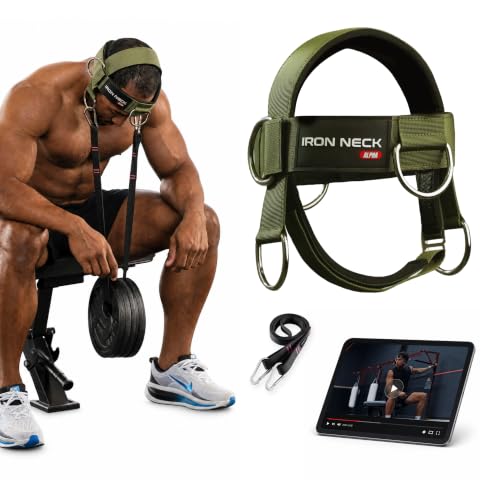
The Alpha is the different tool in this guide: there is no chain. A neoprene-padded nylon harness carries four side clips and two hanging clips, and plates hang from a 43-inch nylon tether with the two included carabiners, so the load stays centred instead of settling across a chain link. The side clips are the real point — clip a resistance band or a cable handle to the front, back or either side and the same harness trains lateral flexion and rotation, directions a hanging chain handles poorly. Fit comes from an adjustable head strap and chin strap with a quick-fastening closure. Iron Neck publishes no load capacity for the Alpha, and the Specs block records that plainly; this is a harness for moderate plate loads and band work, not for chasing the heaviest stack.
Specs
- Design: Strap (tether) suspension, no chain; strap-style harness
- Harness material: Neoprene-nylon with neoprene padding; metal D-rings and clips
- Suspension: Nylon tether, 43 in
- Plate attachment: Plates hang from the tether; 4 side clips and 2 hanging clips; 2 carabiners included; no loading pin; also accepts resistance bands and cable handles
- Fit adjustment: Adjustable head strap and chin strap; one size fits most
- Maker load figure: Not published by the maker
4. GABANTT Neck Trainer Kit — Chain and Band Kit, Strap Style

The GABANTT is sold as a complete kit rather than a bare harness. The neoprene-and-nylon harness has rings on every side — front, back and both flanks — for four-way training, and the box adds a steel chain, two resistance bands and a loading pin. The pin is the thoughtful part: plates stack on the pin below the chain instead of threading onto the chain itself, so the load hangs centred and swings less. The bands give beginners a gentler starting resistance than the smallest plate, which suits the conservative progression this training demands. Fit is one size with hook-and-loop head and chin straps. No load figure is published in the listing data.
Specs
- Design: Chain suspension plus resistance bands; strap-style harness, sold as a kit
- Harness material: Neoprene and nylon; 0.4 in listed thickness
- Chain: Steel chain included; length not stated in the listing data
- Plate attachment: Loading pin included (plates stack on the pin below the chain); rings on front, back and both sides; 2 resistance bands included
- Fit adjustment: One size; adjustable hook-and-loop head and chin straps
- Maker load figure: Not published in the listing data
5. WKWE Neck Harness — Chain Design, Strap Style

The WKWE covers the classic recipe with two small differences. Its closure is a buckle rather than the hook-and-loop used by the other chain harnesses here, which some users find stays set more consistently once adjusted. The 30-inch steel chain hangs plates in the usual way with the two included carabiners, and a nylon tether is included as an alternative suspension. The harness body is neoprene and nylon in a single uniform size. WKWE’s listing states a capacity of up to 280 lb — again a hardware figure for the assembly, and far beyond any load this guide would suggest putting on a neck.
Specs
- Design: Chain suspension; strap-style harness
- Harness material: Neoprene and nylon
- Chain: Steel, 30 in; nylon tether also included
- Plate attachment: Plates hang from the chain; 2 carabiners included; no loading pin
- Fit adjustment: Uniform size; adjustable with buckle closure
- Maker load figure: Up to 280 lb (maker figure for the harness and chain assembly)
Which Harness Fits Your Training
For simple flexion and extension work with plates, any of the three chain harnesses does the job: the DMoose for the standard recipe, the RDX H2 if fit adjustment or a longer chain matters, the WKWE if you prefer a buckle closure. Choose the Iron Neck Alpha if lateral and rotational work with bands or cables is the point of your training, and the GABANTT kit if you want bands and a loading pin in the same box as a first purchase. Whichever you pick, the progression rule is identical: empty harness first, smallest plate second, and patience after that.
Before publication, every pick in this guide was checked against the U.S. Consumer Product Safety Commission recall database (SaferProducts.gov) using product-name searches for “neck harness,” “head harness” and “neck trainer.” All three searches returned no records, and none of the five products above, nor their makers’ harness lines, appears in a CPSC recall.
More from Amazon
Programs that pair well with the guide above. Offers and eligibility are set by Amazon and may change.
Free shipping on eligible items, Prime Video and more. Eligible new members can start with a free trial.
Start a Prime free trialA Prime membership for ages 18-24 with a trial period. Eligibility is set by Amazon.
See Prime for Young AdultsAudiobooks and podcasts to listen to on the go. Eligible new members can start with a free trial.
Try Audible freeAd-free music streaming. Eligible new subscribers can start with a free trial.
Try Music Unlimited freeAs an Amazon Associate we earn from qualifying purchases.










Write Your Review
No reviews yet. Be the first to share your experience!