

Key takeaways
- The best pull-up bars compared by mount type — doorway leverage, screw-in, wall and ceiling — with fit ranges, grip layouts and honest capacity notes.
As an Amazon Associate we earn from qualifying purchases.
A pull-up bar is the simplest strength tool you can own, but the bar itself is only half the product. The other half is the mount. How a bar attaches — hooked over door trim, screwed into a door jamb, lag-bolted to wall studs, or bolted to ceiling joists — decides how much load it can honestly carry, how much damage it can do to your home, and whether it stays put when a set gets hard. Two bars with the same headline capacity figure can behave completely differently in use, because a doorway leverage bar is only ever as strong as the trim it leans on, while a bolted bar is only as strong as the framing behind the drywall.
This guide compares five pull-up bars across the four mount types that matter for home training. Each pick is labelled with its mount type up front, and the buying guide at the end explains how to measure your doorway, studs, or joists before ordering, plus the safety checks that apply to every bar on this list.
Affiliate Disclosure: This article contains affiliate links. If you buy through a link on this page, we may earn a commission at no extra cost to you. Product details below come from manufacturer specifications.
The five picks at a glance
- Iron Gym Original — doorway leverage bar, no screws, three grip positions, the classic renter-friendly option.
- ProsourceFit Multi-Grip — doorway leverage bar with twelve cushioned grip positions and optional screw-in brackets in the box.
- Garren Fitness Maximiza — doorway screw-in telescoping bar, for frames where leverage bars cannot hook on.
- Ultimate Body Press Wall Mount Pull Up Bar — wall-mounted bar on 16-inch studs with four grip positions and extra wall clearance.
- Ultimate Body Press Ceiling Mount Pull Up Bar — ceiling-mounted 48-inch bar for garages and basements with exposed or finished joists.
1. Iron Gym Original — doorway leverage, no screws

The Iron Gym is the bar that defined the doorway category. It hooks over the top of a door frame and uses leverage: the bar sits in the opening on one side while a padded support rests against the trim on the other, so your body weight wedges it tighter rather than pulling it loose. There are no screws and no permanent fixings, and it lifts off in seconds for storage or for floor work such as push-ups, dips, and sit-ups.
Three grip positions — narrow, wide, and neutral — cover chin-ups, standard pull-ups, and parallel-grip work. All grips are foam over steel. The trade-offs are the ones shared by every leverage bar: it needs a compatible frame (24 to 32 inches wide with trim the support can bear against), it can scuff paint and compress soft trim over time, and the maker’s 300 lb figure assumes a sound frame and a static, controlled load. Treat it as a strict-pull-up tool, not a swinging or kipping station.
Specs
- Mount type: Doorway leverage (no screws)
- Stated user capacity: 300 lb (manufacturer figure; static load on a sound frame)
- Door fit: Doorways 24–32 in wide; trim up to 3.5 in wide
- Grip positions: 3 (narrow, wide, neutral)
- Grip surface: Foam over steel
- Construction: Heavy-duty steel
- Hardware: Safety bracket and assembly tools included
2. ProsourceFit Multi-Grip — doorway leverage, twelve grips
The ProsourceFit Multi-Grip follows the same leverage principle as the Iron Gym but stretches the concept: at 41.25 inches overall it is a longer bar, and it carries twelve cushioned grip positions, including wide, hammer, and close-grip angles that a three-position bar cannot offer. That variety is the reason to pick it — grip changes are the cheapest form of programming variety in bodyweight training.
It fits doorways from 24 to 36 inches wide, with molding up to 3.5 inches wide and wall thickness up to 6.25 inches, and two slip-on foam grips protect the frame at the outermost handles. Unusually for a leverage bar, ProsourceFit also includes J brackets in the box, so the same bar can be screwed into the doorway later if you settle on a permanent spot. The maker’s capacity figure is again 300 lb, with the same condition as every doorway bar here: a sturdy frame, a controlled pull, and no swinging.
Specs
- Mount type: Doorway leverage (no screws); optional screw-in J brackets included
- Stated user capacity: 300 lb (manufacturer figure; static load on a sound frame)
- Door fit: Doorways 24–36 in wide; molding up to 3.5 in wide; wall thickness up to 6.25 in
- Grip positions: 12 cushioned positions
- Overall length: 41.25 in
- Grip surface: Cushioned foam, plus 2 slip-on foam grips for the outer handles
- Construction: High-grade steel
3. Garren Fitness Maximiza — doorway screw-in

Some doorways simply cannot take a leverage bar: the trim is too flat, too ornate, or missing entirely. The Maximiza solves that by ignoring the trim altogether. It is a telescoping chrome steel bar that seats into mounting cups screwed directly into the wooden door jambs, and it adjusts to fit openings from 26 to 39 inches wide. Because nothing hooks over the molding, there is nothing pressing on your paintwork, and the bar can be moved between heights or doorways.
Three sets of mounts are included — two heavy-duty and one medium-duty — so one bar can serve up to three doorways. The maker states a 300 lb capacity with the heavy-duty mounts fitted, and that number, as with the screw-in design generally, depends on the screws biting into solid wood: this bar is for wooden frames only, never hollow or metal jambs, and never on friction alone. The honest cost of the design is a few small screw holes in the jamb, which is exactly the trade the leverage bars above are designed to avoid.
Specs
- Mount type: Doorway screw-in (telescoping bar in screwed door mounts)
- Stated user capacity: 300 lb (manufacturer figure, with heavy-duty mounts)
- Door fit: Adjustable width, 26–39 in; solid wood doorframes
- Mounts included: 3 sets (2 heavy-duty, 1 medium-duty)
- Grip positions: 1 straight bar
- Grip surface: Non-slip foam grips
- Construction: Chrome steel
4. Ultimate Body Press Wall Mount Pull Up Bar — wall-mounted
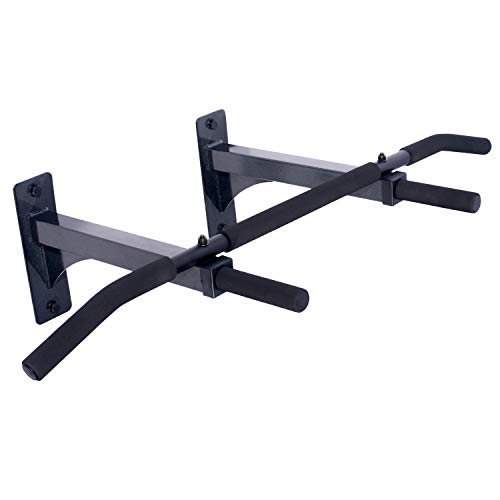
Bolting a bar to wall studs removes the doorway from the equation entirely. This Ultimate Body Press bar is machined so its mounting holes land exactly on studs spaced 16 inches on center, the standard framing pattern in most US homes, and it holds a 42-inch bar 14 inches out from the wall. That clearance is the headline feature: many wall bars sit so close to the wall that your forehead or knees brush it on every rep, while this one leaves room for a clean, full-range pull.
Four grip positions — spaced 10, 16, 24, and 36 inches apart — cover narrow, standard, wide, and parallel grips, with high-density foam over knurled steel. The parallel handles reach 21 inches from the wall. The listing’s maximum weight recommendation is 300 lb, and because the bar is a permanent fixture it doubles as an anchor for accessories such as ab straps or rings. The limits are placement and framing: it only fits 16-inch on-center studs, and a bolted bar is only as trustworthy as the studs and lag bolts behind it.
Specs
- Mount type: Wall-mounted (bolts to wall studs)
- Stated user capacity: 300 lb (manufacturer maximum weight recommendation)
- Stud fit: 16 in on-center mounting holes
- Bar width: 42 in
- Grip positions: 4 (spaced 10, 16, 24, 36 in apart)
- Clearance: 14 in from wall to bar; parallel grips extend 21 in from wall
- Grip surface: High-density foam over knurled steel
5. Ultimate Body Press Ceiling Mount Pull Up Bar — ceiling-mounted
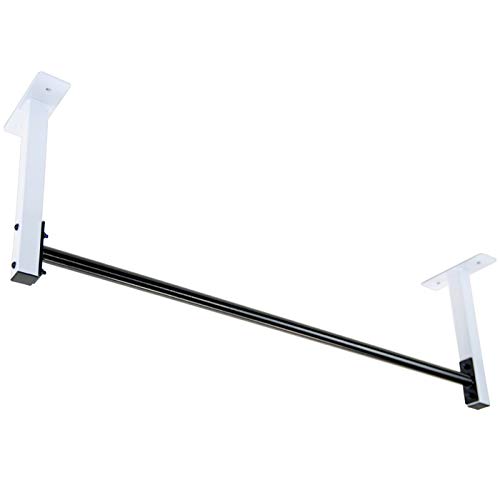
For a garage or basement, the ceiling is often the best mounting surface of all: it frees the walls, centres the bar in open space, and lets you hang with nothing to kick. This bar drops a straight 48-inch bar 14 inches below the ceiling on square-tube risers — a drop sized for standard 8-foot ceilings — and its 48-inch on-center mounting plates span three 16-inch joists or two 24-inch joists, so it fits typical residential framing in either direction.
The risers are through-bolted to the bar rather than only welded, which removes the rotational play that makes lesser ceiling bars feel loose. The 1.25-inch bar has a textured hammertone grip surface instead of foam, and the maker states a 450 lb capacity with complete mounting hardware included. That figure, like every capacity in this guide, is a manufacturer number that presumes correct installation into sound joists — ceiling drywall alone holds nothing, and finding the joists is the whole job.
Specs
- Mount type: Ceiling-mounted (bolts to ceiling joists)
- Stated user capacity: 450 lb (manufacturer figure, correctly installed into joists)
- Joist fit: 48 in on-center plates; spans three 16 in joists or two 24 in joists
- Bar: 48 in straight bar, 1.25 in diameter
- Drop: 14 in risers (sized for 8 ft ceilings)
- Grip surface: Textured hammertone steel (no foam)
- Construction: All steel with 5 mm plate mounts; through-bolted risers; mounting hardware included
How to choose: start with the mount, not the bar
Doorway leverage bars (Iron Gym, ProsourceFit) are the only zero-install option. They suit renters and anyone who wants the bar gone between sessions. Their limits are real: they need a frame 24–36 inches wide with trim the support can bear on, they mark soft paint and trim over time, and their hold depends on leverage, which means it depends on the frame.
Doorway screw-in bars (Garren Maximiza) trade a few screw holes for independence from trim shape. They are the fallback for flat, wide, or decorative molding, and for doorways at the wide end of the range.
Wall-mounted bars (Ultimate Body Press Wall Mount) are permanent, always ready, and double as accessory anchors. They need studs where you want the bar — measure your stud spacing first, because this pick fits 16-inch on-center framing only.
Ceiling-mounted bars (Ultimate Body Press Ceiling Mount) give the freest hang and suit garages and basements. Check your ceiling height against the riser drop: a 14-inch drop under an 8-foot ceiling puts the bar at a natural grabbing height for most adults, while taller ceilings may need longer risers than this model offers.
Whichever mount you choose, measure before ordering: doorway width and trim depth for doorway bars, stud spacing for wall bars, joist spacing and ceiling height for ceiling bars. A stud finder and a tape measure are part of this purchase.
Capacity figures, stated honestly
Every capacity in this guide is a manufacturer figure, and manufacturers do not test to one shared standard. A doorway bar’s number assumes a sound frame, correct seating, and a static load — a controlled dead-hang pull. Dynamic movement multiplies the force at the mount: kipping, swinging, and dropping into the bottom of a rep can load a bar well beyond your body weight. Weighted pull-ups add load the same way. Stay inside the stated figure with margin, and treat doorway leverage bars in particular as strict-movement equipment.
Safety checks that apply to every pick
- Inspect the mounting surface first. Door trim should be solid wood, firmly attached, and free of cracks or rot. Studs and joists must be located and confirmed, not guessed — a bolt that misses the framing holds nothing.
- Test before you commit. After installing or hanging any bar, load it gradually: hang with your feet still touching the floor, then with bent knees, before your first full rep.
- Re-check regularly. Leverage bars should be re-seated and checked every session. Screwed and bolted bars should have their fixings checked for loosening every few weeks.
- Start low. Keep your feet low and your reps strict while you learn a new bar’s behaviour. Never swing, kip, or hang upside down on a doorway bar.
- Mind the fall zone. Train over a clear floor, and never let children play on or hang from any bar unsupervised.
- Recall screening: before finalising this list, every pick was checked against the CPSC SaferProducts recall database by product and brand name. None of the five bars, and none of their model families, appears in any recall record. The only pull-up-related recall in the database covers a resistance-band pull-up assist accessory from another brand, a different product type entirely.
Bottom line
Renters and beginners should start with a leverage bar: the Iron Gym Original for a simple three-grip setup, or the ProsourceFit Multi-Grip if grip variety matters more than compactness. If your trim will not take a leverage bar, the Garren Fitness Maximiza moves the fixing into the jamb itself. Once you are ready to bolt something down permanently, the Ultimate Body Press wall bar suits a spare room with standard studs, and its ceiling-mounted sibling is the strongest, freest option here for a garage or basement — provided your joists and ceiling height match its plates and risers.
More from Amazon
Programs that pair well with the guide above. Offers and eligibility are set by Amazon and may change.
Free shipping on eligible items, Prime Video and more. Eligible new members can start with a free trial.
Start a Prime free trialA Prime membership for ages 18-24 with a trial period. Eligibility is set by Amazon.
See Prime for Young AdultsAudiobooks and podcasts to listen to on the go. Eligible new members can start with a free trial.
Try Audible freeAd-free music streaming. Eligible new subscribers can start with a free trial.
Try Music Unlimited freeAs an Amazon Associate we earn from qualifying purchases.










Write Your Review
No reviews yet. Be the first to share your experience!