

Key takeaways
- The best seed sprouters for fresh greens year round: an automatic electric model, stackable trays, a stainless steel kit and a mason jar lid set.
As an Amazon Associate we earn from qualifying purchases.
A seed sprouter does one simple job: it holds seed in a warm, damp, well-drained space while you rinse it with plain water until it germinates and grows into a sprout. There is no soil, no growing medium and no fertiliser involved. That is the line that separates a sprouter from the microgreen kits and hydroponic rigs it is often shelved next to — microgreens grow in a mat or medium and are cut above the root, while sprouts are eaten whole, root and all, after nothing more than soaking and rinsing. If a kit needs coco mats, nutrient solution or a grow light to work, it is not a sprouter.
The equipment itself is deliberately low-tech, and the honest truth is that the sprouter matters less than the routine. Sprouting safety is a rinsing discipline: seed sits warm and wet for days, which is exactly the environment bacteria enjoy, so the gear that works best is the gear that drains completely and makes twice-daily rinsing easy rather than awkward. Buy seed sold specifically for sprouting, not garden seed, rinse morning and evening, and let every rinse drain away fully. Yields are modest by design — about a tablespoon of seed per tray or jar is a normal load, and overloading is the fastest route to a slimy, failed batch.
This guide covers five sprouters across the three real formats: one automatic electric model that rinses for you, three stackable tray systems in plastic and stainless steel, and a mason jar lid kit for the smallest batches. Specs are maker figures unless a section says otherwise.
Affiliate Disclosure: This article contains affiliate links. If you buy through a link on this page, we may earn a commission at no extra cost to you.
1. Tribest Freshlife FL-3000 — Automatic Electric Sprouter

The Freshlife FL-3000 is the one pick here that removes the twice-daily rinse from your schedule. A small electric pump lifts water from the base reservoir and sprinkles it over the sprouting barrel in short cycles — roughly five minutes of watering followed by a longer rest, repeated around the clock. Seeds sit on a tray inside the barrel, excess water drains straight back down, and a fresh batch of alfalfa, broccoli or mung beans is ready in about five to eight days depending on the seed.
The trade-offs are real and worth stating. The unit takes up genuine counter space, it needs a power outlet, and “automatic” does not mean maintenance-free: the reservoir water is recirculated, so it should be changed daily to keep it fresh, and the pump and sprinkler head need periodic cleaning so they do not clog with seed hulls. One barrel is included and the system can be expanded with additional barrels stacked on the same base, up to three, which suits households that eat sprouts daily. For anyone who has killed a third jar of sprouts by forgetting the evening rinse, this is the fix.
Specs
- Type: Automatic / electric
- Barrels: 1 sprouter barrel included, expandable to 3 stacked barrels
- Watering: Automatic sprinkler, short spray cycles on a timer pattern
- Drainage: Sprinkler water drains back into the base reservoir
- Dimensions: 10 x 10 x 11 in
- Best use: Hands-off daily sprouting for regular sprout eaters
2. Kitchen Crop Deluxe Seed Sprouter (VKP1200) — Stackable Tray

The Kitchen Crop Deluxe is the classic stackable tray design, made in the USA by VKP Brands. Four round trays stack on a drain base, and watering happens from the top: you pour water into the irrigation lid and it filters down through each tray in turn, so one pour rinses the whole stack. The tray floors use a hydrophobic design that keeps water moving instead of letting seeds sit in a puddle, and keeps small seeds from washing into clumps while they germinate.
Four trays means four crops at once — alfalfa on one level, radish on another, a salad mix on a third — or a staggered rotation where a new tray is started every couple of days for a continuous supply. The stack can be extended with extra trays, up to ten per base, though taller stacks get awkward to rinse under a tap. A packet of organic alfalfa seed is included to start the first batch. Capacity per tray is small, as it should be: a tablespoon or so of seed per tray, spread thin.
Specs
- Type: Stackable tray
- Trays: 4 growing trays included, stackable up to 10 per base
- Tray size: 6 in diameter
- Material: Plastic, BPA-free as the maker states
- Drainage: Irrigation lid pours through the stack into a drain tray
- Included: Drain tray, irrigation lid, 1 oz organic alfalfa seed packet
- Footprint: About 6.1 in round
- Best use: Staggered, multi-variety batches for steady supply
3. SOLIGT Stackable Stainless Steel Seed Sprouting Kit — Stainless Tray
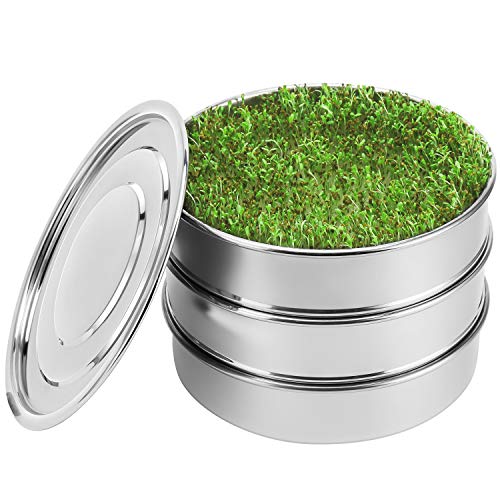
The SOLIGT kit answers the most common objection to tray sprouters: plastic. Its two sprouting trays, base and cover are 304 stainless steel, so nothing absorbs odours or stains, and the whole set can be scrubbed or run through a dishwasher between batches — a genuine hygiene advantage in a hobby where equipment hygiene is the whole game. The trays use a fine mesh floor rather than slots, which holds tiny seeds like alfalfa and broccoli that can slip through coarser tray designs.
Two 8-inch trays is a moderate capacity: enough for a household’s sandwich and salad sprouts, less than the four-tray stacks in this guide produce. In use it follows the standard tray routine — spread soaked seed thinly on the mesh, rinse under the tap twice a day, and let the mesh drain into the base tray before restacking. The cover keeps light off germinating seed for the first days. Steel costs more than plastic and shows water spots, but it is the buy-it-once option in this category.
Specs
- Type: Stackable tray
- Trays: 2 mesh sprouting trays, plus base tray and cover
- Tray diameter: 8 in
- Material: 304 stainless steel
- Drainage: Mesh tray floors drain into the solid base tray
- Best use: Plastic-free sprouting with easy sanitising between batches
4. Gardens Alive! Two-Tier Stackable Seed Sprouter — Compact Tray
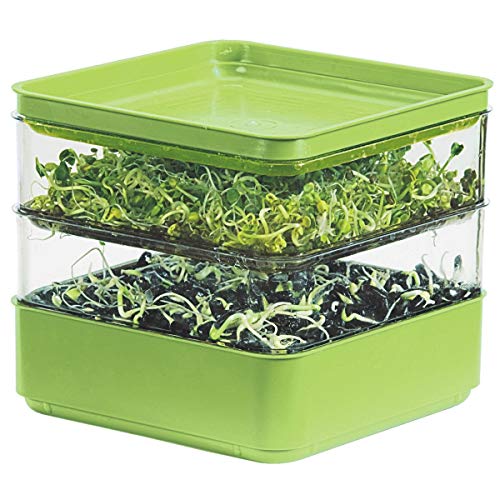
Gardens Alive! sells this two-tier sprouter as the small-counter answer to the bigger stacks. The footprint is roughly five and a half inches square, closer to a large mug than a kitchen appliance, and the two trays come with a lid that doubles as the watering top. It expands to four tiers with add-on trays if the habit sticks, but as sold it is sized for one or two people adding sprouts to meals rather than growing them as a staple.
The routine is the standard tray method: soak the seed, spread it on a tray, rinse twice daily and let the stack drain into its base. The small trays enforce the discipline that makes sprouting work — a tablespoon of seed per tray is a full load, and thin spreading is what keeps air moving between seeds. For a first sprouter, or for a cabin or small apartment kitchen where the four-tray towers are simply too much hardware, this is the sensible scale.
Specs
- Type: Stackable tray
- Tiers: 2 included, expandable to 4
- Material: BPA-free, food-grade plastic as the maker states
- Dimensions: 5.5 x 5.5 x 5.25 in
- Drainage: Trays drain down through the stack into the base
- Included: Lid / watering top
- Best use: Beginners and small counters, one- or two-person batches
5. Happyiren Sprouting Kit for Wide Mouth Mason Jars — Jar Lid Kit

The cheapest way into sprouting is a jar you already own, and this kit is just the part that makes a jar work: two one-piece sprouting lids with a built-in mesh screen and an integrated stand, sized for wide mouth mason jars. Fill the jar, screw on the lid, soak and drain through the mesh, then rest the jar upside down on the lid’s stand so water keeps draining and air keeps moving between rinses. No cheesecloth, no rubber bands, no improvised screens.
Two lids mean two jars in rotation — one batch growing while the next soaks — which is the natural rhythm of jar sprouting. Jars are the small-batch format: a quart jar handles a couple of tablespoons of seed at most, and leafy sprouts like alfalfa will fill the jar as they grow, which is part of the appeal. The limits are equally clear. There is no way to scale a jar beyond adding more jars, and the twice-daily rinse is entirely on you. As a first step before committing to a tray system, though, nothing else in this guide gets a first harvest of broccoli sprouts onto a sandwich for less effort or money — and if the habit fades, the lids take up a drawer corner instead of a shelf.
Specs
- Type: Jar sprouting kit (lids only, jars not included)
- Count: 2 sprouting lids
- Fit: Wide mouth mason jars, 3.38 in / 86 mm opening
- Material: BPA-free plastic as the maker states, one-piece lid with mesh screen
- Drainage: Built-in stand holds the jar inverted to drain through the mesh
- Best use: Small batches and first-time sprouters
How to Choose a Seed Sprouter
Start with the rinse, not the hardware. Every format in this guide grows the same sprouts; what differs is who does the rinsing and how completely the system drains afterwards. Sprouts that sit in standing water between rinses are the ones that turn slimy and sour, so drainage design — mesh floors, draining bases, inverted jar stands — is the real buying criterion, ahead of capacity claims.
Choose a jar kit if you want a small, occasional batch and the lowest possible commitment. Choose a stackable tray system if sprouts are a regular part of meals: trays scale by adding levels, let you run several varieties at once, and stagger start dates for a continuous harvest. Choose the automatic electric model if the twice-daily routine is the thing that has defeated you before — it trades counter space, a power outlet and daily reservoir changes for never missing a rinse.
Whichever format you pick, three habits decide whether it works. Buy seed labelled for sprouting, since it is sold for raw consumption and handled accordingly. Rinse twice a day, every day, and drain fully each time. And keep loads modest — about a tablespoon of seed per tray or jar — because crowded seed mats trap moisture and heat. Sprouting asks very little of its equipment; it asks almost everything of the routine around it.
More from Amazon
Programs that pair well with the guide above. Offers and eligibility are set by Amazon and may change.
Free shipping on eligible items, Prime Video and more. Eligible new members can start with a free trial.
Start a Prime free trialA Prime membership for ages 18-24 with a trial period. Eligibility is set by Amazon.
See Prime for Young AdultsAudiobooks and podcasts to listen to on the go. Eligible new members can start with a free trial.
Try Audible freeAd-free music streaming. Eligible new subscribers can start with a free trial.
Try Music Unlimited freeAs an Amazon Associate we earn from qualifying purchases.










Write Your Review
No reviews yet. Be the first to share your experience!