

Key takeaways
- Compare the best fishing retractors and zingers by cord material, cord length, retraction force and mount, from Kevlar tethers to magnetic releases.
As an Amazon Associate we earn from qualifying purchases.
A fishing retractor — called a zinger on a fly vest — is a small spring reel in a housing, with a cord that pays out when a tool is pulled and winds itself back when the tool is released. Its whole job is simple: a dropped tool lands back against the vest instead of in the river. Nippers, hemostats, forceps and small pliers are the tools that live on retractors, because they are the tools an angler reaches for most often with wet hands, mid-current, while holding a rod in the other hand.
The category looks uniform from a distance and is not. Cord material and cord length decide how a retractor behaves: a Kevlar cord, a polyester cord and a PVC-covered steel coil all extend and recover differently. Retraction force, stated in ounces, decides which tools the reel can actually lift — a reel rated under the weight of the tool sags, spools out and is worse than no retractor at all. The mount matters just as much: pin-on, carabiner, belt clip and snap hook each suit different vests and packs. The five products below were chosen to cover those differences honestly, from a US-made Kevlar tether to a magnetic net release that skips the spring reel entirely.
Affiliate Disclosure: This article contains affiliate links. If you buy through them, the site may earn a commission at no extra cost to you. Products were selected on specifications and stated features, not on commission.
1. Boomerang Tool Company Small Retractable Gear Tether

Boomerang Tool Company builds its tethers around three published numbers, and this Small model states all of them: a 24-inch cord made with DuPont Kevlar fiber, 4 ounces of retraction force, and a stainless steel spring inside a molded polycarbonate case. The Kevlar cord is the detail that separates this class of tether from badge-reel zingers — aramid fiber resists abrasion and fraying at the housing exit, which is where thin nylon cords on light zingers usually fail first.
The mount is a carabiner, so the tether moves between a vest D-ring, a pack loop and a belt loop without tools. At the working end, a universal wire end fitting holds the tool, and the fitting is a pinch-release quick-change design: squeeze it and the tool swaps off, which makes it practical to move one tether between nippers and forceps across a day. The listing for this ASIN is the green-cased variant of the Small tether; Boomerang’s fishing series uses the same mechanism in a black case. Four ounces of retraction is honestly a light-tool rating — nippers, hemostats and small forceps ride correctly, while full-size pliers will pull the cord out and keep it out.
Specs
- Cord: DuPont Kevlar fiber, 24 in reach
- Retraction force: 4 oz
- Case: Molded polycarbonate
- Spring: Stainless steel, weather resistant
- Mount: Carabiner
- End fitting: Universal wire fitting, pinch quick-change
- Model: 0TRG-211
- Weight: 0.1 lb
- Origin: Made in USA
2. SF Strongest Magnetic Net Release
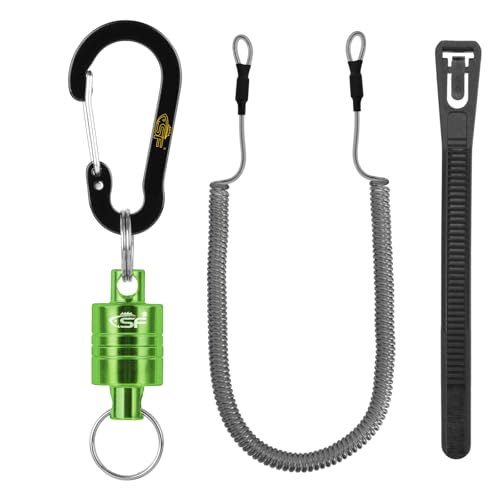
This SF product solves the net problem with a different mechanism, and it is worth being precise about that: there is no spring reel here. A landing net parks against a two-part magnetic dock made from aviation aluminum, measuring 3.5 × 1.5 × 1.5 cm. A firm pull separates the magnets and frees the net, and a coiled cord keeps the net attached while it is in use. The cord is steel wire covered in PVC, 45 cm long in its coiled state and extending to a maximum of 2.5 m, with the maker stating roughly 95 percent recovery back to its coiled length.
That design fits the net use case better than a zinger does. A net is pulled out a handful of times per outing and needs reach more than it needs retraction force, and a magnetic dock holds a net parked high on the back of a vest where a spring reel rated in ounces could never lift it. An aluminum alloy carabiner hook attaches the dock to a D-ring. The same setup works for heavy tools that stay parked — a priest or a large set of pliers — but for nippers that come out fifty times a day, a spring zinger below is the better tool. Colors run Black, Silver, Green and Gunmetal.
Specs
- Mechanism: Magnetic release dock with coiled safety cord (no spring reel)
- Magnet clip: Aviation aluminum, 3.5 × 1.5 × 1.5 cm
- Cord: PVC-covered steel wire coil, 45 cm coiled, extends to 2.5 m max
- Cord recovery: About 95 percent to coiled length (per maker)
- Attachment: Aluminum alloy carabiner hook
- Colors: Black, Silver, Green, Gunmetal
- Item weight: 0.05 kg
3. Booms Fishing FF2 Fly Fishing Accessories Kit

The FF2 is a four-piece fly fishing tool kit, and the honest reason it belongs in a retractor roundup is the pin-on zinger bundled inside it. The retractor’s specifications are published, which is not true of every kit zinger: 1.5 ounces (45 g) of retraction force on a 23-inch (60 cm) polyester cord, in a housing measuring 7.5 × 2.8 × 2 cm and weighing 22 g. That is a light rating, stated plainly — it suits the kit’s own tools and a set of nippers, and nothing heavier.
The rest of the kit is built to ride on that zinger. The stainless steel forceps are 5.5 inches long with a curved tip, the tie-fast combo tool covers knot tying, line cutting and hook-eye cleaning, and a leather-style leader straightener strips memory out of leaders and cleans fly line. The pin-on mount deserves its trade-off stated clearly: a pin is the most secure mount on soft vest fabric and the least kind to it, because a season of pinning and unpinning chews the fabric around the hole. Anglers who rotate between vests should note the zinger cannot move without leaving that mark. For a single dedicated vest, the FF2 covers the core streamside tools and their tether in one purchase.
Specs
- Zinger mount: Pin-on
- Retraction force: 1.5 oz (45 g)
- Cord: Polyester, 23 in (60 cm)
- Zinger size: 7.5 × 2.8 × 2 cm; weight 22 g
- Kit contents: Stainless steel forceps, tie-fast combo tool, pin-on retractor, leader straightener
- Forceps: Stainless steel, 5.5 in, curved tip
- Materials: Polyester, stainless steel
- Model: FF2
4. SF 2-in-1 Knot Tying Tool with Retractor

SF’s 2-in-1 takes the opposite approach to a separate zinger: the retractor is built into the tool’s carry system, so the knot tying tool itself lives on the vest. The tool is a stainless steel nail-knot tyer of the classic flat pattern, combining a knot tying channel with a line clipper, a hook sharpener and a jig eye cleaner — the four functions used when changing flies and rebuilding leaders on the water. The tool hangs from a D-ring on a polymer-housing zinger, which keeps it reachable and keeps it out of the river when it slips from cold fingers mid-knot.
The tool itself weighs about 1.2 ounces, light enough that a small zinger retracts it without sag, and the silver finish is uncoated stainless. Two limits should be understood before buying. First, the zinger is sized for this tool and tools like it — it is not a general-purpose tether for pliers. Second, a knot tool on a cord is a convenience for anglers who re-tie often; an angler who ties one nail knot per season is carrying the retractor for the clipper and sharpener, which is still a reasonable trade. Within its intended job — leader work at the vest — the combination is coherent, and every part of it is the tether system working as designed.
Specs
- Format: 2-in-1 knot tying tool with built-in zinger retractor
- Tool functions: Nail-knot tying, line clipping, hook sharpening, jig eye cleaning
- Tool material: Stainless steel
- Retractor housing: Polymer
- Attachment: D-ring between tool and retractor
- Tool weight: About 1.2 oz
- Color: Silver
- Brand: SF (Sunshine Outdoor)
5. Eupheng Fly Fishing Tools Kit

The Eupheng kit bundles four pieces — a knot tying tool, a tippet spool holder, a zinger retractor and a dry fly patch — as a starter vest setup. The zinger is the organizing piece: per the listing it attaches to a fly vest, jeans, a neck lanyard or a backpack, and it is meant to carry the kit’s knot tool and small accessories like nippers so they stay at hand and off the riverbed. The knot tool is a 4-in-1 design covering knot tying, line clipping, hook sharpening and hook eye cleaning.
The tippet holder is the other genuinely useful component: a black anodized aluminum T-holder on an elastic cord that carries from one to five tippet spools, with the dark finish chosen to keep glare down. One gap in this listing should be stated rather than smoothed over — the maker does not publish a cord length or a retraction force for the zinger, so there is no specification to check a heavier tool against. Treat it as a light-duty tether for the included tool and nippers, which is the load it was bundled for, and choose one of the rated tethers above if the tool to be carried is heavier than that.
Specs
- Kit contents: 4-in-1 knot tying tool, tippet spool holder, zinger retractor, dry fly patch
- Knot tool functions: Knot tying, line clipping, hook sharpening, hook eye cleaning
- Tippet holder: Black anodized aluminum T-holder, elastic cord, holds 1–5 spools
- Zinger attachment: Vest, jeans, neck lanyard or backpack (per listing)
- Zinger cord rating: Not published by the maker
- Brand: Eupheng
How to Choose a Fishing Retractor or Zinger
Match retraction force to the tool, not to hope. Retraction force is the weight the spring can lift back to the housing. Nippers and hemostats sit comfortably on 1.5 to 4 ounces. Small pliers need the upper end of that range or beyond, and a landing net defeats any light zinger outright — nets belong on a locking, high-force net retractor or on a magnetic release like the SF dock above. A tool that outweighs the rating does not break the retractor immediately; it spools the cord out, dangles, snags, and teaches the angler to stop using it.
Read the cord before the case. Kevlar and other aramid cords resist abrasion and hold high breaking strengths in thin diameters. Nylon and polyester cords are softer, quieter and common on light zingers, and they fray at the housing exit over time — inspect that point. Steel cable and PVC-covered steel coils shrug off abrasion and suit magnetic releases and heavy parked tools, at the cost of a stiffer, springier feel. Cord length between 23 and 36 inches covers vest work; longer cords reach further and tangle more.
Choose the mount for the garment. Pin-on mounts hold firmest on vest fabric and damage it slowly, one hole at a time. Carabiners need a D-ring, loop or tab but move between garments in seconds and leave nothing behind. Belt clips suit waders and belts. Snap hooks split the difference. Quick-release end fittings, like the pinch fitting on the Boomerang tether, matter if one retractor serves several tools.
Think about water. A stainless spring and a housing that can be rinsed are the baseline for saltwater use; some heavy-duty designs add a flushing path that clears sand from the mechanism when the cord cycles. Whatever the design, a freshwater rinse and a dry storage spot decide how many seasons the spring survives. A lock, where fitted, holds the cord at working length for tasks like streamside fly tying — a convenience feature, not a strength feature.
FAQ
Is a zinger different from a retractor?
No. Zinger is the name fly anglers gave the same spring-reel tether. Retractor is the general term across fishing, hunting and tool use. The mechanism — a spring, a cord and a housing — is identical, and the specifications that matter are the same.
How much retraction force do nippers and forceps need?
Most nippers and hemostats weigh well under 2 ounces, so a retractor rated at 1.5 to 4 ounces lifts them cleanly. The rating to check is against the heaviest tool the cord will carry, including anything clipped to the same ring.
Can a zinger hold a landing net?
A light zinger cannot, and hanging a net from one will strip the cord or tear the mount out of the vest. Nets need a locking net retractor rated around 12 ounces of force, or a magnetic release with a coiled safety cord, which holds the net parked and lets it go with a pull.
Do pin-on retractors damage a vest?
Slowly, yes. Each pin cycle works the same hole in the fabric, and over a season the area around it frays. A carabiner or clip mount avoids the damage entirely but needs a loop or D-ring to attach to.
Conclusion
The right retractor is the one whose published numbers match the tool it will carry. The Boomerang Small tether is the strongest all-round specification here — a Kevlar cord, a stated 4-ounce rating and a quick-change fitting in a US-made housing. The SF magnetic release is the correct answer for a landing net, a job no light zinger can do. The Booms FF2 and Eupheng kits suit anglers setting up a first vest, with the FF2’s zinger carrying a published rating and the Eupheng’s left unpublished, and the SF 2-in-1 folds the tether into the knot tool itself. Whichever design is chosen, the check is the same before the first trip: hang the intended tool on the cord, let go, and confirm the reel lifts it home. A retractor that passes that test keeps tools out of the river, which is the entire reason it exists.
More from Amazon
Programs that pair well with the guide above. Offers and eligibility are set by Amazon and may change.
Free shipping on eligible items, Prime Video and more. Eligible new members can start with a free trial.
Start a Prime free trialA Prime membership for ages 18-24 with a trial period. Eligibility is set by Amazon.
See Prime for Young AdultsAudiobooks and podcasts to listen to on the go. Eligible new members can start with a free trial.
Try Audible freeAd-free music streaming. Eligible new subscribers can start with a free trial.
Try Music Unlimited freeAs an Amazon Associate we earn from qualifying purchases.










Write Your Review
No reviews yet. Be the first to share your experience!