

Key takeaways
- Compare five fishing viewing cameras on screen size, cable reach, infrared lighting and cold-weather battery life for ice holes and boat decks.
As an Amazon Associate we earn from qualifying purchases.
An underwater camera does a job that sonar cannot. A flasher or fish finder tells you a fish is under the hole and roughly how it reacts; a camera shows you the fish itself — the species, the size, the exact moment it noses up to your jig and turns away. Watching a perch refuse a bait teaches you more about jigging cadence, bait size and color in one afternoon than a season of guessing from sonar marks. That is the right way to think about the five systems below: they are a complement to the sonar you already own, not a replacement for it.
The honest limit comes first. A camera sees only as far as the water lets it. In clear northern lakes that can be a satisfying distance; in stained, algae-heavy or silted water the view can shrink to almost nothing, while a flasher keeps working in total murk. Cameras earn their place in reasonably clear water, for checking structure, confirming what kind of fish a sonar mark really is, and learning how fish behave around a bait. If your home water looks like coffee, sonar stays your primary tool and a camera becomes an occasional luxury.
Affiliate Disclosure: This article contains affiliate links. If you buy through these links, we may earn a commission at no extra cost to you.
1. MarCum Recon 5 Underwater Viewing System
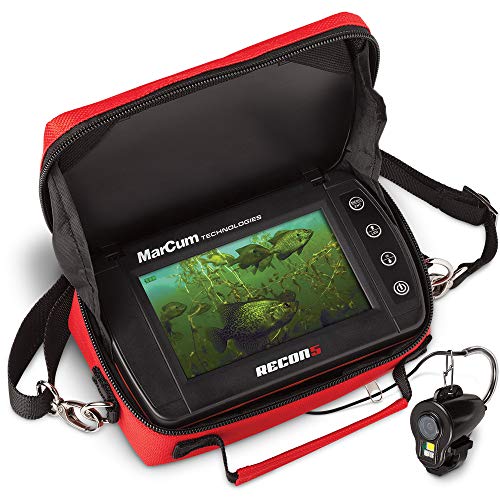
The Recon 5 is the pocket option from a brand that built its name on ice electronics. The whole system is built around a 5-inch high-resolution LCD in a hand-sized housing, with the camera and 50 feet of cable packing down small enough to ride in a coat pocket or a sled’s storage tub. For hole-hoppers who drill, check, and move, that compactness matters more than raw screen size.
MarCum’s lighting setup addresses the spooking question directly: the camera carries switchable dark-water lighting, so you can run infrared-style illumination that fish barely react to instead of blasting a white light into the hole. The lithium battery delivers up to about six hours of viewing, and lithium is the right chemistry for ice work because it holds its charge far better in deep cold than the sealed lead-acid packs older systems used.
The trade-offs are the small screen and the brand-name cost structure: two anglers crowding around a 5-inch display inside a shelter will wish for more screen, and there is no recording on this base model, so what you see is gone when you lift the camera. As a scouting tool that lives alongside a flasher, though, it is the most ice-focused design in this group.
Specs
- Display: 5-inch color LCD, 800 x 480 resolution
- Cable: 50 ft
- Camera: Color CMOS, wide viewing angle
- Lighting: Switchable infrared / dark-water LED lighting
- Battery: Internal rechargeable lithium-ion, up to 6 hours
- Weight: About 2 lb
2. Eyoyo Underwater Fishing Camera, 7-Inch 1000TVL Kit (EF07A)

Eyoyo’s long-running EF07A kit is the big-screen value formula: a 7-inch color TFT monitor with a flip-up sun visor, a 1000TVL camera, and a long 30-meter cable, all packed in a carry case with its own battery box. That screen size changes the experience — inside a shelter or on a boat deck, two people can actually watch together, and the sun visor genuinely helps when bright snow glare washes out cheaper displays.
Twelve infrared LEDs handle the low-light work, switching the picture to high-contrast monochrome when the water goes dark. Infrared is the right default for fishing: fish react far less to it than to white light, and in a dark shelter after sunset it extends your viewing well past what ambient light allows. The 4500 mAh battery is rated for six to eight hours, though expect the lower end of that range on the coldest days, when any battery gives back less than its label promises.
This base version is live-view only — there is no recording function, which keeps it simple and keeps the cost down, but anglers who want to study footage later should look at the DVR version below. The camera body is a straightforward bullet shape that drops through a standard ice hole without fuss.
Specs
- Display: 7-inch color TFT LCD with sun visor
- Camera: 1000TVL, 12 infrared LEDs
- Cable: 30 m (about 98 ft)
- Battery: 4500 mAh rechargeable pack, about 6–8 hours
- Waterproofing: IP68-rated camera
- Recording: Live viewing only
3. Eyoyo Underwater Fishing Camera, 7-Inch 1080P DVR (EF07RHB)

The EF07RHB is Eyoyo’s step-up kit, and the upgrades target exactly the two weaknesses of the base model: image sharpness and memory. The camera records in 1080P to the DVR function, so a refusal, a follow, or a full strike can be replayed at home — and replay is where the learning happens, because you can watch your jig cadence frame by frame against the fish’s reaction. The 7-inch IPS panel also holds its contrast at wider viewing angles than a basic TFT, which matters when the screen sits on a bucket between two chairs.
It keeps the formula that works: 12 infrared lights for dark water, an IP68 waterproof camera, a 30-meter cable, a sun visor, and a hard carrying case. Eyoyo also builds this version around a low-temperature battery design, a meaningful detail for ice use, since standard packs lose capacity fast once they sit on frozen ground all day. Keep the battery box inside the shelter or off the ice on a sled and you protect that runtime further.
Between this and the EF07A, the choice is simple: if you only want to look, the base kit does it; if you want footage to learn from, the DVR version is the one to buy.
Specs
- Display: 7-inch IPS LCD with sun visor
- Camera: 1080P, 12 infrared lights
- Cable: 30 m (about 98 ft)
- Recording: DVR video recording with playback
- Battery: Rechargeable pack with low-temperature design
- Waterproofing: IP68-rated camera
4. LUCKYLAKER Underwater Fishing Camera (FL180AR)

The LUCKYLAKER FL180AR takes the handheld route: the monitor, controls and battery live in a single walkie-talkie-style unit, with the camera dropping away on a 20-meter cable. It is the grab-and-go option — no separate battery box, no case full of parts — and that simplicity suits bank, dock and small-boat fishing as much as the ice.
Despite the compact form it records. The unit captures video and still photos to the included 16 GB card, with on-screen file browsing and playback, so it covers the learning loop that the cheapest live-only kits skip. Four infrared LEDs and a wide 120-degree viewing angle handle dark water; the field of view is genuinely useful at close range, which is where camera fishing happens — you are watching a jig and the fish around it, not scanning a basin.
Battery life is the honest weakness: roughly five to six hours from the built-in 4000 mAh pack, the shortest in this group, so it fits half-day trips and quick structure checks better than dawn-to-dark shelter sessions. The 4.3-inch screen is likewise a solo viewer. Within those limits, it packs an unusual amount of function into a unit that fits in one hand.
Specs
- Display: 4.3-inch LCD, 480 x 272 resolution
- Camera: 120-degree viewing angle, 4 infrared LEDs
- Cable: 20 m (about 65.6 ft)
- Recording: Video recording and photo capture, playback on unit, 16 GB card included
- Battery: Built-in 4000 mAh, about 5–6 hours
- Form factor: Handheld all-in-one monitor unit
5. FishPRO 4.3-Inch Underwater Fishing Camera by MOQCQGR

FishPRO is MOQCQGR’s camera line, and this 4.3-inch model is built around one idea: remove the learning curve. The controls are minimal, charging is modern USB-C, and the camera’s infrared lighting adjusts across three grades instead of a simple on-off, so you can dial illumination down to the lowest level that still shows your jig — the single best habit for not spooking light-shy fish like walleye and crappie.
A 4X digital zoom helps read details at the edge of the camera’s clear range, and the 65-foot cable is generous for a unit this small; at about a pound and a half, the whole kit disappears into a tackle bag. The 1000TVL camera resolution matches the bigger Eyoyo base kit, so the picture itself is not the compromise — the screen size is. Like the Recon 5 and the LUCKYLAKER, this is a personal viewer, best for one angler checking holes, docks and shallow structure.
For boat decks it earns a mention too: drop it beside the hull to confirm what the sonar is marking under the boat, or check a brush pile before you spend an hour casting to empty wood. Small, simple and quick to deploy is a real category of value, and this is its representative here.
Specs
- Display: 4.3-inch LCD
- Camera: 1000TVL
- Lighting: 3-grade adjustable infrared lighting
- Zoom: 4X digital zoom
- Cable: 65 ft
- Charging: USB-C; weight about 1.5 lb
How to Choose
Start with your water clarity. Cameras are close-range tools. In clear water you might see several feet; in stained water the practical range collapses, and no screen size or camera resolution fixes physics. If your lakes run dirty most of the season, buy sonar first and treat a camera as a secondary toy.
Match the screen to the setting. A 4.3- or 5-inch pocket unit is right for one mobile angler. A 7-inch screen is right for a shelter, a family, or a boat deck where the camera stays deployed. Daylight readability matters as much as size on bright ice — look for a sun visor or a high-brightness IPS panel, and shade the screen inside the shelter whenever you can.
Think about aim, not just view. A dropped camera points where the cable lets it, and twisting the cable from above is imprecise. Fins and ballast weights help hold a direction, and a camera panner — a small tripod positioner that sits over the hole and rotates the camera with a remote or by hand — is the real upgrade for systematically scanning around a hole. If you fish one hole for hours, budget for a panner; it turns a fixed view into a search tool.
Lighting discipline beats lighting power. Infrared first, white light last. Start with IR at its lowest setting, raise it only until the jig reads clearly, and remember that in shallow, clear water even IR and the camera body itself can put fish on edge. A camera that lets you dim its lights, like the FishPRO, respects that reality.
Cold eats batteries. Lithium packs handle cold best; whatever you buy, keep the battery warm — inside the shelter, inside a coat between holes — and treat rated runtimes as mild-weather numbers. A rated six hours can be four on a bitter day.
Decide whether recording matters. Live view answers “what is down there right now.” Recording answers “why did that fish refuse.” If you are buying a camera to get better at jigging, DVR is worth prioritizing; if you are buying it to check structure and species, live view is enough.
FAQ
Can an underwater camera replace my flasher or fish finder?
No. Sonar works in any clarity, at any depth, and reads the whole water column instantly. A camera only sees as far as the water is clear and only where it points. The strongest setup pairs them: sonar to find and follow fish, camera to identify them and refine your presentation.
How far can these cameras actually see?
In clear water, expect a useful view of several feet — enough to watch your jig and the fish around it. In stained or algae-filled water, visibility can fall to inches. Infrared lighting extends the range in darkness but cannot push through suspended silt or heavy stain.
Do the lights scare fish?
White light can, especially in shallow or clear water. Infrared is far less noticeable to fish, which is why every system here leads with IR. Use the lowest light level that gives a clear picture, and give fish a few minutes to settle after the camera first goes down.
Will the camera fit through my ice hole?
Yes — these camera heads are slim bullet or micro shapes designed for standard drilled holes, including the small holes most augers cut. The bigger consideration is the panner or tripod footprint on the ice surface, not the camera itself.
Is recording worth it?
If you fish to learn, yes. Reviewing footage of follows and refusals shows you exactly what your jig was doing when a fish committed or turned away — feedback no other tool gives you. If you only check spots occasionally, a live-view kit covers the job for less complexity.
Conclusion
Buy the camera that matches how you actually fish. Hole-hoppers should take the MarCum Recon 5 or the FishPRO 4.3 for their size and speed. Shelter and boat anglers who fish with company should take a 7-inch Eyoyo — the base EF07A for simple live viewing, the EF07RHB if recording and replay matter to you. The LUCKYLAKER FL180AR splits the difference as a handheld that still records. Whichever you choose, run it beside your sonar, keep the lights low, and let what you see change how you jig — that feedback loop is the entire reason these cameras exist.
More from Amazon
Programs that pair well with the guide above. Offers and eligibility are set by Amazon and may change.
Free shipping on eligible items, Prime Video and more. Eligible new members can start with a free trial.
Start a Prime free trialA Prime membership for ages 18-24 with a trial period. Eligibility is set by Amazon.
See Prime for Young AdultsAudiobooks and podcasts to listen to on the go. Eligible new members can start with a free trial.
Try Audible freeAd-free music streaming. Eligible new subscribers can start with a free trial.
Try Music Unlimited freeAs an Amazon Associate we earn from qualifying purchases.

Write Your Review
No reviews yet. Be the first to share your experience!