

Key takeaways
- Hard tubes and soft fishing rod cases compared for camping and travel, with honest notes on crush protection, airline limits and rod length fit.
As an Amazon Associate we earn from qualifying purchases.
Fishing rods rarely break on the water. They break in the truck bed when a cooler slides across the tips, in the garage when a ladder tips onto the blank, and in the back of a loaded car when a tent bag lands on the guides. The fragile parts of a rod — the last few inches of the tip and the small ceramic guide inserts — are exactly the parts that stick out, catch on things, and take the hit when gear shifts around them. A rod case exists to solve that transport problem, and it is worth being clear about which kind of case solves which part of it.
Hard tubes and soft cases do different jobs. A rigid tube surrounds the blank with a shell that resists crushing and bending, so it protects tips and guides against real impacts: tailgates, baggage belts, other luggage, a dog standing in the wrong place. A soft case mostly keeps rods separated, untangled and unscratched, and adds pockets for reels and tackle. That is genuinely useful for a tidy car boot or a walk to the bank, but fabric and light padding will not save a tip section if something heavy lands on it. Neither type is better in the abstract; they answer different risks, and many camping anglers end up owning one of each.
This guide compares five rod cases sold on Amazon: three rigid tubes built for vehicle and airline travel, and two soft cases built for organization and lighter duty. Each entry states plainly what the case can and cannot protect, because the honest differences here are about physics, not features.
Affiliate Disclosure: This article contains affiliate links. If you buy through a link on this page, the site may earn a commission at no extra cost to you. Products are chosen for their specifications and suitability for the use described, and the limitations of each case are stated as plainly as its strengths.
1. Plano Guide Series Airliner Telescoping Rod Case (458800)
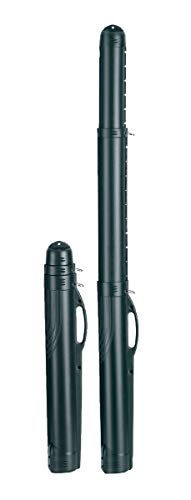
The Airliner is the case that shows up whenever anglers talk about flying with a full set of rods, and the design explains why. It is a rigid polypropylene tube that telescopes from 47 inches collapsed to 88 inches extended, so one case covers everything from short breakdown rods to one-piece saltwater sticks. Inside, a three-tier layout separates rods into layers instead of letting them rattle against each other, and Plano rates the capacity at up to eight 7-foot rods. A position locking device holds the tube at the length you set, and the molded handle is fixed and sturdy.
The trade-offs are size and weight. At about seven pounds empty and 4.5 inches in diameter, this is not a case you carry down a trail; it is a case you load into a vehicle or check as baggage. The diameter also sets a limit: rods with very large guides or reels left attached will not fit, so reels travel separately. For a camping trip where rods ride in a truck bed under other gear, though, this is the level of protection that actually prevents the cooler-slide accident described above. It is the benchmark hard tube in this guide, and the one the other tubes are measured against.
Specs
- Type: Hard telescoping rod tube
- Material: Polypropylene
- Length: Telescopes from 47 to 88 inches; 4.5-inch diameter
- Capacity: Up to 8 rods up to 7 feet long, three-tier interior
- Features: Position locking device, comfort molded handle
2. Flambeau Bazuka Rod Case (6085)

The Bazuka takes a simpler approach than the Plano: a one-piece, blow-molded tube with a hinged door at the top instead of a fully separating lid. It telescopes from 63 to 87 inches and holds up to six rods of 6 feet 6 inches, which covers most freshwater and light saltwater quivers. Foam padding at both ends cushions the tips and butt ends, the handle is molded into the body so there is nothing to tear off, and the door can be locked with a padlock. Flambeau markets the case as airline approved, a claim worth reading carefully — it means the case meets the general idea of what airlines accept as checked sporting equipment, not that any airline guarantees your rods will arrive intact.
In practice the Bazuka’s appeal is that it is a single tough shell with few parts to fail, sized for the rods most campers actually own. The narrower tube means bulky surf guides and attached reels are out, and the telescoping section depends on a friction-and-clip arrangement that should be checked before a flight rather than assumed. For truck-bed and roof-box duty on the way to a campsite, it offers the same class of crush protection as the Airliner in a slightly smaller, simpler package, and it stores standing in a garage corner without complaint.
Specs
- Type: Hard telescoping rod tube, blow-molded
- Length: Telescopes from 63 to 87 inches
- Capacity: Up to 6 rods up to 6 feet 6 inches
- Features: Lockable hinged door, foam padding at both ends, molded-in handle
3. Plano 3-Inch Adjustable Rod Case (35102-6)

This is the tube for the angler with one or two long rods rather than a full quiver. The case is a slim 3 inches in diameter and adjusts to protect rods up to 8 feet 6 inches, which makes it one of the few hard cases that swallows a long two-piece rod whose longest section runs past seven feet. Foam padding cushions the rod inside, and the case is lockable, which matters for both airline checking and for keeping curious hands off gear at a shared campsite.
The narrow diameter is both the point and the limitation. A single rod, or two slim ones, ride protected; a collection does not fit, and oversized guides can make loading a squeeze. There is no room for an attached reel, so this is a rod-only tube. What it does better than the big multi-rod cases is disappear: it slides behind a truck seat, along a wall, or into the corner of a tent-side gear pile without dominating the space. For the camper who travels with a favorite long rod and wants genuine crush protection for it without buying a case the size of a golf bag, this is the proportionate answer, and its sandstone finish is easy to spot among a pile of black luggage.
Specs
- Type: Hard adjustable rod tube
- Diameter: 3 inches
- Length: Adjusts to fit rods up to 8 feet 6 inches
- Capacity: 1 to 2 rods, rod-only (no attached reels)
- Features: Foam padding, lockable
4. Booms Fishing PB3 Expandable Fishing Rod Carry Case

The PB3 sits at the opposite end of the protection scale from the tubes above, and it is honest about what it is: a padded soft case for rods only, with the reels removed. This version expands from about 6.3 to 7 feet, holds two to three rods, and closes with two-way zippers. The padding is enough to stop rods scuffing each other and to take the sting out of minor knocks in a car, and when the trip is over the case folds down flat, which no rigid tube can do.
That convenience comes with a clear limit. A soft case will not protect a tip against a heavy object, a slammed door edge, or baggage handling, and this one should never be checked on a plane. It also asks you to unmount reels, which some anglers will find a nuisance and others will see as good discipline, since reels are often worth protecting separately anyway. Where the PB3 earns its place is in the camping scenarios that are about order rather than impact: keeping two or three breakdown rods clean, separated and grab-ready in the car, then folding the case away in a drawer or under a bed until the next trip. Judged as an organizer with padding, it is a sensible tool. Judged as armor, it is not one, and no soft case is.
Specs
- Type: Soft folding rod-only case (no reel space)
- Length: Expandable, approximately 6.3 to 7 feet
- Capacity: 2 to 3 rods with reels removed
- Features: Padded protection, two-way zippers, folds flat for storage
5. Lixada Fishing Rod Case, 3 Layers Oxford Bag

The Lixada is the organizer of this group: a soft Oxford fabric bag with three main compartments that take rods with reels still mounted, plus front pockets for tackle, floats and small gear. It comes in 90, 120 and 150 cm lengths, closes with metal zippers, and carries by two hand straps or an adjustable shoulder strap. Reinforced piping along the edges helps it hold its shape, and the whole bag folds compactly when empty — small enough to stash inside a larger pack or a camp storage box.
The honest caveats are about protection and sizing. Oxford fabric resists moisture, scratches and tears, but it is a shell against abrasion, not against crushing; a rod tip inside this bag is no safer from a falling cooler than a rod tip in a rod sock. The length figures also need care: each size fits rods shorter than the stated bag length, so a rod whose longest section runs close to the full measurement will not fit, and the smallest size carries only one front pocket instead of two. Within those limits, this is a practical camp bag: it keeps a rod-and-reel combo, a spare, and the small tackle that goes with them in one grab-and-go bundle for the car, the boat, or the walk from campsite to shoreline.
Specs
- Type: Soft folding rod and tackle bag
- Material: Oxford fabric with reinforced piping
- Length: 90 cm, 120 cm or 150 cm options
- Capacity: Three main compartments for rods with reels attached, plus front pockets
- Features: Metal zippers, two hand straps, adjustable shoulder strap, folds flat
How to Choose
Start with the damage you are actually trying to prevent. If your rods ride loose in a truck bed, a boat locker, or a checked baggage hold, only a rigid tube answers the risk, and the choice among tubes is about diameter and length. If your rods ride inside a car, separated from heavy gear, a soft case that prevents tangles and scratches may be all the protection the situation calls for, at a fraction of the bulk.
Next, do the length math properly, because it is where most buyers go wrong. A case does not need to fit your rod’s assembled length; it needs to fit the longest single section of the rod when broken down. A 7-foot two-piece rod produces sections of roughly three and a half feet. A 9-foot four-piece fly rod produces sections under two and a half feet. A one-piece 7-foot rod needs the full seven feet plus a little clearance, which is why the telescoping tubes exist. Measure the longest section, add an inch or two for the foam and the cap, and buy for that number — and remember that soft bag lengths are maximums the rod must come in under, not targets to match exactly.
Then be realistic about airlines. A lockable, crush-resistant tube is the correct way to fly with rods, and checking one is routine. But no case makes the airline responsible for your gear: sporting equipment typically travels at the owner’s risk, oversize charges may apply to long tubes, and security staff can open or cut a lock. Keep the rods’ sections padded and separated inside the tube, remove reels where the design requires it, and treat the case as strong mitigation, not a guarantee.
Finally, think about storage between trips. Tubes stand in a corner and protect rods year-round in the garage, which is where a surprising share of rod damage happens. Soft cases fold away but leave rods only lightly protected at home. The best case is the one that matches your transport, your longest rod section, and your storage space — in that order.
FAQ
Can I take a rod case on a plane as carry-on?
Generally no. Even collapsed, most rod cases exceed cabin baggage dimensions, and fishing rods are normally checked. A lockable hard tube is the standard way to check them; confirm the airline’s sporting equipment rules and any oversize fees before you travel.
Will a soft case protect my rods in a truck bed?
Only against scratches and tangles. If anything heavy can slide or fall onto the rods — coolers, firewood, toolboxes — a soft case will not prevent a snapped tip or a crushed guide. Use a hard tube, or keep soft-cased rods on top of the load and secured.
How do I know what case length I need?
Measure the longest single piece of your rod when it is broken down, not the assembled length printed on the blank. Add a small margin for end padding. If you own a one-piece rod, the case must be longer than the whole rod.
Should reels stay attached inside the case?
Only in cases designed for it, such as the Lixada bag in this guide. Tubes are rod-only: attached reels usually will not fit the diameter and can be damaged by pressure. Removing reels also protects the reel itself, which often costs as much as the rod.
Conclusion
A rod case is transport insurance, and like insurance it only pays out against the risks it actually covers. The Plano Airliner and Flambeau Bazuka give real crush protection for vehicle and airline travel; the slim Plano adjustable tube does the same job for one or two long rods; the Booms Fishing PB3 and Lixada bag trade that armor for organization, light weight and storage that folds away. Match the case to your longest rod section and your worst realistic accident, and your rods will survive the journeys between the fishing — which is where they were always most at risk.
More from Amazon
Programs that pair well with the guide above. Offers and eligibility are set by Amazon and may change.
Free shipping on eligible items, Prime Video and more. Eligible new members can start with a free trial.
Start a Prime free trialA Prime membership for ages 18-24 with a trial period. Eligibility is set by Amazon.
See Prime for Young AdultsAudiobooks and podcasts to listen to on the go. Eligible new members can start with a free trial.
Try Audible freeAd-free music streaming. Eligible new subscribers can start with a free trial.
Try Music Unlimited freeAs an Amazon Associate we earn from qualifying purchases.







Write Your Review
No reviews yet. Be the first to share your experience!