

Key takeaways
- Compare the best fishing pliers for camping, boats and bank fishing: corrosion-resistant picks with braid cutters, split ring tips, sheaths and lanyards.
As an Amazon Associate we earn from qualifying purchases.
Fishing pliers look like a minor purchase until the first hook ends up deep in a fish’s jaw at dusk, the line is braided, your hands are wet, and the only tool in the camp box is a pair of hardware-store pliers that rusted shut in the spring. Pliers get used on almost every fish, rig change and snagged lure, so the details that sound like marketing — jaw material, cutter type, a spring that holds the jaws open — turn out to be the whole story.
For camping anglers the environment is harsher than the tackle shop suggests. Pliers live in damp tackle bags, ride in boat compartments that never fully dry, and get dropped in sand and mud. Corrosion resistance is therefore not a premium extra; it is the difference between a tool that lasts for years and one that seizes up after a single wet weekend. Salt water speeds the process dramatically, but freshwater dew and fish slime will eat unprotected carbon steel over a season.
This guide compares five fishing pliers sold on Amazon that cover the main approaches to the problem: anodized aluminum frames with stainless jaws, coated carbon steel, fully stainless builds, and one set that bundles pliers with a lip gripper. Each entry states the trade-offs plainly, including where a cheaper tool asks you to do the corrosion prevention yourself.
Affiliate Disclosure: This article contains affiliate links. If you buy through a link on this page, the site may earn a commission at no extra cost to you. Products are chosen for their specifications and suitability for the use described, and each tool’s limitations are stated as plainly as its strengths.
1. Piscifun Aluminum Fishing Pliers

The Piscifun pliers follow the pattern that has become the default for modern fishing pliers: machine-cut aircraft-grade aluminum handles paired with stainless steel jaws. Aluminum cannot rust, and the anodized finish shrugs off the damp tackle-bag storage that kills lesser tools, while the stainless jaws provide hardness pure aluminum cannot. At roughly three and a half ounces, they are light enough to hang from a belt or vest all day unnoticed.
The jaw layout covers the jobs that actually come up at the water’s edge. A split ring tip at the nose opens the rings on crankbaits and spoons so hooks can be swapped without wrecking a thumbnail. The serrated jaw faces grip hooks firmly for removal, and grooves behind the jaws crimp split shot and sleeves. The cutters are tungsten carbide, which matters more than it sounds: carbide edges shear braided line cleanly instead of crushing and fraying it the way serrated steel cutters do, and they handle mono and fluorocarbon just as well.
The handles are spring-loaded, so the jaws stay open and the tool works one-handed — a genuine help when the other hand is holding a rod or controlling a fish. The trade-offs are the usual ones for this design: aluminum frames can flex under heavy crimping loads, the carbide cutter inserts are small and not user-replaceable, and the pivot deserves a rinse after saltwater use. A nylon sheath and coiled lanyard are included, and they are not accessories to leave in the box: clipped on and tethered, the pliers survive the trip; loose in a boat, they eventually go over the side.
Specs
- Material: Aircraft-grade anodized aluminum handles, stainless steel jaws
- Jaw/cutter type: Serrated jaws with split ring tip; tungsten carbide side cutters for braid, mono and fluorocarbon
- Action: Spring-loaded, one-handed operation
- Sheath/lanyard: Nylon sheath and coiled lanyard included
- Model: PF-01
2. KastKing Intimidator Fishing Pliers (7 Inch)

The Intimidator takes the opposite approach to corrosion from the aluminum tools in this guide. The frame is S45C carbon steel — strong, hard, and resistant to bending — protected by a polymer coating rather than by the metal itself. The design keeps the tool slim and rigid, and tungsten carbide cutters snip braid, mono and wire cleanly.
The honest caveat is that the coating is the only thing standing between the steel and the water. While the coating is intact, the pliers shrug off weather; once it chips at the jaw tips or wears at the pivot, rust starts in exactly the places you cannot easily clean. Anglers who rinse, dry and occasionally oil these pliers get good service from them. Anglers who toss them wet into a tackle tray after every trip should expect orange spots within a season, and faster near salt water. That is not a defect so much as a maintenance contract, and buyers should know they are signing it.
In hand, the Intimidator is a straightforward tool: a straight nose (a split ring nose version is also offered), ergonomic soft-grip handles, and enough jaw length for general hook removal on freshwater and inshore species. It suits the camper who fishes mostly freshwater, wants a rigid steel tool, and will spend ten seconds drying it at the end of the day. Anyone heading for the coast or a kayak, where everything stays wet, should look at the stainless and aluminum options instead.
Specs
- Material: S45C carbon steel with corrosion-resistant polymer coating
- Jaw/cutter type: Straight nose (split ring nose also available); tungsten carbide cutters
- Grip: Ergonomic soft-grip handles
- Sheath/lanyard: None specified in the listing details reviewed
- Model: KTATLSPLR-INPL-7 (7 inch)
3. BUBBA 8.5-Inch Stainless Steel Pliers

Bubba built its name on non-slip grips, and these pliers carry the same textured red handle the brand uses on its fillet knives. Underneath is high-carbon stainless steel with a titanium nitride coating, a combination aimed squarely at saltwater use: stainless resists corrosion through the bulk of the metal rather than only at the surface, and the hard coating adds a further barrier at the jaw faces, where tools take the most abuse.
At eight and a half inches, this is the longest tool in the guide, and the extra length is the point. Long jaws keep fingers away from the teeth of pike, walleye and saltwater species, reach hooks that are deep rather than lip-hooked, and give more leverage on heavy hooks. The jaws are spring-loaded for one-handed work, and the tool adds anvil-style cutters and crimping tools for leader sleeves. A sheath and a lanyard hole are included, which matters on a boat: a tool this size usually lives in a holder at the console or on a belt rather than in a pocket.
The trade-offs follow from the size. This is more plier than a trout or panfish angler needs, and it is heavier in a vest than the aluminum options. The anvil cutters handle mono and leader material well but do not cut braid as cleanly as tungsten carbide edges. Buy it for reach, grip security in wet hands, and stainless durability — not as a lightweight bank-fishing tool.
Specs
- Material: High-carbon stainless steel with titanium nitride (TiN) coating
- Jaw/cutter type: Long serrated jaws; anvil cutters and crimping tools
- Action: Spring-loaded with non-slip grip handle
- Sheath/lanyard: Sheath included; lanyard hole in handle
- Size: 8.5 inches
4. KastKing Cutthroat 7-Inch Fishing Pliers (Split Ring Nose)

The Cutthroat is KastKing’s stainless answer to the same brief the Intimidator answers with coated steel. The frame is 420 stainless steel, a workhorse grade that balances hardness with corrosion resistance, finished with slip-resistant rubber handles. Because the corrosion resistance runs through the metal, a scratched or worn pair keeps resisting rust instead of exposing bare carbon steel — the forgiving choice for anglers who are casual about drying their gear.
The split ring nose is the headline feature: a hooked tip that pries open split rings so treble hooks and lures can be changed quickly. Grooved slots near the back of the jaws crimp leader sleeves and split shot, the serrated faces handle hook removal, and tungsten carbide cutters deal with braid, mono and fluorocarbon. A straight nose version exists for anglers who rarely change lure hooks and prefer a plain gripping tip.
KastKing includes a molded sheath with a belt clip and a coiled lanyard, the right way to carry pliers on a boat, kayak or wading belt. The compromises are modest: seven inches is a middle size that suits most freshwater and inshore work but offers less reach on toothy fish than the longer Bubba, and 420 stainless is a mid-tier steel whose jaw edges will wear sooner than premium alloys under heavy daily use. For a camp tackle box serving several anglers and species, it is a sensible, low-maintenance default.
Specs
- Material: 420 stainless steel
- Jaw/cutter type: Split ring nose (straight nose also available); tungsten carbide cutters; crimping grooves
- Grip: Slip-resistant rubber handles
- Sheath/lanyard: Molded sheath with belt clip and coiled lanyard included
- Size: 7 inches
5. ZACX Fishing Pliers and Lip Gripper Set (Package B)
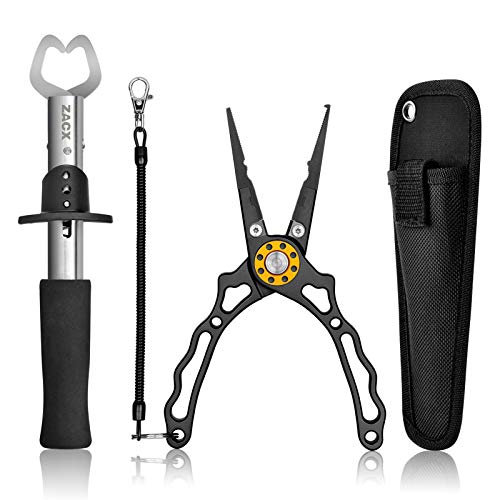
The ZACX package answers a slightly different question: instead of pliers alone, it pairs an aluminum fishing plier with a separate fish lip gripper, so one tool works the hook while the other holds the fish. For catch-and-release fishing from the bank or a campsite dock, that pairing is practical — the gripper keeps a hand out of the water and away from hooks and teeth while the pliers unhook.
The pliers themselves use machine-cut aluminum handles with a hollowed-out design that keeps weight down, stainless jaw inserts, and a spring-loaded action for one-handed use. The jaw set covers the standard tasks: a split ring tip, serrated gripping faces, and a braid line cutter. The gripper has an EVA foam handle sized for a secure hold with wet hands. A sheath and lanyard are included, keeping the set together on a belt rather than scattered through a tackle bag.
The compromises are those of most bundled sets. Neither tool matches the best dedicated pliers in this guide for jaw hardness or cutter quality, the gripper is a light-duty design suited to panfish, bass and similar species rather than heavy fish, and two tools means two tools to rinse and dry. What the set offers is coverage: a camper who currently owns no fish-handling tools at all gets both jobs done in one purchase, in corrosion-resistant materials that tolerate life in the camp box between trips.
Specs
- Material: Machine-cut aluminum pliers with stainless jaw inserts; gripper with EVA foam handle
- Jaw/cutter type: Split ring tip, serrated jaws, braid line cutter; spring-loaded
- Set contents: Fishing pliers with sheath, fish lip gripper, lanyard
- Use: Freshwater and saltwater; fly and ice fishing tool set
- Package: Package B
How to Choose Fishing Pliers for Camping
Start with the metal. Corrosion resistance decides how long any pair of fishing pliers lives. Anodized aluminum frames with stainless jaws, and full stainless builds, carry their protection in the metal itself and tolerate damp storage. Coated carbon steel is strong and rigid, but the coating is a surface promise: chips and wear spots rust, so those tools belong with anglers who rinse and dry their gear. If your fishing is coastal, or from a kayak or boat where tools stay wet for days, stick to aluminum and stainless.
Match the cutter to your line. Braided line is where cheap pliers fail first. Tungsten carbide cutter inserts shear braid cleanly; serrated steel edges and simple anvil cutters tend to crush and fray it, leaving whiskers that will not pass through a rod guide. If you fish braid, carbide cutters are close to mandatory. Mono and fluorocarbon are far more forgiving, and every cutter type in this guide handles them.
Check the jaw features you will actually use. A split ring tip earns its place if you change hooks on lures; it is dead weight if you fish bait under a bobber. Crimping grooves matter to anglers who build leaders. Length matters by species: six to seven inches suits panfish, bass and trout, while longer jaws are safer around toothy fish.
Plan to keep them. Pliers dropped in the water are gone, and a lake bank at dusk is an easy place to set a tool down and walk away from it. A belt sheath plus a coiled lanyard is the standard solution, worth more than any extra jaw feature. Spring-loaded jaws are the other quiet essential: with cold, wet hands and a fish in the other hand, a tool that opens itself gets used; one that needs two hands gets left in the box.
Maintain the pivot. Rinse pliers after saltwater use, dry them before storage, and oil the pivot occasionally. Grit in the joint grinds any pivot loose over time.
Frequently Asked Questions
Are aluminum or stainless steel pliers better for saltwater?
Both work, with different strengths. Aluminum frames cannot rust and are lighter, but the jaws are steel inserts and the pivot needs rinsing. Full stainless pliers are heavier and stronger for heavy crimping and big hooks. Either outlasts coated carbon steel in salt water, where a coating chip quickly becomes a rust spot.
Why do my pliers fray braided line instead of cutting it?
Because the cutter is crushing rather than shearing. Serrated edges and worn steel cutters squeeze braid’s fibers apart instead of slicing them. Tungsten carbide inserts hold a sharper edge and cut braid cleanly. If a pair frays braid when new, the cutter design is the problem, not your technique.
What size pliers should a camping angler buy first?
A seven-inch pair is the practical default: long enough for hook removal on most freshwater and inshore species, small enough for a tackle bag or belt sheath. Add a longer pair if you regularly handle pike, walleye or saltwater fish, where distance from teeth matters.
How do I stop losing pliers overboard or on the bank?
Use the sheath and lanyard the better tools include. Clip the sheath to a belt or tackle bag, run the coiled lanyard between the pliers and the sheath or a belt loop, and make returning the pliers to the sheath a habit rather than setting them down. Bright handle colors help when a tool does get set down in grass or sand.
Conclusion
Fishing pliers are a small tool with an outsized effect on a camping fishing trip: reached for constantly, abused routinely, and lost easily. The right choice depends on honest answers about where you fish and how you treat gear. Aluminum and stainless tools like the Piscifun, the Cutthroat and the Bubba forgive wet storage and salt air; the coated-steel Intimidator rewards anglers who dry their tools with a rigid, strong frame; and the ZACX set covers fish handling and hook removal in one package. Whichever pair you choose, buy the sheath-and-lanyard habit along with it — the best pliers are the ones still in camp at the end of the season.
More from Amazon
Programs that pair well with the guide above. Offers and eligibility are set by Amazon and may change.
Free shipping on eligible items, Prime Video and more. Eligible new members can start with a free trial.
Start a Prime free trialA Prime membership for ages 18-24 with a trial period. Eligibility is set by Amazon.
See Prime for Young AdultsAudiobooks and podcasts to listen to on the go. Eligible new members can start with a free trial.
Try Audible freeAd-free music streaming. Eligible new subscribers can start with a free trial.
Try Music Unlimited freeAs an Amazon Associate we earn from qualifying purchases.







Write Your Review
No reviews yet. Be the first to share your experience!