

Key takeaways
- Five dog backpacks for camping and hiking compared on girth fit, capacity and harness design, plus honest load limits for keeping trail dogs safe.
As an Amazon Associate we earn from qualifying purchases.
A dog backpack lets a fit, adult dog carry its own food, water, bowl and waste bags on a camping trip, freeing up real space in your own pack. Done badly, though, it is a chafing, lopsided load on an animal that cannot tell you where it hurts. The difference is rarely the brand name. It is fit, load weight and how gradually the dog was trained into the work.
So this guide starts with the honest part. A healthy, fully grown, conditioned dog should carry no more than about 10 to 15 percent of its body weight, and that figure includes the empty pack itself. Some manufacturers quote higher ceilings, but those are maximums for conditioned working dogs, not targets for a pet on a weekend trail. Puppies whose growth plates are still closing, senior dogs, and dogs with joint, back or breathing problems should carry little or nothing. If your dog falls into any of those groups, the right purchase may be no pack at all.
The five packs here are all saddlebag-style packs the dog wears, sold on Amazon. Each Specs list is drawn from the manufacturer’s listing.
Affiliate Disclosure: This article contains affiliate links. If you buy through a link on this page, we may earn a commission at no additional cost to you. That income helps keep the site running, and it does not change which products we include or what we say about them.
Ruffwear Approach Pack

The Approach Pack is the benchmark in this category, and the reason is its harness. Instead of hanging the bags off a couple of straps, Ruffwear builds the saddlebags onto an integrated harness chassis with five points of adjustment, a molded foam and mesh back panel, and bags cut to sit weight-forward over the shoulders, where dogs carry load best. Stabilizer straps — Ruffwear calls them flopper stoppers — keep the bags from swinging as the dog moves, which is what separates a pack a dog forgets about from one it fights all day.
Capacity is generous: the medium holds 13 liters and the large size 21 liters, enough for two days of kibble, a collapsible bowl and a small first aid kit. Two leash points, a padded grab handle and reflective trim round it out. The trade-offs are real, though. The saddlebags are not removable, so the dog wears the full pack even when you only need the harness. The step-in design means lifting a front leg through the harness, which some dogs dislike. And it sits at the premium end of this category. Fit is by chest girth only: measure behind the front legs and trust the tape, not the breed chart.
Specs
- Sizes (by chest girth): XS 17–22 in, S 22–27 in, M 27–32 in, L/XL 32–42 in
- Capacity: 5 L (XS), 10 L (S), 13 L (M), 21 L (L/XL)
- Pack weight: 0.73 lb (XS) to 1.3 lb (L/XL)
- Harness: integrated chassis with five adjustment points, molded foam and mesh panel
- Saddlebags: radial-cut, weight-forward, non-removable, with stabilizer straps
- Leash points: aluminum V-ring and reinforced webbing loop; padded top handle
- Shell: 150-denier polyester ripstop
Kurgo Big Baxter Pack

Kurgo’s Baxter line comes in two sizes: the standard Baxter for dogs of roughly 30 to 85 pounds, and the Big Baxter linked here, for dogs of about 50 to 110 pounds. The design is simpler than the Ruffwear’s — two zippered saddlebags on an adjustable strap harness — but it has one thoughtful feature the category often skips: a padded support panel along the spine that spreads pressure across the back. Total capacity on the Big Baxter is about 7.5 liters across both bags, suiting long day hikes and light overnights for a big dog.
The honest limitations are fit-related. With fewer adjustment points than the Approach Pack, the Baxter can need re-cinching mid-hike, and narrow-chested, deep-bodied dogs are the hardest to keep it centered on; if the girth strap is not snug, the bags will migrate to one side on a slope. The bags also sit a little further back than a weight-forward design. It is not waterproof, so food needs its own dry bag inside.
Specs
- Sizes: Baxter (dogs about 30–85 lb) and Big Baxter (dogs about 50–110 lb)
- Capacity: about 7.5 L total across two saddlebags (Big Baxter)
- Pack weight: about 1 lb 4 oz (Big Baxter)
- Harness: adjustable chest and belly straps with a padded spine support panel
- Storage: two zippered saddlebag compartments
- Features: reflective trim, top handle, rear leash attachment point
Mountainsmith K-9 Pack
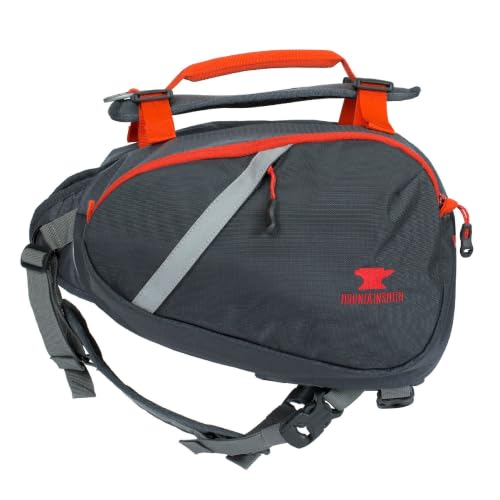
Mountainsmith has made packs for people for decades, and the K-9 shows it: a four-point adjustable harness, a fleece-lined and padded chest strap, and a padded belly strap, all aimed at keeping the load stable on big, deep-chested dogs. It comes in three sizes with serious capacity — up to 16 liters in the large — and a girth range of about 20 to 40 inches across the line covers medium dogs through genuinely large trail breeds.
Each side carries a zippered main compartment plus a smaller pocket, useful for separating food from waste bags. A grab handle and D-ring leash attachment complete the feature set. The compromises: it is a boxier, less contoured pack than the Ruffwear, so on lean or narrow dogs the bags can ride oversized, and the padding that makes it comfortable also makes it warm — a consideration for summer hiking discussed below. For a large, fit dog on a multi-day trip, it is one of the few packs sized for the job.
Specs
- Sizes: Small, Medium, Large (girth fit about 20–40 in across the range)
- Capacity: 7 L (S), 12 L (M), 16 L (L)
- Pack weight: 15 oz (S), 1 lb (M), 1 lb 3 oz (L)
- Harness: four-point adjustment, fleece-lined padded chest strap, padded belly strap
- Storage: zippered main compartment plus smaller pocket on each side
- Features: top grab handle, D-ring leash attachment, reflective trim
OneTigris Dog Pack Hound

The OneTigris Hound pack takes a different route: heavy-duty 1000D nylon, a tactical look with hook-and-loop panels on each side, and a simpler strap system at a plainer level of construction than the Ruffwear or Mountainsmith. Each side has a zippered main compartment, and the top carries a grab handle with a metal leash ring. For campers who are hard on gear, the abrasion-resistant fabric is the main appeal.
The trade-offs match the design priorities. The hook-and-loop panels are decoration for most campers — useful if you run identification patches, dead weight if you do not. The harness is less contoured than the leaders in this category, with less fine adjustment, so getting it to sit perfectly level takes more fiddling, and it rewards careful girth measurement before ordering; “medium” here does not match “medium” from other brands. Treat it as a rugged, simple hauler for day hikes and car camping rather than a precision fit for long backcountry miles.
Specs
- Sizes: Medium, Large (fit by chest girth using the maker’s size chart)
- Material: 1000D nylon
- Storage: zippered main compartment on each side, plus smaller pockets
- Harness: adjustable chest and belly straps with quick-release buckles
- Features: hook-and-loop panel on each side, top grab handle, metal leash ring
Outward Hound DayPak

The DayPak is the light-duty option in this list, and it should be bought with that understanding. It is a lightweight saddlebag pack with breathable mesh side panels, expandable zippered pockets, and a simple adjustable strap harness. For a healthy dog on a short, easy day hike — carrying its own treats, a collapsible bowl, waste bags and little else — that is genuinely all you need, and the mesh panels make it the coolest-wearing design here.
What it is not is a load hauler. The pockets are small, the structure is minimal, and there is less padding and load stabilization than on any other pack in this guide, so weight shifts more as the dog moves. Load it like a backpacking pack and you will have a crooked, uncomfortable dog within the hour. Treat it as an introductory pack for training a young adult dog to wear a pack at all, with token weight, and it makes complete sense.
Specs
- Sizes: Small, Medium, Large (sized by girth and dog weight on the maker’s chart)
- Storage: two expandable zippered saddlebag pockets
- Harness: adjustable straps with breathable mesh side panels
- Features: reflective accents, D-ring leash attachment
- Construction: lightweight nylon, minimal padding by design
How to Choose
Measure girth, not breed. Every pack here is sized by chest girth — the circumference of the ribcage at its widest point, just behind the front legs. Breed labels are a rough guess at best: two dogs of the same breed can be two sizes apart. Measure with a soft tape, snug but not tight, and if your dog falls between sizes, favor the size whose range centers on your measurement, not one cinched to its limit.
Respect the load limit. Weigh the loaded pack on a kitchen scale, not by feel. Keep the total — pack plus contents — at or below roughly 10 to 15 percent of body weight, and start far below that. Dense items are the trap: water is the worst offender, since a liter of water weighs a full kilogram. Where water weight is significant, carry the dog’s water yourself and let the dog carry light, bulky items like its bowl, a jacket and waste bags.
Balance both sides. Pack each saddlebag separately and weigh them. An uneven load — even by a few hundred grams — will slowly pull the pack sideways, and a shifted pack chafes, changes gait and can strain one side of the body. Put the heaviest items forward and close to the body, check the pack’s position at every stop, and re-balance after the dog eats or drinks.
Train into it gradually. A pack is a skill, not an accessory. Start with the empty pack on short, fun walks at home. Add small amounts of weight over days and weeks, watching for rubbing, reluctance, or changes in how the dog moves. Check under the straps and around the armpits after every outing; redness or hair wear means the fit or load is wrong, and no trip is worth a raw sore.
Plan around heat and trail rules. A loaded dog works harder and overheats faster, and a pack covers part of the torso the dog needs to shed heat. In summer, hike early or late, build in shade and water breaks, and reduce the load or leave the pack off entirely on hot days. Finally, not every trail or campsite allows dogs, and many that do require a leash — check the rules for your destination first.
FAQ
How much weight can my dog actually carry?
For a healthy, fully grown, conditioned dog, keep the pack and everything in it at or below about 10 to 15 percent of body weight, and begin training with far less. Puppies, senior dogs and dogs with joint or back problems should carry little or nothing. When in doubt, ask your vet — they know your dog’s joints better than any size chart.
How do I measure my dog for a backpack?
Measure the girth: wrap a soft tape around the widest part of the ribcage, just behind the front legs, snug against the coat. That measurement drives sizing for every pack in this guide.
Why does the pack keep sliding to one side?
Almost always one of two causes: the two bags are not equally loaded, or the girth strap is not snug enough and the harness rotates on the ribcage. Weigh both sides, re-center the pack, and snug the straps in the order the maker specifies. If it still slides, that pack’s harness shape may simply not suit your dog’s build.
Can my puppy wear a dog backpack?
A puppy can get used to wearing an empty or nearly empty pack for short periods as part of training, but should carry no real load until fully grown, typically at 12 to 18 months depending on breed and size. Growing joints are easily damaged by load, and no trip justifies the risk.
Conclusion
The right dog backpack is the one that fits your dog’s girth, stays level under a balanced load, and is loaded with restraint. The Ruffwear Approach Pack is the most complete design here for regular hikers; the Mountainsmith K-9 suits big dogs and bigger volumes; the Kurgo Big Baxter is a roomy, simpler option for large breeds; the OneTigris Hound trades refinement for rugged fabric; and the Outward Hound DayPak is an honest light-duty starter. Whichever you choose, measure carefully, weigh the load and train up slowly — the pack should share a small part of the work, never turn your dog into the trip’s pack animal.
More from Amazon
Programs that pair well with the guide above. Offers and eligibility are set by Amazon and may change.
Free shipping on eligible items, Prime Video and more. Eligible new members can start with a free trial.
Start a Prime free trialA Prime membership for ages 18-24 with a trial period. Eligibility is set by Amazon.
See Prime for Young AdultsAudiobooks and podcasts to listen to on the go. Eligible new members can start with a free trial.
Try Audible freeAd-free music streaming. Eligible new subscribers can start with a free trial.
Try Music Unlimited freeAs an Amazon Associate we earn from qualifying purchases.










Write Your Review
No reviews yet. Be the first to share your experience!