

Key takeaways
- Low-voltage and high-voltage monitoring, commonly disconnecting around 104 volts and 132 volts on a 120-volt system.
- Open-neutral, reverse-polarity, and missing-ground detection.
- Surge suppression measured in joules and maximum surge current.
- A time-delay restart, often about 128–136 seconds, to protect air-conditioner compressors after power returns.
- A readable display that identifies the fault instead of showing only “power” or “no power.”
- Outdoor-rated construction, weather protection, and a secure way to lock the unit to the pedestal.
The best RV surge protectors for campground power are usually portable EMS units that monitor voltage, wiring faults, grounding, polarity, and frequency—not simple plug-in surge strips rated only in joules.
Our top picks
![GEARGO RV Surge Protectors 30 Amp RV Circuit Analyzer, [𝟐𝟎𝟐𝟔 𝐍𝐞𝐰 𝐔𝐩𝐠𝐫𝐚𝐝𝐞𝐝 & 𝐆𝐞𝐧𝟐] Full Protection, RV Adapter Plug for Camper(Orange)](https://m.media-amazon.com/images/I/41NU4tSRcLL._SL500_.jpg)
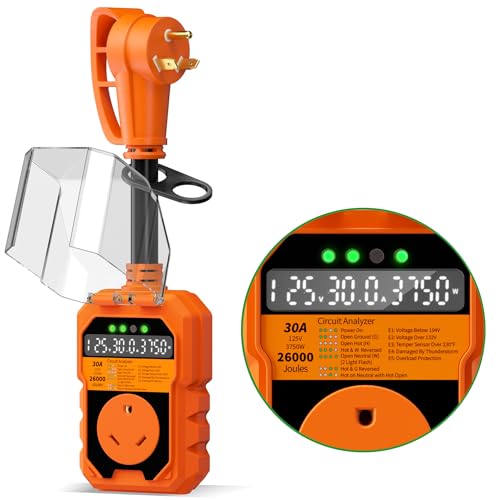


As an Amazon Associate we earn from qualifying purchases at no extra cost to you. Ratings are shown as listed on Amazon.
Quick picks by RV camping situation
| Situation | Best choice | What to prioritize | Typical market range |
|---|---|---|---|
| Occasional camper on a tight budget | Portable 30-amp EMS | At least 2,000 joules, fault display, weather cover, 30-amp TT-30P plug | $100–$180 |
| Frequent 30-amp traveler | Progressive Industries EMS-PT30X or Hughes Autoformers Power Watchdog PWD30-EPO | Automatic disconnect, voltage monitoring, delay timer, replaceable or serviceable parts | $180–$300 |
| Large fifth wheel or motorhome | Portable 50-amp EMS | 50-amp 14-50P plug, dual-leg voltage monitoring, protection for both hot legs | $250–$400 |
| Permanent seasonal site | Hardwired 30- or 50-amp EMS | Enclosed installation, remote display option, professional installation access | $250–$500 before installation |
| Campgrounds with questionable pedestals | EMS with an error code display and EPO | Open-neutral, reverse-polarity, miswired-ground, low/high-voltage shutdown | $180–$400 |
What makes an RV surge protector worth buying?
Campground electrical failures are not limited to lightning or a brief spike. A loose neutral can create dangerously high voltage on one side of a 120/240-volt supply. A reversed hot and neutral, missing ground, or sustained low voltage can damage appliances even when no dramatic surge occurs. An EMS—electrical management system—checks these conditions and disconnects the RV when they fall outside its programmed limits.
For most RVs, useful protection includes:
- Low-voltage and high-voltage monitoring, commonly disconnecting around 104 volts and 132 volts on a 120-volt system.
- Open-neutral, reverse-polarity, and missing-ground detection.
- Surge suppression measured in joules and maximum surge current.
- A time-delay restart, often about 128–136 seconds, to protect air-conditioner compressors after power returns.
- A readable display that identifies the fault instead of showing only “power” or “no power.”
- Outdoor-rated construction, weather protection, and a secure way to lock the unit to the pedestal.
Head-to-head: leading portable EMS options
| Product or type | Available plug size | Notable protection | Display and usability | Best fit |
|---|---|---|---|---|
| Progressive Industries EMS-PT30X | 30 amp TT-30P | EMS monitoring, surge protection, automatic disconnect, time delay | Digital fault and voltage information; portable enclosure | 30-amp owners who want detailed diagnostics |
| Progressive Industries EMS-PT50X | 50 amp 14-50P | Protection and monitoring for a 120/240-volt, two-leg RV connection | Portable digital display and fault information | 50-amp fifth wheels and motorhomes |
| Hughes Autoformers Power Watchdog PWD30-EPO | 30 amp TT-30P | Surge protection, voltage monitoring, automatic emergency power-off | Fault display; some versions add app-based monitoring | Users who value visible status and fast fault identification |
| Hughes Autoformers Power Watchdog PWD50-EPO | 50 amp 14-50P | Two-leg 50-amp EMS protection and automatic disconnect | Display and, depending on version, Bluetooth/app information | Large RVs and owners who want remote status information |
| Southwire Surge Guard portable EMS units | 30 amp and 50 amp versions | Voltage, wiring, surge, and delay protection vary by model | Models range from basic indicators to diagnostic displays | Buyers who prefer the Surge Guard product family |
Model specifications can vary within each brand, so verify the exact model number before ordering. A basic “surge guard” with lights may not provide the same low-voltage, neutral, and automatic-shutoff protection as a full EMS model.
Joules: useful number, but not the deciding number
Joule ratings indicate how much surge energy the suppression components are designed to absorb over their service life. Portable RV products commonly fall in the range of roughly 1,000 to 4,000 joules, while premium EMS units may advertise higher values. More joules can mean more energy capacity, but it does not guarantee better protection from a severe campground fault.
For example, a 3,000-joule unit is not automatically three times safer than a 1,000-joule unit. The quality of the suppression components, clamping behavior, grounding path, thermal safety, and whether the device disconnects during abnormal voltage matter at least as much. Treat joules as a comparison within similar products, not as the sole buying criterion.
30 amp or 50 amp: choose by the RV inlet
A 30-amp RV normally uses a TT-30 connection: one 120-volt hot leg, neutral, and ground. A 50-amp RV uses a NEMA 14-50 connection: two 120-volt hot legs, neutral, and ground. A 50-amp EMS monitors both hot legs and must be connected to a correctly wired 50-amp pedestal.
Do not use a 30-amp protector simply because an adapter lets a 50-amp RV plug into a 30-amp receptacle. The adapter may be useful for reducing available power, but it does not turn a 30-amp EMS into a 50-amp, dual-leg device. If you regularly use adapters, select protection for the connection actually entering the protector and understand that the RV will still have reduced capacity.
Why voltage monitoring matters more than a big joule number
Air conditioners, refrigerators, converters, and battery chargers can be harmed by sustained low voltage. A busy campground may have a supply that drops when many air conditioners start, or a long and undersized feeder may create voltage loss. A protector that only reacts to a fast spike can continue feeding the RV during this condition.
Look for an EMS that displays actual voltage and disconnects automatically outside a stated range. A useful unit should also show whether the fault is low voltage, high voltage, open neutral, reversed polarity, or missing ground. This saves time when deciding whether to move sites, call campground maintenance, or inspect an adapter.
Setup steps that prevent common mistakes
- Inspect the plug and cable. Do not connect a unit with cracked plastic, bent blades, discoloration, melted insulation, or a loose receptacle.
- Attach the protector to the pedestal first. Keep the RV main breaker off while the EMS performs its initial wiring check.
- Read the display before connecting the RV. Confirm that the unit reports correct wiring and acceptable voltage.
- Connect the RV shore cord. Turn on the pedestal breaker, then the RV main breaker, and allow the delay timer to finish before starting air conditioners.
- Secure the device. Use the built-in locking tab or a pedestal lock so it is not hanging from the receptacle.
- Disconnect in reverse order. Turn off the RV main breaker, switch off the pedestal breaker, then unplug the shore cord and EMS.
The initial check matters because a protector may correctly refuse power. Never defeat the device, bypass the EMS, or repeatedly reset it without finding the cause of a fault. A pedestal with an open neutral or reversed wiring needs campground maintenance, not a different reset sequence.
Weatherproofing and ownership realities
Portable EMS units live in a harsh location: direct sun, rain, dust, condensation, and repeated mechanical strain. Weather-resistant does not mean submersible. Keep the display and plug connection above standing water, use the supplied cover if provided, and make a drip loop so water does not run directly toward the RV inlet.
The plug blades and receptacle contacts usually wear before the electronics. Heat discoloration, a loose fit, buzzing, or a burning odor indicates excessive resistance and requires immediate disconnection. Clean exterior dirt with a dry or slightly damp cloth; do not spray cleaner into the receptacle or open the enclosure.
Surge components can sacrifice themselves during a major event. Some units indicate that protection has been exhausted, while others may continue passing power after their suppression parts have degraded. Check the manufacturer’s status indicators and replacement policy annually. Store the EMS indoors when traveling is over, and avoid leaving it connected during severe storms when the site can be safely disconnected.
Final buying recommendation
For a 30-amp RV, choose a portable EMS with a TT-30P plug, displayed voltage, fault codes, automatic low/high-voltage shutdown, wiring-fault detection, and a compressor-friendly delay. For a 50-amp RV, choose a model designed for the 14-50 connection and dual-leg monitoring. Prioritize the protection functions and clear diagnostics first, then compare joule ratings, weather protection, warranty support, and replacement parts.
A simple surge-only device can be better than nothing, but the best RV surge protectors for campground power are full EMS units because they address the slow, invisible wiring and voltage problems that a joule rating alone cannot detect.


Write Your Review
No reviews yet. Be the first to share your experience!