
Key takeaways
- Find the best camping flashlights for camp chores, night hikes, and emergencies. Compare brightness, runtime, batteries, and waterproofing before you buy.
A good flashlight is one of the smallest items in a camp kit and one of the most used. The best camping flashlights earn their place by doing the ordinary jobs well: lighting the path to the washroom after dark, finding a dropped tent peg in the grass, reading a map inside the tent, and checking a noise outside without waking the whole campsite. They also need to keep working when conditions turn against them, which is why brightness alone is a poor way to choose one. Runtime on a useful low mode, a battery system that fits the trip, and a body that survives rain and drops matter just as much as the headline lumen figure.

This guide compares five handheld flashlights that suit camping, from a pocketable rechargeable light with natural-looking colour to a long-throw duty light and a simple AA-powered backup. Every pick is a handheld flashlight, not a headlamp or a lantern, so use the quick picks to narrow the field and the buying guide to match a light to your style.
As an Amazon Associate, we earn from qualifying purchases.
Quick Picks
Our Short List of 3
- Best for: Campers who want one capable rechargeable flashlight that covers everything from tent chores to night walks, without carrying spare batteries.
- Max output: 2,800 lumens (turbo); peak beam distance: 380 metres
- LED: Luminus SFT70; battery: 5,000mAh 21700 lithium-ion, included
- Charging: USB-C; rating: IP68; impact resistance: 1 metre
- Body: anodised aluminium; included: battery, USB-C cable, holster, lanyard
- Best for: Campers who want maximum reach and multi-night runtime, especially on larger sites and open ground.
- Max output: 3,300 lumens (turbo); max beam distance: 505 metres; peak beam intensity: 63,500 candela
- LED: NiteLab UHi 40; battery: 5,300mAh 21700 lithium-ion, included
- Charging: USB-C; length: 138.5mm
- Weight: around 82 grams without battery; body: hard-anodised aluminium

- Best for: First-time campers, families who want a simple spare light, and anyone who prefers swappable AA batteries over recharging at camp.
- Max output: 500 lumens; beam distance: 93 metres; LED: CREE XP-L2
- Battery: 2 x AA (not included); modes: five brightness settings, including a 0.3-lumen firefly mode
- Runtimes: 13 lumens for around 51 hours, 0.3 lumens for around 15 days
- Water rating: IPX8 waterproof; weight: around 1.7 ounces without batteries
All 4 Picks at a Glance
| Product | Specs | Action |
|---|---|---|
| 1. Fenix PD36R Pro |
| Check price on Amazon |
| 2. Nitecore MH12 Pro |
| Check price on Amazon |
| 3. ThruNite Archer 2A V3 |
| Check price on Amazon |
 5. Streamlight ProTac HL-X 88065 |
| Check price on Amazon |
1. Fenix PD36R Pro
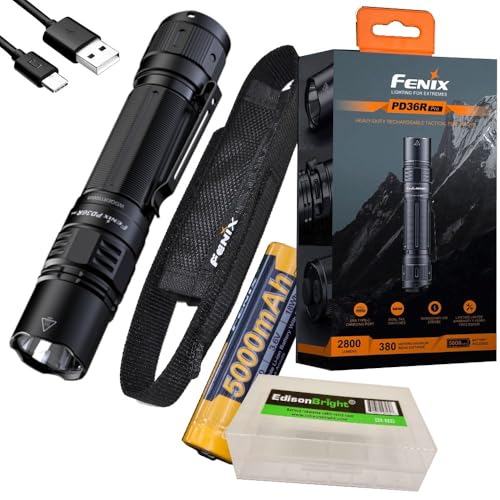
- Best for: Campers who want one capable rechargeable flashlight that covers everything from tent chores to night walks, without carrying spare batteries.
- Max output: 2,800 lumens (turbo); peak beam distance: 380 metres
- LED: Luminus SFT70; battery: 5,000mAh 21700 lithium-ion, included
- Charging: USB-C; rating: IP68; impact resistance: 1 metre
- Body: anodised aluminium; included: battery, USB-C cable, holster, lanyard
Campers who want one capable rechargeable flashlight that covers everything from tent chores to night walks, without carrying spare batteries.
The Fenix PD36R Pro is the strongest all-round camping flashlight here because it balances what matters at a campsite: a bright turbo for checking a distant tree line, a low mode that runs for dozens of hours, fast USB-C charging, and a sealed body that shrugs off rain. It runs on a single 21700 lithium-ion cell with a 5,000mAh capacity. The headline figures are a maximum output of 2,800 lumens and a 380-metre beam, driven by a Luminus SFT70 LED. The modes campers use most are the lower ones: a 30-lumen eco mode rated for around 42 hours and a 150-lumen mode rated for around 19 hours.
Pros:
Cons:
2. Nitecore MH12 Pro
- Best for: Campers who want maximum reach and multi-night runtime, especially on larger sites and open ground.
- Max output: 3,300 lumens (turbo); max beam distance: 505 metres; peak beam intensity: 63,500 candela
- LED: NiteLab UHi 40; battery: 5,300mAh 21700 lithium-ion, included
- Charging: USB-C; length: 138.5mm
- Weight: around 82 grams without battery; body: hard-anodised aluminium
Campers who want maximum reach and multi-night runtime, especially on larger sites and open ground.
The Nitecore MH12 Pro is the endurance and long-throw pick. Its headline is a maximum output of 3,300 lumens with a 505-metre beam, the longest throw in this guide by a wide margin, ideal for checking across a field or down a dark trail. Just as important, its 50-lumen low mode is rated for 50 hours, so it can run at a genuinely useful brightness for several nights without a recharge. It uses a NiteLab UHi 40 LED and a 5,300mAh 21700 battery, the largest cell here, charged through USB-C.
Pros:
Cons:
3. ThruNite Archer 2A V3
- Best for: First-time campers, families who want a simple spare light, and anyone who prefers swappable AA batteries over recharging at camp.
- Max output: 500 lumens; beam distance: 93 metres; LED: CREE XP-L2
- Battery: 2 x AA (not included); modes: five brightness settings, including a 0.3-lumen firefly mode
- Runtimes: 13 lumens for around 51 hours, 0.3 lumens for around 15 days
- Water rating: IPX8 waterproof; weight: around 1.7 ounces without batteries
First-time campers, families who want a simple spare light, and anyone who prefers swappable AA batteries over recharging at camp.
The ThruNite Archer 2A V3 is the simple one, and simplicity is a real virtue at a campsite. It runs on two ordinary AA batteries, the kind sold at any camp store, so there is no charger to pack, no cable to lose, and no worry about a flat rechargeable cell. If the light dies, fresh AAs bring it back in seconds, making it an excellent first flashlight, a backup for a family kit, and a spare to keep in the car or tent pocket. It uses a CREE XP-L2 LED with a maximum output of 500 lumens and a 93-metre beam. Five settings run from a 0.3-lumen firefly mode rated for around 15 days up to the 500-lumen high, with a 13-lumen low mode rated for around 51 hours.
Pros:
Cons:
4. Wurkkos FC11C
Brand: Wurkkos
ASIN: B0D311QCJM
Link: https://www.amazon.com/dp/B0D311QCJM
The Wurkkos FC11C is the value rechargeable pick, earning its spot with a feature the brighter lights skip: a high colour-rendering LED. Its 90-plus CRI output shows colours close to how they look in daylight, which makes a real difference when cooking at camp, reading a map, or finding a small item in the grass. It delivers up to 1,200 lumens with a 155-metre beam, powered by a rechargeable 18650 battery and charged through USB-C with a battery indicator, so it tops up from a power bank. It has multiple modes plus strobe and SOS, a magnetic tail cap, and an IP68 waterproof aluminium body. The listed variant is the 5000K version, a neutral white without the harsh blue tint of cheaper lights.
Specs
- Max output: 1,200 lumens; beam distance: 155 metres
- LED: high CRI 90-plus, 5000K neutral white (listed variant)
- Battery: rechargeable 18650, included; charging: USB-C with battery indicator
- Water rating: IP68 waterproof; body: aircraft-grade aluminium
- Features: magnetic tail cap, multiple modes including strobe and SOS, flicker-free output
- Included: battery, USB-C cable, pocket clip
Pros:
- High CRI light renders colours naturally, helping with cooking, maps, and finding small items
- USB-C charging, a magnetic tail cap, and an IP68 body at a budget-friendly tier
- Compact and light enough to carry in a pocket on every walk
Cons:
- Lower maximum output and a smaller battery than the 21700 lights, so high-brightness runtimes are shorter
- The listed ASIN covers a specific colour-temperature variant, so check it before ordering if you want a warmer or cooler beam
Best for: Campers who want a capable, affordable rechargeable flashlight with natural-looking light for cooking and close-up tasks.
5. Streamlight ProTac HL-X 88065
- Best for: Campers who want a rugged, dependable light with long-storage batteries, and anyone keeping a flashlight in a vehicle or emergency kit between trips.
- Max output: 1,000 lumens with included CR123A batteries; beam distance: 330 metres
- Peak beam intensity: 27,100 candela; LED: C4 LED
- Battery: 2 x CR123A lithium, included; optional SL-B26 rechargeable pack sold separately
- Runtimes (CR123A): high 1,000 lumens for around 1.25 hours, medium 400 lumens for around 3 hours, low 65 lumens for around 20 hours
Campers who want a rugged, dependable light with long-storage batteries, and anyone keeping a flashlight in a vehicle or emergency kit between trips.
The Streamlight ProTac HL-X 88065 is the rugged dual-fuel pick, built for campers who want a light that keeps working no matter what power is available. The boxed 88065 configuration ships with two CR123A lithium batteries and produces 1,000 lumens with a 330-metre beam, and the same light can also run on the optional SL-B26 rechargeable battery pack. CR123A cells have a long shelf life and hold up well in cold weather, so this suits a light that lives in a vehicle or an emergency kit between trips. With the included cells it gives 1,000 lumens on high for around 1.25 hours, 400 lumens on medium for around 3 hours, and 65 lumens on low for around 20 hours, plus strobe for signalling. The beam is balanced, with strong centre intensity and wide peripheral light, which suits walking a trail at night.
Pros:
Cons:
Buying Guide: How to Choose a Camping Flashlight
Brightness: lumens are only half the story. Manufacturers headline the maximum lumen figure, but at camp the more useful number is the output of the low and medium modes and how long they last. A 30 to 50-lumen mode is enough for walking around camp, cooking, and reading, and holding that level for 40 to 50 hours covers a whole trip. Turbo modes of 2,000 lumens or more are useful for a few seconds of route finding, but they drain a battery fast and heat the light up, so treat them as a burst. Look for at least three well-spaced modes, and a firefly mode under 5 lumens if you share a tent.
Beam: throw, flood, or a bit of both. Beam distance tells you how far the light reaches, and beam shape tells you how useful it is up close. A tight, long-throw beam like the 505-metre Nitecore is excellent for spotting a trail marker, but it can feel like a narrow spotlight inside a tent. A wider beam lights up a whole cooking area at once. For general camping, a balanced beam with a bright centre and usable spill is the most versatile, which is why the Fenix and Streamlight picks work so well as all-rounders.
Batteries: rechargeable, disposable, or both. Rechargeable lights with USB-C charging are the most convenient for regular campers, because they top up from the same power bank or car socket as a phone. The catch is that a flat rechargeable light is useless until it charges, so a power bank or a spare cell belongs in the kit on longer trips. AA-powered lights like the ThruNite solve that problem: fresh cells are available at any camp store, and swapping takes seconds. CR123A lights like the Streamlight sit in between, with batteries that store for years and cope well with cold.
Water and impact resistance. Camp lights get rained on, dropped on rocks, and knocked off picnic tables, so check the ingress protection rating. IPX8 means the light can be submerged, and IP68 means it is dust-tight as well as waterproof. Impact resistance of one metre is a useful minimum. A knurled body helps grip when hands are wet or cold, and a lanyard or pocket clip stops the light disappearing into long grass.
Size, weight, and carry. A flashlight that stays in the car is no use at midnight. Pocket-sized lights like the Wurkkos and ThruNite disappear into a jacket and are easy to grab for every walk, while the larger 21700 lights are better clipped to a belt or carried in a pack pocket. A magnetic tail cap, as on the Wurkkos, adds a useful trick: stick the light to a vehicle, a metal table, or a tent pole and it becomes a hands-free work light.
Modes and controls. Simple controls win at camp, especially with cold hands or in the dark. One switch for on and off, plus a second switch for brightness, is easier than a long sequence of half-presses. Strobe and SOS modes are worth having for emergencies, but they should sit out of the way of the normal modes. A battery indicator, like the one on the Fenix, prevents the most common campsite frustration: discovering a dead light after dark.
Frequently Asked Questions
How many lumens do I need for camping?
For most camp tasks, 100 to 300 lumens is plenty: walking to the washroom, cooking, and reading all sit comfortably in that range. A maximum of 500 to 1,000 lumens covers trail walking, while 2,000 lumens or more is useful only in short bursts for route finding. Pay more attention to the low-mode runtime than to the maximum figure, because the low mode is the one still running on the third night of a trip.
Are rechargeable flashlights better than battery-powered ones for camping?
Rechargeable lights are more convenient and cheaper to run over time, especially with USB-C charging from a power bank, and the large 21700 cells here hold enough charge for a long weekend. Battery-powered lights win on simplicity and storage: AA and CR123A cells can sit in a kit for months and be swapped in seconds. The best setup for a long trip is often one of each, a rechargeable main light and a battery-powered backup.
Can I use a camping flashlight in the rain?
Yes, provided the light has a proper water rating. Look for IPX8 or IP68, which mean the light is protected against submersion, and check the charging port cover is closed before the light gets wet. All five lights in this guide carry an IPX8 or IP68 rating. Avoid lights with no stated water rating, and dry the light before storing it after a wet trip.
What is the difference between a flashlight and a lantern for camping?
A flashlight throws a focused beam in one direction, ideal for walking, searching, and pointing at a specific task. A lantern spreads light in all directions and is better for lighting a whole tent or picnic table. Most campers benefit from both: a flashlight for moving around and a lantern for the communal area. This guide covers handheld flashlights only, the tool you reach for whenever you leave the tent after dark.
Should I carry a spare flashlight when camping?
Yes, a spare is cheap insurance. A small AA light like the ThruNite Archer 2A V3 weighs almost nothing and covers you if the main light is dropped in a stream or simply runs flat. At minimum, carry spare batteries or a power bank, and keep the spare somewhere you can find it in the dark, such as a tent pocket or the glove box.
Conclusion
The best camping flashlights match the way you camp, not the ones with the biggest numbers on the box. For most campers, the Fenix PD36R Pro is the best overall pick: its 2,800-lumen turbo and 380-metre beam handle anything the night throws at it, and its low modes run for dozens of hours. Campers who want the longest reach and low-mode runtime should choose the Nitecore MH12 Pro, with its 505-metre throw and 50-lumen mode rated for 50 hours. The ThruNite Archer 2A V3 is the pick for simplicity and for a first or backup light, the Wurkkos FC11C is the value rechargeable with the most natural-looking light, and the Streamlight ProTac HL-X 88065 is the rugged dual-fuel choice for a light that must work after months in storage. Whichever you choose, pack a spare power source, check the battery before dark, and keep the light within reach, because the best flashlight at camp is the one in your hand when you need it.
More from Amazon
Programs that pair well with the guide above. Offers and eligibility are set by Amazon and may change.
Free shipping on eligible items, Prime Video and more. Eligible new members can start with a free trial.
Start a Prime free trialA Prime membership for ages 18-24 with a trial period. Eligibility is set by Amazon.
See Prime for Young AdultsAudiobooks and podcasts to listen to on the go. Eligible new members can start with a free trial.
Try Audible freeAd-free music streaming. Eligible new subscribers can start with a free trial.
Try Music Unlimited freeAs an Amazon Associate we earn from qualifying purchases.

Write Your Review
No reviews yet. Be the first to share your experience!