
Key takeaways
- Compare the best battery powered fish finder picks: two castable rechargeable sonars and a wired handheld unit, checked against their Amazon US listings.
A fish finder that runs on its own battery changes where you can fish. There is no boat battery to wire into, no transducer bracket to drill, and nothing stopping you from scanning a campground lake, a dock or a stretch of bank the day you arrive. The three units below are all self-powered, but they work in different ways. The Deeper PRO+ 2 is our top pick: a castable sonar ball with three beam widths, its own GPS and a rechargeable cell rated for up to nine hours. The Garmin STRIKER Cast GPS is the runner-up, trading some sonar refinement for a longer stated battery life and Garmin’s contour mapping.
These picks are aimed at shore and dock anglers, campers fishing unfamiliar water, kayak and small-boat anglers who do not want fixed wiring, and ice anglers who move between holes. Every unit was selected from its Amazon US listing, and the deciding facts are the ones that define this category: the battery is built in or included as a portable power source, charging is by USB, and the sonar, screen and power all travel in one kit. A conventional fish finder head unit that needs a separate 12-volt boat battery is a different product, and none appear here.
Quick Picks
As an Amazon Associate we earn from qualifying purchases.
| Product | Best for | Key spec |
|---|---|---|
| Deeper PRO+ 2 | Castable scanning with GPS mapping | Three sonar beams, scans to 330 ft deep, rechargeable battery up to 9 hours |
| Garmin STRIKER Cast GPS | Long battery life and contour maps | Rechargeable, 10+ hours per charge, GPS with Quickdraw Contours |
| LUCKY Portable Fish Finder | A self-contained screen with no phone needed | 2.4 in color display handset, wired transducer, USB rechargeable |
How to Choose
Castable sonar or a wired handheld
Two formats dominate this category. Castable units like the Deeper and the Garmin are sealed balls you tie to a line and throw: the sonar floats at the surface and sends its picture to your phone. A wired handheld like the LUCKY keeps the screen in your hand and dangles its transducer over the side on a cable. Castables reach water you cannot stand over and pack smallest; a wired unit gives you a dedicated screen and never depends on your phone battery or a wireless link.
Battery capacity and charging
Battery life is the spec that defines a portable unit. Stated runtimes here run from about five hours for the LUCKY handset to ten-plus hours for the Garmin, with the Deeper in between at up to nine. All three recharge over USB, so a power bank in your tackle bag extends any of them. Note how each listing expresses charging: the Deeper publishes a fast-charge figure, reaching most of a charge in about 45 minutes, which matters when you remember the night before a trip.
Depth range and beam coverage
Stated depth capability separates casual pond units from serious tools. The Deeper scans from just under the surface down to 330 feet and lets you switch between wide, medium and narrow beams, so you can search broadly and then zoom in on one spot. The Garmin and the LUCKY both work down to around 200 and 328 feet respectively on a single beam angle. For most shore, dock and kayak fishing in lakes, anything past 100 feet of depth is headroom; beam choice and target separation usually matter more than the maximum number.
GPS and mapping
A built-in GPS turns a fish finder into a mapping tool. The Deeper PRO+ 2 and the Garmin STRIKER Cast GPS both log the depth under the sonar as you retrieve it and build bathymetric maps in their apps, so a flat, featureless-looking lake gains visible drop-offs and holes you can return to. The LUCKY has no GPS: it tells you depth and fish presence in the moment, and that is the whole job. Decide whether you are scouting new water repeatedly, where maps pay off, or checking depth at a spot you already know.
What is in the box
Portable kits differ in the small parts. The Garmin includes a carrying bag and a 20-foot tether alongside its USB cable. The Deeper includes a neoprene pouch, a USB cable and attachment bolts for mounting options. The LUCKY’s transducer cable is part of the unit itself. Check the listing’s box contents against how you plan to carry the unit, especially if it will live in a camping tote rather than a dedicated tackle bag.
The 3 Best Options
Deeper PRO+ 2 — OUR TOP PICK
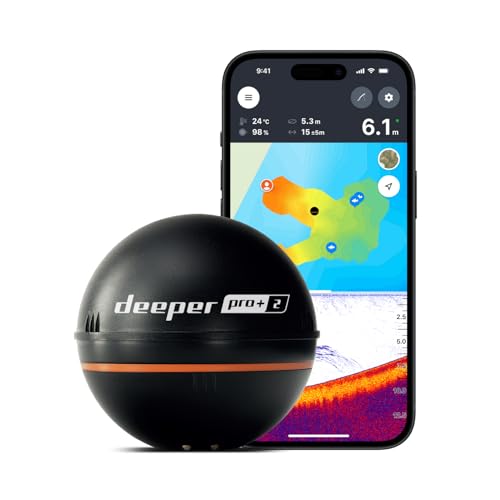
The PRO+ 2 packs the most sonar into the smallest package here: a 2.56-inch ball weighing 3.2 ounces that you cast on a suitable line and watch on the Fish Deeper app. Its three beams, a wide 100 kHz beam at 47 degrees, a medium 240 kHz beam at 20 degrees and a narrow 675 kHz beam at 7 degrees, cover searching and pinpointing in one unit, and the listing states target separation down to 0.4 inches on the narrow beam. It scans from 6 inches to 330 feet deep, connects over its own Wi-Fi signal out to 330 feet, and its internal GPS builds depth maps as you reel in, with no phone signal needed once the app is installed. The rechargeable 950 mAh lithium-ion battery is rated for up to nine hours and fast-charges, which suits long days split between several spots. It also carries an ice fishing flasher mode, so the same ball works through the ice in winter.
Specs
- Format: castable sonar ball, 2.56 in diameter, 3.2 oz
- Beams: 100 kHz at 47 degrees, 240 kHz at 20 degrees, 675 kHz at 7 degrees
- Depth range: 6 in to 330 ft
- Connection: built-in Wi-Fi, up to 330 ft, to the Fish Deeper app
- GPS: built-in, for bathymetric mapping
- Battery: rechargeable lithium-ion, 950 mAh, up to 9 hours
- Charging: USB, fast charge to 80 percent in about 45 minutes
- In the box: sonar, USB cable, neoprene pouch, attachment bolts, quick guide
Best for: Anglers who fish many kinds of water, shore, dock, kayak and ice, and want beam control plus mapping in one pocket-sized unit.
Watch out for: Your phone is the screen, so its battery and water protection become part of the system; long sessions call for a power bank and a waterproof phone pouch. Casting a 3.2-ounce ball also asks for a suitably rated rod and line, used with a side swing rather than an overhead snap cast.
Garmin STRIKER Cast GPS
Garmin’s castable takes a simpler approach to the sonar and leans on endurance and mapping. The pod weighs 2.6 ounces, streams traditional sonar and an ice flasher view to the STRIKER Cast app on a phone or tablet, and is rated at more than ten hours on a charge, the longest stated runtime in this guide. Its working range is up to 200 feet from your device and its sonar reads down to 200 feet, which covers the lakes, ponds and reservoirs most shore anglers fish. The GPS version listed here builds Quickdraw Contours maps with one-foot contour lines as you cast and retrieve, and you can mark waypoints on fish and structure from the app. The kit is complete for travel: the pod, a carrying bag, a 20-foot tether for dock use and a USB charging cable are all in the box.
Specs
- Format: castable sonar pod, 2.6 oz
- Model: 010-02246-02 (GPS version)
- Connection: wireless streaming to the STRIKER Cast app, up to 200 ft
- Sonar depth: up to 200 ft
- GPS: built-in, Quickdraw Contours mapping
- Battery: internal rechargeable, 10+ hours per charge
- In the box: STRIKER Cast GPS, carrying bag, 20 ft tether, USB cable, documentation
Best for: Campers and shore anglers who fish long days, want contour maps of their regular waters, and prefer a familiar app ecosystem.
Watch out for: There is a non-GPS version of the STRIKER Cast with a different model number, so confirm the listing says GPS before ordering. Like the Deeper, it needs your phone as the display, and its single fixed beam gives less search-versus-detail flexibility than the Deeper’s three.
LUCKY Portable Fish Finder
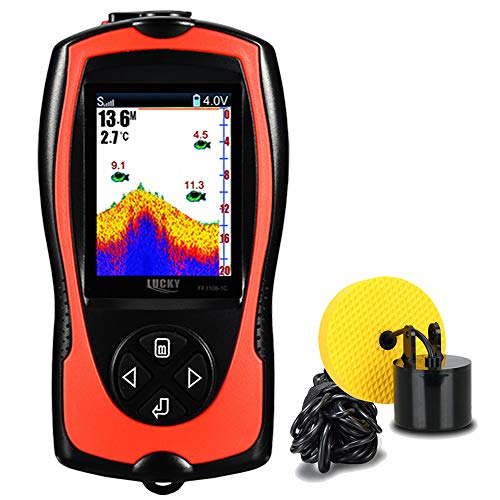
The LUCKY is the traditional portable in the group: a handset with its own 2.4-inch color screen and a transducer that hangs in the water on a cable of about 26 feet. Nothing pairs, nothing connects to a phone, and the reading in front of you shows water depth, fish icons with their depth, and the bottom contour. Its 200 kHz sonar works through a 45-degree beam and detects down to 328 feet, figures aimed squarely at docks, piers, small boats and ice holes where the water you care about is close to straight down. The internal battery recharges over USB and is rated for about five hours of use, and the whole kit packs into a small bag with no separate parts to lose beyond the handset and its cabled transducer.
Specs
- Format: handheld unit with wired transducer
- Display: 2.4 in color screen on the handset
- Sonar: 200 kHz, 45-degree beam
- Depth detection: up to 328 ft
- Transducer cable: about 26 ft
- Battery: internal rechargeable over USB, about 5 hours of use
- Readout: depth, fish icons and depth, bottom contour, water temperature per the listing
Best for: Anglers who want a dedicated screen, fish mainly from docks, piers and small boats, and prefer a unit a child or a guest can use without a phone.
Watch out for: The five-hour battery is the shortest here, and the transducer only sees the water within its cable length of where you stand or sit. There is no GPS and no mapping, so it answers questions about the spot under the transducer rather than charting a lake.
Which One Fits Your Situation
- You are camping at a lake you have never fished: the Deeper PRO+ 2, because its wide beam searches new water quickly and its GPS maps the depths you find for the rest of the trip.
- You fish the same shoreline waters all season and keep long hours: the Garmin STRIKER Cast GPS, whose ten-plus-hour battery and Quickdraw Contours maps reward repeat visits.
- You fish from a dock or pier and dislike phone-based gear: the LUCKY, with its own screen and a transducer you lower straight down on its cable.
- You ice fish as well as open water: the Deeper or the Garmin, both of which include a flasher mode for fishing through holes.
Common Mistakes
- Buying a fixed-mount fish finder for portable use. Head units designed for a boat console need a separate 12-volt battery and a mounted transducer; a battery powered unit carries its power with it, which is the point of this category.
- Judging only by maximum depth. Most shore and lake fishing happens far shallower than 200 feet. Beam angle, target separation and battery life shape your day more than the biggest depth number.
- Forgetting the phone is part of the system. With castable sonars, your phone is the screen and part of the battery budget. Bring a power bank and a way to keep the phone dry.
- Casting a sonar ball on light tackle. Castables weigh two to three ounces. Use a rod and line rated for the weight and a smooth side cast, and tie on with the attachment point the maker specifies.
- Leaving the battery flat between trips. Rechargeable cells stored empty for months age quickly. Charge the unit after trips and top it up before the next one.
Frequently Asked Questions
How long do these batteries actually last on the water?
Stated runtimes are up to nine hours for the Deeper PRO+ 2, more than ten hours for the Garmin STRIKER Cast GPS and about five hours for the LUCKY handset. Cold weather, screen brightness on your phone and constant scanning all trim those figures, so treat them as best-case numbers and carry a USB power bank on long days.
Can a castable fish finder replace a boat-mounted unit?
For finding depth, structure and fish from shore, a dock, a kayak or a small boat, yes, within its depth and range limits. A mounted unit still wins for continuous use at speed on a larger boat, with a bigger dedicated screen and the boat’s own power. The two formats solve different problems, and many anglers end up owning one of each.
Do I need cell service for the app-based sonars?
No. The Deeper creates its own Wi-Fi connection to your phone, and the Garmin streams directly to its app as well. Download the app and any maps you want before leaving home, and both units work at a remote campsite with no signal at all.
Which of these works for ice fishing?
All three can be used through the ice: the Deeper PRO+ 2 and the Garmin both include a dedicated flasher view, and the LUCKY’s transducer can be lowered through a hole on its cable. Battery performance drops in deep cold, so keep the unit inside a jacket layer between holes when temperatures are well below freezing.
What does the tether on the Garmin do?
The 20-foot tether in the Garmin’s box lets you fish the pod from a dock, pier or bridge without casting: lower it into the water, let it drift a short way out, and read the sonar on your phone while the tether keeps the pod recoverable. It is also a sensible safety line whenever you cast near snags.
A battery powered fish finder earns its place in a camp kit because it asks for nothing: no wiring, no mounting, no boat at all if you fish from shore. Pick the Deeper for the most capable castable sonar, the Garmin for battery life and mapping, or the LUCKY for a simple screen-in-hand unit, and you will spend your next trip reading the water instead of guessing at it.
More from Amazon
Programs that pair well with the guide above. Offers and eligibility are set by Amazon and may change.
Free shipping on eligible items, Prime Video and more. Eligible new members can start with a free trial.
Start a Prime free trialA Prime membership for ages 18-24 with a trial period. Eligibility is set by Amazon.
See Prime for Young AdultsAudiobooks and podcasts to listen to on the go. Eligible new members can start with a free trial.
Try Audible freeAd-free music streaming. Eligible new subscribers can start with a free trial.
Try Music Unlimited freeAs an Amazon Associate we earn from qualifying purchases.
Write Your Review
No reviews yet. Be the first to share your experience!