

Key takeaways
- Protect a Suburban steel tank with the right RV anode rod. Compare magnesium and aluminum zinc picks by length, thread size, and water type before you buy.
As an Amazon Associate we earn from qualifying purchases.
Affiliate Disclosure: This article contains affiliate links. If you buy through them, we may earn a commission at no extra cost to you.
An anode rod is the cheapest insurance inside an RV water heater. It is a sacrificial length of magnesium or aluminum alloy threaded into the tank drain port, designed to corrode on purpose so the steel tank behind it does not. Water, heat, and dissolved minerals attack exposed steel at every chip in the glass lining. The rod gives that corrosion an easier target. When the rod is mostly eaten away, protection stops, and the tank itself starts to pay. Replacing a worn rod on schedule is the difference between a routine maintenance item and a full water heater replacement.
The critical fit note comes first, because it decides whether you need a rod at all. Glass-lined steel tanks, the Suburban and Mor-Flo style used in a large share of RVs, require an anode rod and use the size covered in this guide: about 9.25 inches long with a 3/4-inch NPT thread that also serves as the drain plug. Glass-lined aluminum-tank heaters, the Atwood and later Dometic style, do NOT use anode rods. Their tank material is aluminum clad rather than lined steel, the drain uses a nylon plug, and fitting a steel-tank rod is not the maintenance step those heaters call for. If your heater has a nylon drain plug and no rod was fitted from the factory, skip this guide and follow the heater maker’s flush routine instead. Every pick below is for a heater that takes a rod.
How to Choose an RV Anode Rod
Material: magnesium versus aluminum and zinc
Magnesium is the standard factory material, and it protects most aggressively. It sits higher on the galvanic scale, so it gives up electrons readily and shields exposed steel even in soft, low-mineral water where corrosion current is weak. The trade-off is honest: magnesium wears faster, especially in hard or mineral-heavy water, and in some water supplies it can feed the bacteria that produce a sulfur, rotten-egg smell in the hot water. If your hot water starts to smell after a rod change, the rod material is one of the first suspects.
Aluminum, usually alloyed with a small amount of zinc, is the slower, longer-lasting option. It protects adequately in most water, lasts noticeably longer in hard water that eats magnesium quickly, and the zinc content helps suppress the sulfur odor problem rather than feed it. The trade-off is weaker protective drive in very soft water and a tendency to build a bulky, gel-like corrosion layer that can make an old rod stubborn to remove. Neither material is universally better. Magnesium suits most campground and municipal water and owners who inspect yearly. Aluminum-zinc suits hard well water, sulfur smell, and owners who found a magnesium rod disappearing in a single season.
Length and thread size
For steel-tank RV heaters the fit is standardized but not universal, so confirm both numbers against the rod you remove. The common Suburban and Mor-Flo size is 9.25 inches of rod length on a 3/4-inch NPT thread, removed with a 1-1/16-inch socket. Camco lists its Suburban-fit aluminum rod at 9.5 inches, a nominal difference that reflects how makers measure from different points on the hex head; what matters is that the threaded section seats fully and the rod does not bottom out against the far wall of the tank. A rod that is too long can foul the tank interior, and a rod that is too short simply protects less. Match the replacement to the old rod laid beside it.
Inspection and replacement rhythm
Pull the rod at least once a year, and twice a year in hard water. A rod worn to a thin wire core, pitted deeply over most of its length, or reduced to less than roughly a third of its original diameter has done its job and needs replacing. A rod coated in smooth calcium scale can sometimes be cleaned and returned, but heavy flaking and exposed core wire are the end. Always relieve tank pressure before removal, let hot water cool, and expect a tank’s worth of water to drain from the port. Wrap the new threads with PTFE tape, taking care that tape does not cover the first thread, and snug the rod firmly without over-torquing the hex.
The 5 Picks
1. ONENESS 369 Magnesium Anode Rod, 2-Pack

The ONENESS 369 two-pack is the straightforward magnesium choice for a Suburban or Mor-Flo steel tank. Each rod uses a magnesium core in the standard RV size, 9.25 inches long on a 3/4-inch NPT thread, matching the factory Suburban replacement reference 232767. Magnesium is the right default for most water: it delivers the strongest sacrificial protection for the glass-lined steel tank, particularly in the softer municipal and campground supplies many RVs fill from. The two-pack format fits the maintenance rhythm well, since a spare rod stored in the rig means a worn rod found during a trip can be swapped on the spot rather than noted and forgotten. The listing pairs the rods with thread seal tape, which is the one consumable the job needs.
The honest limits are the magnesium trade-offs already described. In hard, mineral-heavy water this rod will be consumed faster than an aluminum rod, and if your supply carries sulfur bacteria, magnesium can contribute to a rotten-egg smell in the hot side. Owners in those conditions should look at the aluminum-zinc picks below instead. Within its intended water, though, this is the reference configuration: correct material, correct size, and a spare in hand.
Specs
- Material: Magnesium
- Length: 9.25 inches
- Thread: 3/4-inch NPT
- Pack: 2 rods with thread seal tape
- Fit: Suburban and Mor-Flo steel-tank RV water heaters, replacement for reference 232767
- Removal: 1-1/16-inch socket
2. Eleventree Magnesium Anode Rod, 3-Pack

Eleventree’s three-pack suits owners who maintain the heater on a fixed annual schedule and prefer to buy the consumable in bulk. The rods are magnesium, listed at 99.8 percent AZ-31 magnesium alloy in the maker’s description, in the same Suburban size: 9.25 inches long with 3/4-inch NPT threads, positioned as a replacement for Suburban part 232767 and compatible with Suburban and Mor-Flo tanks. Three rods cover several seasons of yearly changes for a single heater, or a single change across a small fleet of rigs maintained together.
Because the material is magnesium, the same guidance applies: strongest protection in typical water, faster consumption in hard water, and a possible contribution to sulfur odor in problem supplies. The pack includes PTFE tape for the threads. What the pack does not include is a flush wand or removal socket, so owners starting from scratch will need the 1-1/16-inch socket separately. Judged purely as a stock of correct-size magnesium rods, it is a sensible way to keep the maintenance habit cheap and uninterrupted.
Specs
- Material: Magnesium, AZ-31 alloy
- Length: 9.25 inches
- Thread: 3/4-inch NPT
- Pack: 3 rods with PTFE tape
- Fit: Suburban and Mor-Flo steel-tank RV water heaters, replacement for reference 232767
- Removal: 1-1/16-inch socket
3. Ozek Magnesium Anode Rod, Single

The Ozek rod is the single-rod version of the same job, for owners who need one replacement now and do not want a multi-pack. It is a magnesium rod sized for Suburban water heaters at 9.25 inches with a 3/4-inch NPT thread, and the listing includes PTFE tape for installation. A single pack is also the low-commitment way to confirm fit on a heater you have not serviced before: match it against the rod that comes out, and if the size is right, future orders are a known quantity.
Protection behavior follows the material. Magnesium gives the strongest sacrificial current for a glass-lined steel tank and is the factory-style choice for Suburban heaters. It will wear faster than aluminum in hard water and can be part of a sulfur-smell problem in some supplies. The listing states the rod fits Suburban tanks; it is not a fit for aluminum-tank Atwood or Dometic heaters, which do not use a rod at all. For a standard Suburban service with no spares required, this pick covers it in the simplest form.
Specs
- Material: Magnesium
- Length: 9.25 inches
- Thread: 3/4-inch NPT
- Pack: 1 rod with PTFE tape
- Fit: Suburban steel-tank RV water heaters
- Removal: 1-1/16-inch socket
4. Eau Aluminum-Zinc Anode Rod, 2-Pack

This Eau two-pack is the aluminum-zinc answer for the two problems magnesium handles worst: hard water that consumes rods quickly and hot water that smells of sulfur. The rods are an aluminum-zinc alloy, 9.25 inches long on a 3/4-inch thread, sized for Suburban and Mor-Flo heaters. Aluminum corrodes more slowly than magnesium, so in mineral-heavy water the rod lasts longer between changes, and the zinc in the alloy is there specifically to discourage the sulfate-reducing bacteria behind rotten-egg odor. The pack includes two rods and thread tape, so a spare is on hand.
The trade-off should be stated plainly. Aluminum-zinc delivers a milder protective current than magnesium, so in very soft water it is not the maximum-protection choice, and aluminum rods can develop a thick, crusty corrosion layer that makes removal harder if they are left far beyond their service interval. Inspect on the same yearly rhythm and removal stays routine. For well water, hard water, or any rig whose hot water has developed a sulfur smell on a magnesium rod, this is the pick designed for that water.
Specs
- Material: Aluminum-zinc alloy
- Length: 9.25 inches
- Thread: 3/4-inch NPT
- Pack: 2 rods with thread tape
- Fit: Suburban and Mor-Flo steel-tank RV water heaters
- Removal: 1-1/16-inch socket
5. Camco 11563 Aluminum Anode Rod
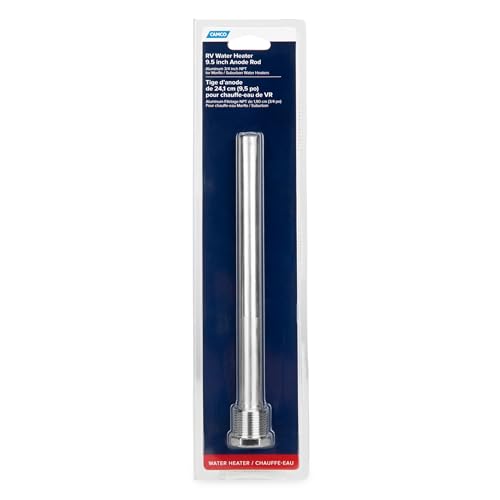
Camco’s 11563 is the established name-brand aluminum option for Suburban and Mor-Flo heaters. The rod is aluminum, listed at 5/8-inch diameter by 9.5 inches long on a 3/4-inch NPT fitting; the half-inch difference against the 9.25-inch listings reflects measurement convention at the hex, and the threaded fit is the same Suburban standard. Camco positions the rod as a corrosion absorber that extends heater life by taking the attack that would otherwise reach the tank and elements, which is exactly the sacrificial role described throughout this guide.
As an aluminum rod, it trades some of magnesium’s protective drive for longevity, and it is a reasonable factory-adjacent choice for hard water or for owners whose magnesium rods have been disappearing too quickly. It is a single rod with no tape or tools in the pack, so keep PTFE tape in the service kit. Owners who want the strongest protection in soft water should stay with magnesium above; owners who want a slower-wearing rod from a long-standing RV parts maker will find this one fits that brief.
Specs
- Material: Aluminum
- Length: 9.5 inches, 5/8-inch rod diameter
- Thread: 3/4-inch NPT
- Pack: 1 rod
- Fit: Suburban and Mor-Flo steel-tank RV water heaters, Camco part 11563
- Removal: 1-1/16-inch socket
Which Rod for Which Water
For most RVs filling from municipal or campground supplies, start with magnesium in the correct size: the ONENESS 369 two-pack or the Eleventree three-pack if you service on a fixed schedule, and the Ozek single if you need just one rod. Magnesium’s stronger protective current is the safer default for a glass-lined steel tank, and its faster wear is manageable when you inspect yearly.
Switch material when the evidence points that way. If a magnesium rod is more than half gone in a single season, your water is hard enough that aluminum’s slower wear earns its place. If the hot water smells of sulfur, move to an aluminum-zinc rod such as the Eau two-pack, and flush the tank at the same service, since the bacteria live in the tank as well as reacting at the rod. The Camco 11563 covers the same aluminum role in a single name-brand rod.
Whatever you choose, keep the two fit rules in front of every order. The rod must match the old one in length and thread, 9.25 inches and 3/4-inch NPT for the Suburban and Mor-Flo steel tanks covered here. And if the heater is an aluminum-tank Atwood or Dometic design with a nylon drain plug, it does not use an anode rod at all, so the correct purchase is no rod, just a spare plug and a regular flush. A rod replaced on time is a small, predictable consumable. A tank replaced late is not.
More from Amazon
Programs that pair well with the guide above. Offers and eligibility are set by Amazon and may change.
Free shipping on eligible items, Prime Video and more. Eligible new members can start with a free trial.
Start a Prime free trialA Prime membership for ages 18-24 with a trial period. Eligibility is set by Amazon.
See Prime for Young AdultsAudiobooks and podcasts to listen to on the go. Eligible new members can start with a free trial.
Try Audible freeAd-free music streaming. Eligible new subscribers can start with a free trial.
Try Music Unlimited freeAs an Amazon Associate we earn from qualifying purchases.

Write Your Review
No reviews yet. Be the first to share your experience!